Thank you all for your comments following last week’s post. It’s lovely to hear everyone’s reactions to what I’ve written and reminds me of the importance of this ongoing research and thinking around my teaching. So this week’s inspiration came from my new-found hobby of swing dancing. It’s a step up from ironing, and somehow continues from last week’s post, which you can read here.
Swing is a social dance. You dance with a partner, either loosely facing or side by side. One person in the couple is the ‘lead’ and the other is the ‘follow’. This description is all highly simplistic I know, because you watch professionals dancing and they’re literally all over the place. But at a very basic level, your footwork and facings essentially mirror that of your partner.
Bare with me.
Following the usual set-up of the beginners class I go to, last night we first learnt a basic step, and then built on that into different variations. The lead dancer started by stepping back on the left leg, the ‘follow’ stepped back on the right. The pattern soon set in till it felt almost unconscious, which we only realised several variations into the class when we suddenly all found ourselves on the ‘wrong’ side of our partners. Having to do the basic step on the other leg before we could get back to ‘home’ felt like picking up a knife in the wrong hand. Panic!
What we experienced was the surprise of having internalised a movement pattern.
Repetition has long been the main way of learning dance steps. We talk about ‘getting it into the body’ or ‘feeling it in the body’ so that it becomes imprinted to such a degree that it can be performed unconsciously. This is the result of neuro-muscular patterning, the particular organisation and co-ordination of parts needed to carry out the movement. The rate of encoding will depend on how practiced our neuro-muscular system is at adapting to the demands of this new circuitry and what other library of sequencing the body already has to draw on. If the basic scaffolding (an understanding of centre, full access to the peripheral joints and an ability to sequence from one to the other) is available, then building the sequence will take less time. Perhaps for those without a basic scaffolding, more basic patterns will need to be laid down first before the full co-ordination can be accomplished. Once a pattern is imprinted into the body, it then becomes the ‘easy’, most available option, which in turn makes us more likely to select it, leading to further re-enforcement etc.
OK so perhaps you have no interest in learning social dancing, although I highly recommend it, but this little unpicking of learning seems relevant to how we create movement biases just through living. As I struggled to get my left leg to start the rock step back, I was reminded of this remark by Liz Koch:
Unlike a machine, we are not symmetrical but bilateral – Liz Koch
We are literally composed of two different and complimentary parts that work together around a single central core. However, somehow, through conscious or unconscious learning, we have all internalised movement patterns that have led to more or less use of one side over another. Of course I’m not suggesting that we all become ambidextrous. We will always have a dominant hand / leg. However I wonder how much we tend to lean onto these dominant sides. Remember that the body will always default to the easiest, most available pattern which, whilst over-developing activity on one side, will equally reduce access on the other side. Injury, for example, can lock us into a pattern that is aimed to protect the injured part in the short term, but causes more imbalances in the long term. Learned non-use leads to functional asymmetry. The result is a metaphorical limp in the neuro-muscular system with various compensation patterns, stresses and strains on the joints that lead to pain and injury.
Perhaps the roles of ‘lead’ and ‘follow’ might equally apply to two sides of our body? If so, the key to reducing this functional asymmetry is to somehow land up on the other side, to trick the body into stepping out of ‘home’ and remaining bi-laterally able.
The way towards bi-later-ability (my own word, not a technical term) is the ABC of better movement:
- Increase Awareness: notice your habits.
- Shake Things Up: walk around the park in the other direction, put your mat down on the other side of the room, start on the opposite leg, go to a different class (because teachers also tend to default into patterns of exercises and teaching techniques that come easiest to them), change the interlace of your fingers.
- Listen to Feedback: Go to a class where a teacher can see what you’re doing and help bring your awareness to patterns that you are not aware of.
Be creative, let me know what other small habit shifts you’ve thought of.
 in my mind of clients who have a DR, the picture is roughly this. The rib cage is flailed, compressing the mid-back area and the pelvis is in a forward tilt. This appears to create more space out the front, making it the favoured posture for a pregnant woman. I think that men who adopt this posture (if they are not obese) do so because they may be trying to sit upright, but don’t have the mobility in their upper thoracic area or shoulders, and therefor hinge on the mid-back section. Once you displace the ribs in this way, it makes it very hard to feel a connection through the centre, so any abdominal work is likely to go into the Hip Flexors or lower back.
 Tibialis anterior hooks under in the inner arch of the foot where it meets the tendon of Peroneus Longus at the base of the first metatarsal. Peroneus Longus runs from this point towards the outer side of the foot and up the outer (lateral) side of the shin bones. The line then continues towards the back of the thigh up the hamstrings and towards the sits bones (ischial tuberosities).
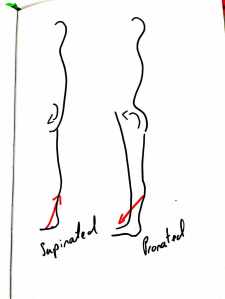 If the arches are dropping inwards there is a fair chance that your knees are rotating inwards and that your pelvis is tilted forwards. If you’re rolling onto the outside of your feet, there’s a fair chance that your knees bow outwards and your pelvis is in a backward tilt (also known as tucking under).
 The first postural type that I come across in lower back pain is when the pelvis is in a slight backward tilt as illustrated in my sketch. We call this a ‘tucked under’ posture. This is an extremely common postural type and one that, funnily enough, Pilates can actually encourage! I have come across numerous lower back pain sufferers who actually adopt this position to relieve the pain. Actually they’re just de-stabilizing the lower back even more. When someone walks into a matwork class, one of the first preparatory exercises they are told to do is the pelvic tilt. I’ll hold my hand up here: this is exactly how I begin my classes! Someone with this tendency is likely to just press into their lower backs. The second preparatory movement is to take the spine into a bridge, where the cue ‘rolling the spine down bone by bone’ also encourages people to collapse into their lower backs further.
 ard tilt, reducing the pull on the lower back. Often achieving this is difficult because the deep hip rotators are tight. So doing a seated glut stretch is a really useful way to create space in the hip joint which will allow the spine to lengthen upwards when sitting.
 Marguerite Galizia