Breathe deeply, strengthen and lengthen your spineand leave feeling energised for the week ahead!
A relaxed and friendly class for all abilities. No matter what your work / life demands, you’ll never get through it without a happy body. Here’s just one hour a week for you to tune in, learn a little and work a lot harder than you expected 🙂
New Course Starts 11th April
Thursdays 6-7pm
229 Great Portland Street (on the corner with Euston Road)
London W1W 5PN
£70 for a 10 class course or £10 drop-in
Contact margueritegalizia@gmail.com to book a space. Mats and equipment provided. Just bring yourself and some comfy clothes. More FAQ’s on my website:
The house I live in is shared with 6 other people. We’re all busy professionals. We’re not friends who knew each other and decided to start living together, although of course we are friendly. And we’re not family. We have a rota in the kitchen for who will take the bin out and pay the cleaner each week. Rules. There’s a part of me that resists the thought of having to pin myself down to petty rules. It seems unintuitive, manufactured, nanny-ing. Surely any reasonable adult knows how to empty a bin when it’s full. Think again. It was my turn to empty the bin last week. Saturday morning + a bin full of rubbish + late for work = an angry scribble on the rota pointing out that weekly duties lasted into the weekend. Oops!
Rules are by nature an act of control, whether self-imposed, tacitly agreed on or not. Having any kind of organisation requires rules, boundaries that protect us from ourselves, or at least from the worst aspects of our human-ness. Most reasonable people agree on this with respect to social organisation. We know that imposing some form of control does not necessarily infringe on freedom. If anything it protects all of our freedoms. The same is true of movement practice, training and choreographic practice.
The Problem with Contemporary Dance Classes
In the contemporary dance world there’s some confusion as to how you train the body without restricting it to one ‘way of moving’. Training involves internalizing a technique: a system with rules. It often generates a kind of aesthetic too. It seems completely contradictory to the idea of individuality and the industry’s obsession with ‘idiosyncratic movement vocabulary.’ In release classes we’re supposed to start each day by re-inventing the dictionary, wiping out centuries of evolutionary movement function and pattern in order to become completely unique ‘movers’. Perhaps it’s no surprise then that we spend 2 hour long professional classes rolling around on the floor like amoebae ‘visualising’. (Actually visualisation is an extremely powerful tool when working with the body, so long as it is grounded in function and is not just thrown around for its own sake. Creating pretty pictures in your head is all very well. But if it serves no purpose then you lose me instantly.) The alternative is to attend a class that is far more stylised, involves ‘exercises’ but is most often a confusion of ideas about how to ‘train’ the body. These classes seem to miss the point because they switch into ‘choreography’ before addressing the most obvious question: where does power and support come from? Learning someone elses co-ordinations is interesting and is useful. But it needs to form a part of a class that addresses movement in a less embellished and more functional format.
The truth is that being asked to do nothing, or to do what you want, leads to exactly the opposite of freedom! You might not be forced into some silly routine, but you’re undoubtedly regurgitating a lifetime’s movement pattern ingrained in your body and fixed as habit, even if you are not aware of it! Choreographers know this. It’s interesting that the movement aesthetic that has come to dominate in contemporary dance work, ‘Release’, has been attributed to a choreographer who still doesn’t ‘teach’ a ‘technique’ class to her company: Trisha Brown. When asked about this Brown’s reply was that she created ‘problems’ that required ‘movement solutions’. She didn’t go out of her way to develop the ‘Release aesthetic’. The aesthetic came out of the questions she proposed. In fact there is a kind of functionality to her movement vocabulary that comes from her adherence to the task at hand. Even the term ‘release’ is something of a misnomer. ‘Release’ is not about flopping around and relaxing, it’s actually about learning to un-embellish movement to create clarity in how you move through space, take or give weight or respond to choreographic structures and scores. It’s actually about efficiency. However, what developed as a functional response to a choreographic intention has become a ‘style’ with ‘moves’, a ‘performance presence’ and a bizarre aversion towards the idea of using muscles.
What’s Natural?
Let’s go back to habit for a moment. Something I am often asked as a pilates teacher is why someone should stand in parallel if their natural posture is turned out. It’s a good question. It’s the KEY question, because underlying it is the assumption that what feels ‘natural’ is ‘natural’. The truth is that what feels ‘natural’ is actually ‘habit’. Just to clarify here, the person asking is normally not actually standing in a ‘turned out position’ but is often standing with a collapsed arch and toes pointed outwards whilst their knee is rotating inwards. So my answer is that parallel is a quick way to align the ankle, knee and hip to spot poor alignment issues that lead to less efficient bio-mechanics in the lower limb and pelvis. Yes we can stand in turned out too. We can stand in a turned in position also, or with legs apart, or with one leg off the floor or any variation of the above, so long as we know that we are aligning ourselves in a way that respects the structure of the joints and most importantly, within a range of movement that we can control. So by gradually progressing through increasingly complex variations of the above, sustaining control throughout, we develop a physical ability to carry out any imaginable movement.
Options not Restrictions
Training should be about giving people options, not restricting. The aim of training, class or practice is to achieve a fully functioning, injury free body that is ready for anything, not restricted by habit or by an adherence to a particular style. As I was writing this article I came across a post by another Pilates Teacher Mike Perry, who says something quite similar with respect to Pilates:
“..Pilates’ intention was to create a form of physical training that, unlike the kinds of training he had done himself (boxing, for example), would ready one for any conceivable physical challenge. In a nutshell, General Physical Preparedness.” – Mike Perry, read the blog here
Training, or any kind of physical conditioning, is only useful when its focus is to prepare the body, to bring the body to a point where it is ready for action, where it has options and can react to internal and external stimuli efficiently and effectively with no need to pre-rehearse. I feel that what is strongly needed in the dance world is an approach to movement development that safeguards the dancer from self-indulgence without enforcing any particular style. It should be a process that gradually brings the performer into themselves more fully, so that habit is replaced by options, providing an informed starting point for any movement exploration. As Gary Carter once said, a dog lying quietly on the floor, sees something worth chasing, springs up and runs after it. It doesn’t slowly extract itself from the floor, do some hip limbering, chose it’s ‘better leg’ and then spring. Similarly, our bodies should be ready for action. We should be able to sprint for the bus without worrying about our knee tracking. A performer should be able to change direction, transfer weight or get to the floor as and when the work requires them to, not when it feels right, or when they’re on their ‘good side’. That is what physical ‘freedom’ means.
Working inefficiently or restricting ourselves to one way of moving will often manifest itself in injury at some point. Problems happen when a ‘way of training’, ie: a ‘technique’ becomes a ‘style’ or worse still a ‘habit’. This is when choices are made not because they are functional but because they fit in with the particular look. This is how parallel position of the feet has become synonymous with the contemporary aesthetic, whereas a turned out position indicates a ballet aesthetic. One ex-royal ballet dancer turned pilates teacher once described how after years of stretching her hamstrings in a turned out position, she happened to step in to perform a piece that required parallel leg kicks and instantly tore her hamstring. Once again to quote Mike quoting Gray Cook:
“Every time we specialise we give up our adaptability” – Gray Cook, quoted in Mike Perry’s What’s Great About Pilates, Part 4. Read the full article here
Mind Training
Habit isn’t just something that the body does. We have thinking habits too. I’ve recently begun attending meditation classes with the wonderful Jill Setterfield. I’ll go into more detail on the content of the sessions another time. Right now I want to bring up a point that I feel is relevant to this discussion. The first step in meditation is to become aware of your thoughts and judgements, to notice what ‘gear’ your mind habitually shifts into. Meditation is not about doing nothing. Actually it often involves a lot of training to learn how to gain control of your thoughts. Jill suggests that allowing your thoughts to drift to where your mind wants to take you does not make you free. Rather you become a slave to a way of thinking or a frame of mind that has grown with you through your interactions in the world. Being able to control your thoughts allows you to become the person you really want to be. It frees you from impulsive actions that are rarely efficient or effective. But it does take practice and training otherwise it’s just a waste of time!
Awareness
The most useful outcome of a truly holistic training structure is the development of awareness. Ultimately I think that this is what makes us free to control our movement, behaviour and creative choices. Being aware means being able to notice the difference between habitual tendencies and the other options that might be available. It is through rules that we become aware of the implications of our actions or the wider picture.
So the moral of the story is: don’t be afraid of rules, rights and wrongs, positions. So long as they are used appropriately, to expand the options available, and not simply for their own sake, then they are a vehicle to freedom and happiness. Don’t be seduced by what feels good. Develop a training structure that opens doors. Do things that you are less comfortable with. That is the only way to ensure that you are not stuck in one pattern but are constantly growing into your body.
Relaxed, friendly and supportive classes for all ages and abilities.
Pilates is a safe and effective movement technique. It can help to relieve muscle and joint pain whilst supporting your all round fitness and wellbeing. This is a general level class. Beginners and Improvers are advised to join for the full ten week course, which will gradually increase in intensity. More advanced participants will be offered more challenging alternatives, although an emphasis on good technique and alignment are focal points in the class.
Breathe deeply, strengthen and lengthen your body and leave feeling energized for the week ahead!
I used to have a sort of embargo against articles about crowdfunding. It wasn’t that I didn’t see a place for it, or thought it was an illegitimate way to make money; I just thought that there wasn’t really any depth to the topic worth talking about.
But, times change, and a fewarticleslater, I find that crowdfunding has really come into its own as a subject worth introducing to my readers. To that end, I was thrilled when I discovered that a dancing blog, of all places, had written up an excellent guide on how someone with no knowledge of crowdfunding could set up a project and get their dreams funded. Below, you will find my summary of the guide’s sticking points, originally compiled by Marguerite Galizia and presented on her personal blog.
What is Crowdfunding?
Crowdfunding is a way to get your projects, personal campaigns…
In Autumn 2011 I took one of the biggest leaps of faith in my whole career: I pitched my work to the general public in a bid to raise funds to complete a project. It worked! I raised just over £2,000 through the crowdfunding platform WeDidThis.
Ok, so now for the reality check: most of that funding came from loyal friends and family. It wasn’t an easy process. I was overwhelmed by the support that I received and naturally extremely grateful too, but I also realised that I needed to have a much more varied network if I ever wanted to raise the same amount again.
Crowdsourcing involves a lot of hard work, and some degree of tact in how you put yourself forward, inform people and keep up the momentum without pissing off half your friends and family.
In my eyes, successful crowdfunding is not just about raising the money, even though that bit is also very important. The key is to inspire people, beyond your immediate circle of contacts, to back your work. This way not only do you avoid over-taxing the generosity of your near and dear ones, but you also gain a wider public through the exposure and interest generated by your pitch. So my first pointer is this: Crowdfunding is not like raising money for charity. It is a professional endeavour, so treat it as such!
Update 07/02/2013: Following the publication of the original article in January, a number of readers pointed out that creating a Platform from which to launch yourself is actually the first step to successful crowdfunding. Whether you are an established company, or a new venture, creating an online profile, either via a website or blog, is the essential FIRST STEP. It’s important to establish your identity and your vision, seperately of the project you are looking to run. Once you have done this, now is the time to begin recruiting followers, before you start asking for money!!! I think this is an important contextualisation of the notion of crowdfunding: it works within the social networking world and is most successful when this online platform / presence has already been established.
This post is an amalgamation of advice from the different websites, together with my own tips and pointers, to help you get off on the right foot.
An individual, or group, pitches their idea to the general public via a crowdfunding website. Entering a pitch is normally free. Often a pitch involves both a video and a written statement. Members of the public can browse pitches and select to support an idea by offering a small donation. In return for their donation they are rewarded with a “gift” that reflects the size of their donation and is related to the outcome of the work.
The website deducts a commission on all donations received to support its own running. Websites will either have an ‘All or Nothing’ or a ‘Keep it All’ policy. In ‘All or Nothing’ you have to reach your target amount in order to receive any of the money. ‘Keep it All’ allows you to keep any money you have raised, even if you have not reached your target amount. However, in the latter case you are normally charged a higher rate by the website and you need to work out whether or not it is possible for you to achieve the stated goal with less than the full amount of funding needed.
In addition, there are credit card or paypal charges which are sometimes added to the funder’s bill rather than to the person pitching, so watch out for this as donators can be put off if they feel that they’re paying paypal rather than paying you.
Donations cannot be ‘giftaided’ because officially speaking contributors are buying rewards so the donation is technically not charity.
Whilst setting up a pitch you specify the time-frame and target amount. You normally receive the money you’ve raised at the end of the campaign. Any fees required are normally deducted from the amount you receive although in some cases you pay the website separately.
Once you have received your money you will also be able to access a list of contributors with their contact details. Be aware that the best way to keep in touch with your patrons is via e-mail, and some websites do not collect this information! So check with the website before you pitch.
How to choose a Site
The crowdfunding site charges a percentage of the total amount raised. It is therefore in their interest to help their pitchers raise as much as possible. Every site you visit will have comprehensive notes on how to run a successful campaign. In addition it’s worth checking out sites who have the highest success rates since this reflects the amount of work the site’s team put into marketing and outreach which will help you access a wider public.
According to Crowdsourcing.org, Kickstarter was the most successful company of 2012. It’s success is linked to the fact that it enables users to “…reach beyond friends and family for capital. These campaigns are clearly interesting distant contributors that are not directly connected to the person or team running them.” – Crowdsourcing.org founder Carl Esposti.
Flexible: You can set a time frame yourself, or choose an All or Nothing option.
5% of each donation + PayPal Charge of 2.5% + $0.30 per transaction.
No
The site is full of useful tips and information and offers comprehensive tools for you to manage your own fundraising. However it does not offer any more personal support.
Flexible: You can set a time frame yourself, or choose an All or Nothing option.
Flexible Funding: 9% charge on each transaction, but if you reach your target you receive 5% back. All or Nothing: 4% charge if you reach your target, but you get no money at all if you don’t reach your target. There is also a 3% credit card processing fee on each transaction and $25 wire fee for non US based campaigns
No
The site is full of useful tips and information and offers comprehensive tools for you to manage your own fundraising. Depending on the interest you generate around your project, it could be featured by the site in media and other advertising.
Crowdfunder, recently merged with Poeple Fund It to become the UK’s biggest crowdfunding platform
Fixed: All or Nothing structure with a choice of 30, 45 or 60 days to raise the full amount.
5% fee on total amount if you reach your target. If you do not reach your target all monies donated are refunded.
Paypal charges 1.9% + 20p for each transaction. Payment via Direct Debit is 1% of your transaction but with a minimum of £0.10 and a maximum of £2.00. Donations over £500 can be transfered directly so as not to incur fees.
Fixed: All or Nothing structure however you set the time frame (up to 60 days) and target amount.
5% fee on total amount if you reach your target. Funders are only charged once the target amount has been reached. + 3-5% third party payment fees. No PayPal
no
The site is full of useful tips and information and offers comprehensive tools for you to manage your own fundraising. Depending on the interest you generate around your project, it could be featured by the site in media and other advertising.
All of Nothing but the time frame is open for you to set.
5% fee on total amount if you reach your target. Funders are only charged once the target amount has been reached. Paypal charges 3.4% + £0.20 per transaction.
Keep it All structure. You determine target amount and time frame up to 90 days
9% fee on all transaction. If you reach your target 5% is refunded. + paypal fees of 2% plus fixed amount depending on currency.
no
The site is full of useful tips and information and offers comprehensive tools for you to manage your own fundraising. Depending on the interest you generate around your project, it could be featured by the site in media and other advertising.
We Did This – arts leg of the PeopleFund It company
All or Nothing. You determine target amount and time frame.
5% fee on all transactions go to WeDidThis. GoCardless deduct 3% fee on all transactions.
no
The site is full of useful tips and information and offers comprehensive tools for you to manage your own fundraising. The team also actively tweet and promote projects. There are some regional events too where creators can pitch their ideas personally to potential investors.
The Pitch
Once you’ve chosen your preferred site it’s time to get your pitch together.
a.) Have a clearly defined goal:
“What are you raising funds to do? Having a focused and well-defined project with a clear beginning and end is vital. For example: recording a new album is a finite project — the project finishes when the band releases the album — but launching a music career is not. There is no end, just an ongoing effort…
With a precisely defined goal, expectations are transparent for both the creator and potential backers. Backers can judge how realistic the project’s goals are, as well as the project creator’s ability to complete them. And for creators, the practice of defining a project’s goal establishes the scope of the endeavor, often an important step in the creative process.” – Kickstarter
b.) Creating your Pitch.
Whether working as a group or individually, it’s important to introduce yourself and get across what your idea is in an upbeat, clear and preferably fun way.
“Tell people why your campaign deserves to be funded. Contributors fund ideas they’re passionate about and support people they trust. Introduce yourself and your background. Describe your project and why it’s important to you. Explain to contributors what you’re hoping to achieve. Keep it concise, yet personal. And be sure to include a pitch video!” – Indiegogo
It’s best to use the pitch video to illustrate the actual idea and show your face. Don’t go into too much detail about how you will use the money in the video. Making the pitch video fun will help attract more people, but don’t get lost in complex animations and filming, especially if you don’t have much filming skills. It’s best to keep it simple and be yourself.
“Check out what successful projects have done in the past and how they’ve done it. Be shameless about copying what they’ve done well!” – Sponsume
c.) Writing a statement
Support your pitch video with a clear plan of action providing more detail on your background, your idea, how you will develop it, how the money will be used. Be aware that in crowdfunding platforms artists do not normally use the money raised to pay themselves.
I guess most people think that there may be something a little cheeky about asking for money that will pay your groceries bill, even if needing to eat is an important factor when being creative. The old mentality that artists should scrape by is very much still current. In fact you often come across pitches that clearly state that the money will be completely used to pay for the resources needed to carry out the project and that all the artists will work for free. You may just need to be sensitive to this. Perhaps just pay artists a small percentage to cover travel and food costs during the project, or just use this funding as seed funding and later apply to the Arts Council to cover artists’ fees.
When donating money people prefer to feel that they are contributing towards something sustainable. Don’t make this money just about this project. Be clear about how this contribution will be an investment in your future work. For example, perhaps it will help you to learn a particular skill, or buy equipment that you can use in future projects. It’s worth thinking about how you can move from purely asking for subsidy towards asking for investment.
d.) Rewards
Recognising why someone might fund you will help you to come up with rewards that will suit your target audience. Crowdfunder lists some possible reasons why people might fund your project:
To get a unique Reward or to get a unique gift for a friend
To support a community, business or industry you believe in
To help a friend launch their project
For the fun of it
When choosing Rewards remember that these are the outcomes that you will need to deliver by the end of the project. Offering interesting options can help to engage your audience and may appear to be more attractive to funders. However, be wary of putting people off. Not everyone wants a cameo role in your dance piece, however if you were making a filmed dance piece this might be more possible. Generally anything that involves your funder’s time may be off-putting. With most performance works, a mention in the credits is quite a good option. Here are some other ideas:
Naming a funder in the production credits
Signed Photo and thank you notes – remember you’ll need to pay for postage for these!
Part of the dance dedicated to them
Invitation to a performance or work in progress
“Rewards are what backers receive in exchange for pledging to a project. The importance of creative, tangible, and fairly priced rewards cannot be overstated. Projects whose rewards are overpriced or uninspired struggle to find support. Rewards ensure that backers will benefit from a project just as much as its creator (i.e., they get cool stuff that they helped make possible!).” Kickstarter
Launching and Managing your Pitch
Once your pitch is live you’ve got to get things moving. Here’s some advice from PeopleFundit:
Top 10 Ways to Promote Your Project
– Tell friends, family & everyone you know
You’ve created your first project and now you’ve got to tell the world! Start with those closest to you. Your friends and family are those most likely to help you out and promote your cause so make sure you tell them how important this is to you!
– Make a poster!
Make a poster and get it printed and put up in local shops and businesses. Are there any businesses that match your project, get in touch and give them some flyers!
– Use Twitter & Facebook
Assuming you have the worldwide average number of friends on Facebook (130) and you tell your friends about your project, if just 10% of your friends tell their friends then over 18,000 people will hear about your project. The numbers add up quickly!
It’s well worth using Facebook as much as you can. Twitter is equally as powerful for quick messages. Tweeting at least a few times a day, retweeting other peoples messages and responding to tweets will keep this momentum going.
– Target Online Communities
If you’ve been interested in the area surrounding your project for a long time then you probably know where people talk about the subject. Get on those sites and start telling people about your project. If you want to search forums then try boardreader Just make sure that you post a link straight to your project so everyone can see it.
– Start a Blog
If you don’t have a blog already it might be worth starting one. This way you’ll meet lots of people that have similar interests and you’ll be able to tell the world about your knowledge surrounding your project. Why are you doing this project, what’s your experience, why will it work, all these are examples of possible blog topics. WordPress or Blogger are great sites that offer free blogging.
– Look for Relevant Bloggers
Once you’ve established yourself as a blogger find out who else blogs about similar topics. See if you can highjack their followers. Email the blogger and suggest a guest blog (i.e. You write a post on their site).
– Keep Commenting
Everywhere you visit online that allows you to comment you should leave a trail. Keep posting the link to your project page and crucially, check back to see if anyone has posted a question about your project. Address people individually and they are more likely to respond favourably. Reply to people who post on your own blog, keep on updating your project page with comments and keep your current pledgers happy. The more you engage with people the more likely they are to do some promotion for you.
– Earn people’s trust
This is all done in your project page. If you write expressively and show your passion for the project people are more likely to back you. A good video and honest words will do more for you than any amount of advertising. When someone pledges for your project then send them a message through Peoplefund.it thanking them.
– Offline press
Have you considered approaching your local paper? If you’re doing something that might just change the world then they might be interested. Email a few reporters with your project details. Look for relevant magazines and publications that are in your subject field. Write them a letter or drop them a line and let them know what you’re planning to do. Have you got any local radio stations that might help promote you? Will you plan a launch day with a local celebrity?
– Share your widget
You can put your project anywhere on the web with your widget. It’s a great device for people to see how much you’ve raised. Just copy the code and paste it in your blog/website/forum and watch people click. Why not approach some larger websites and ask them to do the same?
And Finally…
Crowdsourcing should not be seen as a failure to raise funds from conventional means. If anything it’s a powerful statement against institutional funding that is often tied up with specific political targets or industry expectations. It enables artists to achieve outcomes on their own terms.
Crowdsourcing is a means towards grass roots production. It allows artists greater freedom to question and critique mainstream work, which leads to a richer, more varied and more subversive arts scene.
Most importantly, being crowdfunded means having third party validation, in itself a powerful motivator. It’s an invaluable tool, so don’t destroy it for everyone else. Be honest with your supporters, fulfil your commitments to your funders and champion your peers’ work alongside your own.
I’ve been working on a new project at Lancaster Institute of Contemporary Arts (LICA), based at Lancaster University. The commission from live@LICA was to create work that involved the use of a series of PD-Net screens across campus and which combined the areas of film making and performance. The work is still in progress, and due to be completed and performed on the 10th and 11th May as part of the Curate the Campus Festival.
The work is called: Where am I? Four thoughts on displacement. It consists of 4 stations. Each station is located at a different space on campus.
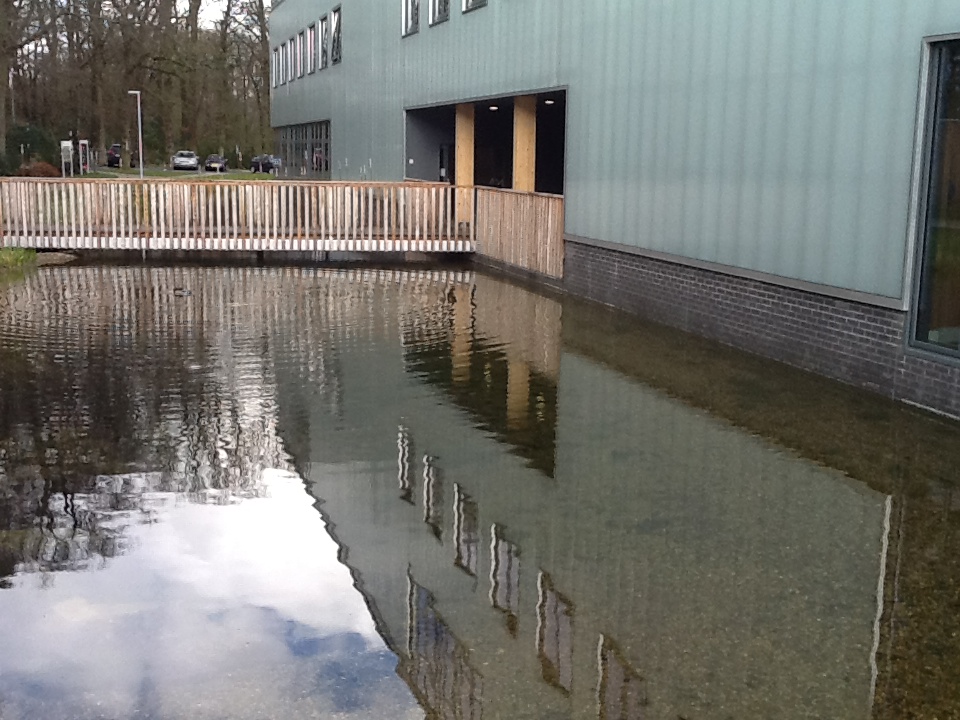
The first is set at the LICA building. The audience stands on the bridge outside. a dancer can be seen in the lobby area of the building. She is filmed by a camera above her. Her movement describes a space she is trying to get out of, looking up to the camera as though she is stuck beneath a glass surface. her image is projected onto the water, so that it looks as though she is trapped below the water’s surface. the audience can see both a profile of the dancer in real life and in real-time and her projected image on the water.
The second in outside the Nuffield theatre, where I use two false window frames (ie frames that are set into the stone work, but then filled in with bricks) as the frame for the image. A dancer stands below a tree in the adjacent square. She is captured from a camera in a window above the audience’s standing area. Her image is projected into the frame of the window. She moves as though she is looking down into the audience’s space from above them, and holds onto the side of the window ledge etc watching as people move below her – eventhough she is actually only to the side of them. Watch a video of this here:
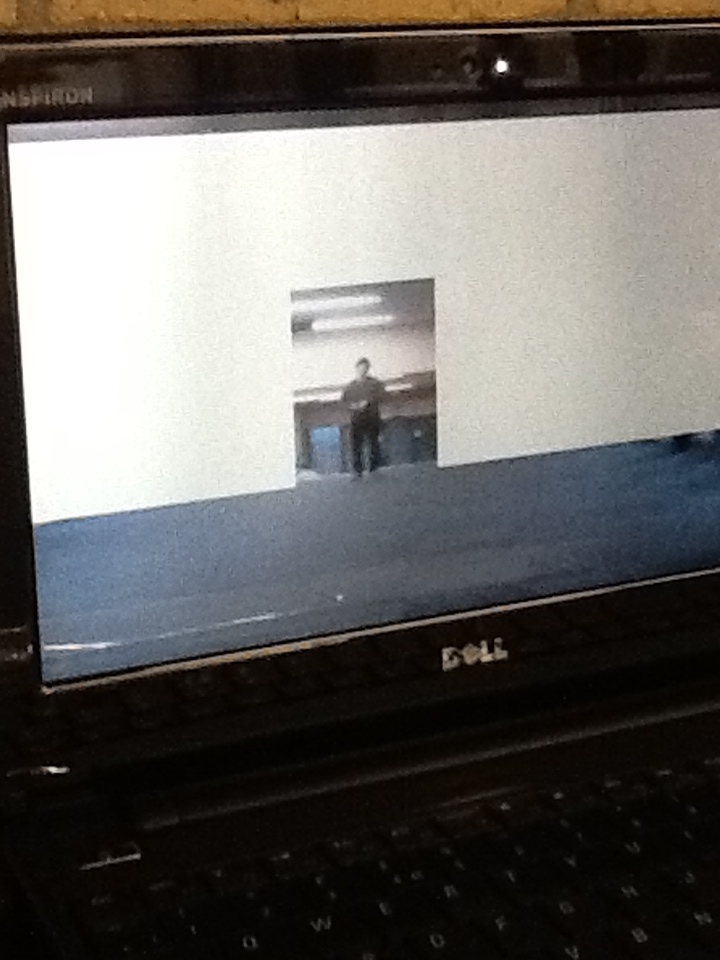
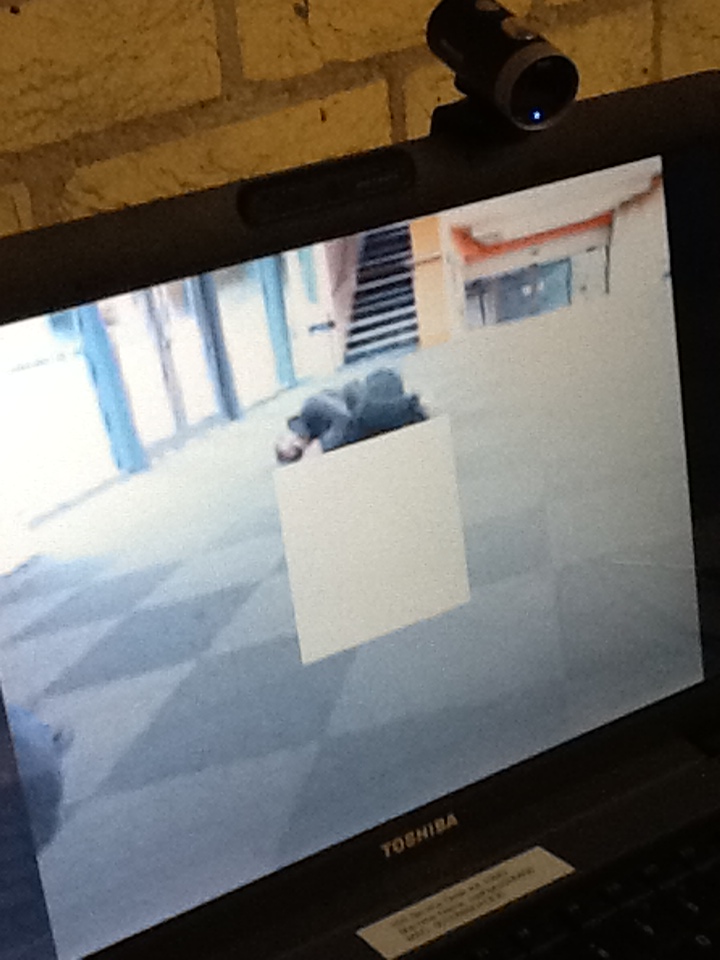
The Faraday foyer. the attached image of the screens shows the set up here. Three adjacent LCD screens show a camera view of the space infront of them. The pics A B and C show the image that is shown on each screen. In A an imaginary door frame is superimposed on the image of the real space. In B a Box is placed in the space. In C a frame. The dancer has to interact with each “object” without losing the illusion in the space.
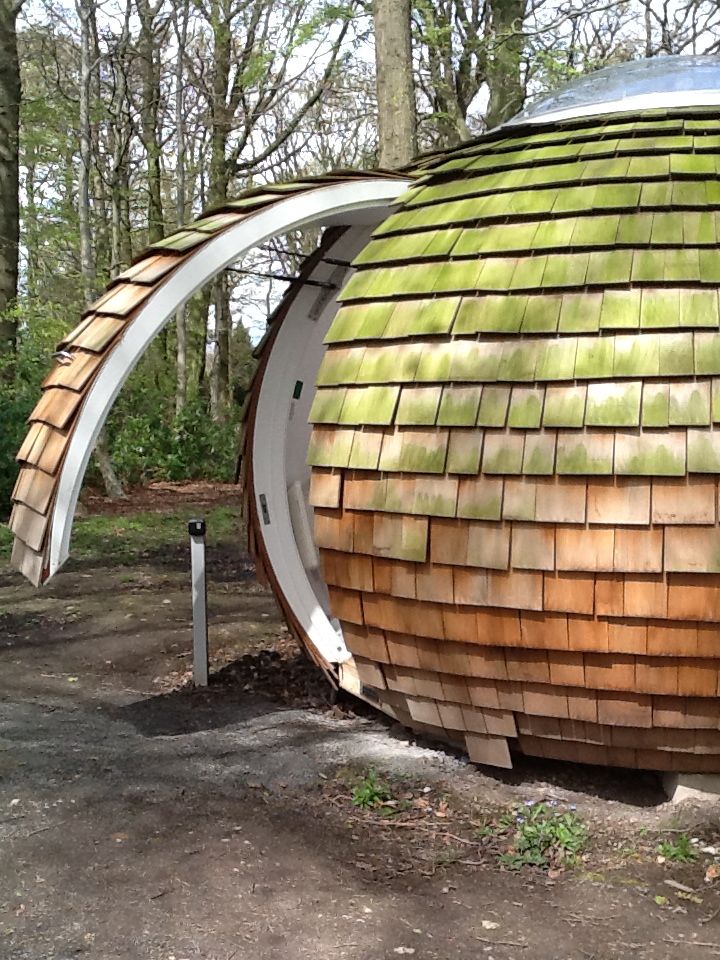
The last installation is set up in a POD (see outside view picture). The picture of the actual piece was taken in daylight so is perhaps less effective. here I decided to use pre-recorded material taken inside the LICA building, where the dancer is looking up at the camera. I will also be capturing some material from the nuffield window to place onto the card shape. I still have some work to do on this set up, since I’d like to find an object that really holds the shape of the movement. My idea here was to take the same idea of using the projected surface / structure as the motivation for the movement, but on a small scale, investigating the space offered by the objects, as mini structures in themselves.
The theme through the piece is this notion of displacement between the live movement in the real space and the space that it appears to interact with, ie: the projected space. I am interested in how the set up directs the dancer’s movement. Watching the dancer attempting to fit into the spaces, for example, the way she feels restricted even though she is standing in an empty space. It gives her movement a task based quality, and her performance presence a feel of concentration and focus. It’s performance but with a very real and necessary motivation, as opposed to having a dancer just moving around in arbitrary patterns.
Ten days ago I launched a fundraising initiative through the crowdfunding platform WeDidThis. I am aiming to raise £2,000 towards the production costs of Strange Loop. Last year I received some funding to carry out the research for this project. The work just needs a little extra money to take it up to production level. I am aiming to show the work at different venues around the UK over the course of 2012, but I need your help to get it out there!
Please take a moment to watch the pitch video on the WeDidThis website:
Crowdfunding allows members of the public to make small donations directly to artists to help them develop a new work. Contributions can be as little as £10 and result in a reward that is linked to the project outcome.
Now I know how annoying it is to be hassled for money. I can assure you that having to ask for money is just as frustrating. My heart sank at the prospect of having to turn into a sales person for my own work. But this is not just about raising the money.
Like many artists out there I spend around 80% of my time filling out applications for funding, opportunities to carry out research, opportunities to perform work…. After spending the better part of three months writing endless applications, all of which were unsuccessful, I realised that crowdfunding was, perhaps, the only way forwards. The reason for this is that so many selection processes boil down to personal taste, perception and who you are up against, all factors that are beyond anyone’s control. If you’ve read Leonard Mlodinov’s The Drunkards Walk, how randomness rules our lives, you’ll understand how so many of the decisions being made about what book gets published, which film is produced or which actor gets the job are rarely based on good judgement alone. More than that, their success is not always down to a trained eye, or good decisions, but are more often the result of statistical processes. I won’t go as far as to say that our whole lives boil down to where we figure in a sequence of numbers, but well, that is almost very much the case.
So how do you escape your own statistical destiny? Luckily, there is such a thing as personal agency: our ability to stand up against the bad numbers and tell them where to go. Crowdfunding is about just that. It’s about cutting out the middle men and institutions (bound by their own selection criteria, politics and institutional aims*), and supporting work just because it ticks your box. Watch the video, read the pitch. If you like the work then help it get off the screen. You can be a part of a project that reaches more people around the UK and Europe and have a chance to say that You Did This.
Thank you
Marguerite
* This is not to say that institutions are wrong to have these limitations, or that they are not effective as a result of them. On the contrary, many arts organisations aim to help as many artists as they possibly can. They’re simply oversubscribed, so they can’t be expected to produce absolutely everything 🙂
In April and May 2011 I carried out a research project, Impossible Spaces. The research received backing from DanceDigital and the Arts Council England and resulted in a work in progress, Strange Loop. The work involves live projection in performance, where the projection is a live relay of the performance space, slightly adjusted by the use of interactive software, to create small differences between what is happening live and what is shown on the projection. My aim was to use the flatness of the projected image to extend the real space and bring about relationships that would not be possible in a 3-D environment. The resulting work in progress was a play on cause and effect, confusing the viewer’s sense of space, time and perspective.
An interview by Dance Digital explains the ideas behind my work with excerpts from Strange Loop:
What is a Strange Loop?
When I started developing this work I called it “Impossible Spaces”, a modification of Escher’s “Impossible Buildings”. Whilst rummaging around for material on Escher I came across Douglas R. Hofstadter’s thesis entitled “Godel, Escher, Bach: An Eternal Golden Braid” In it he describes the notion of “Strange Loops”:
The “Strange Loop” phenomenon occurs whenever, by moving upwards (or downwards) through the levels of some hierarchical system, we unexpectedly find ourselves right back where we started. (Hofstadter, 1979)
In plain language a ‘strange loop’ is an object, a statement or a situation that contains a contradiction in itself. The most well known strange loop is the liar’s paradox, summed up in the statement: “I am lying”. If I was actually lying then I am not actually lying. But If I was saying the truth then the meaning of the statement must be false. The Mobius strip is another example, as are several of Escher’s sketches.
Strange Loop, a work in progress, May 2011
So what did it look like? Here’s a short clip of the work in progress:
Moving On
It’s been five months since the project was wrapped up. In the meantime I have been to the Interaktionslabor in Saarbrucken and the fabulous Digital Futures in Dance Symposium hosted by DanceDigital, Southeast Dance and Pavilion Dance in Bournemouth. Whilst watching, listening and thinking about the way forward, I feel that I’ve finally been able to pin down my own specific identity within this broad field of technology and live performance.
At the moment my work involves an integration of live video projection in a performance context. Dance is my background, the body is my starting point, but it’s a body placed in space and sometimes defined, perceived and manipulated by that space. The idiosyncracy of the work derives from this re-examination of the body’s relationship to the space it inhabits.
I use some digital technology to carry out real-time video processing. But the emphasis is on facilitating an interaction between the live dancer and their virtual counterpart.
I do not use the projection to create a new space behind the dancer. I do not project a dance film behind a live dancer and aim not to use any pre-recorded material in the performance.
Throughout the work the audience should witness an intersection of the two spaces: the real space with the virtual space.
I am concerned with developing an interdependency between the real dancer / space and the projected dancer / space, so that they both need each other in order to exist.
I question what this relationship does to the movement exploration. How does it expand the performer and viewer’s perception of space? What effect does this new space have on the dancer’s movement and performance presence? How can these be amplified and extracted?
My experience of the 2011 Interaktionslabor, Göttelborn, Germany, August 2011 – Marguerite Caruana Galizia
In August 2011 I travelled to the small village of Göttelborn, in the West German region of Saarland, to participate in the 2011 Interaktionslabor. The Interaktionslabor is a yearly event, organised by the multi-media performance artist and academic Johannes Birringer, during which a group of artists spend ten days living and working on the site of an old coal mine. The intention of the lab is to offer a space for artistic development, critical discourse and theoretical enquiry, precipitating a creative interaction and forging new professional relationships amongst the participants and their associated organisations. The particular focus of the lab is on work that involves a combination of performance and multi-media practice. The lab champions the notion of artistic and personal autonomy and implements this, though somewhat vaguely, through its open structure. Participants are invited to bring their knowledge and experience to the group and in turn to learn from other members in a peer to peer situation. Guest artists run workshops throughout the lab, however, whilst these workshops are selected for their relevance to the group’s interests, attendance is completely down to the individuals.
The lab itself takes place in a purpose built space. The guest rooms in one wing, with large potato shaped balconies, look into an open square space. (The largely working class community typically survived on a diet of potatoes and onions, which is why the root vegetable has become a local symbol.) The building operates as a hotel throughout the rest of the year, which accounts for the comfort of these rooms equipped with a writing desk, a small fridge and TV etc. On the ground level, the dining room and kitchen look into the expansive studio/ lab space on the lower level. The group cooked and ate meals together for the duration of the lab, and this communal space became an important part of the creative routine, where we could discuss the progress of the lab and put forwards new ideas and thoughts for the coming days. The lab space is located on the lower ground level, a large high ceilinged space surrounded by full length windows along one side with views out over the coal mine and a nearby power plant. The space could be divided into two rooms with partition doors, but these were mostly kept open so that we worked in parallel at all times. Johannes equipped the lab with all the necessary technical paraphernalia: lights, projectors and cables. We were given more or less free access to whatever equipment or space was available, which allowed us to pick a working time and routine that suited us.
A view of the coal mine taken from the guest rooms
There was no studio booking or rules about when to stop working. In fact many artists chose to work late into the night. An adjacent board room was used by artists who preferred a more contained working space, particularly those editing video footage and working on costume or sound devices.
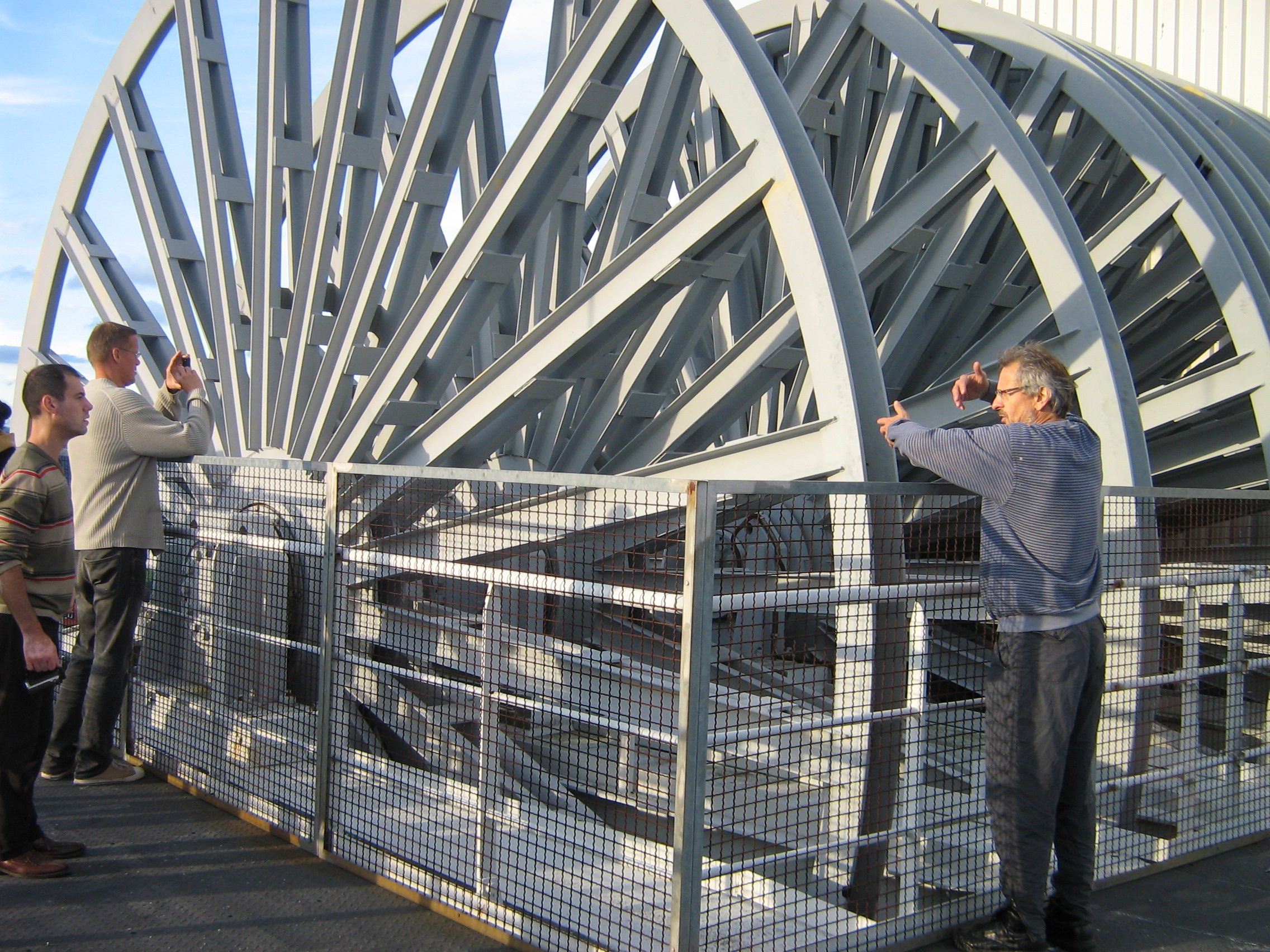
The coal mine boasts one of the tallest towers in the region. Having operated since the nineteenth century, the mine had three towers of escalating heights, reflecting the need to dig deeper into the earth as demand grew and resources ran out. The last of these was only completed a few years before the mine closed in 2001. Despite its relatively recent closure, the space has quickly fallen into disrepair. Whilst some initiative has been taken to turn the outer buildings into what they call an Industriekultur campus, other buildings, such as the old shower rooms, have been completely destroyed.
The wheels at the top of the third tower
On a tour of the site we were given rare access to the main buildings, many of which are no longer open to the public. The miners would arrive in the morning and change into their garments before walking down a long corridor into the mine itself. One side of the corridor was the entrance file with regular paved slabs on the ground, whilst the other side was grated to allow the dust and dirt to fall off the returning miners’ shoes. Johannes took us into the second mine tower, a chamber full of cart tracks, pulleys and machinery. A lift took the miners underground into the tunnels (now blocked up), hoisted by large wheels at the top of the tower. At the tunnel gate a sign on the wall lists the system of knocks that was used for the miners to communicate with the ground staff in case the tunnel collapsed.
Footage taken during the tour of the second mine, where Johannes Birringer describes the “system of knocks” used in case of an emergency:
The coal was loaded into carts, hauled up via the tower pulleys and sent via the cart tracks to the washing room, where it was purified to different degrees before being loaded onto trains to be transported across the country. A large basin just outside the rinsing rooms would collect the soiled water which was carried into the drainage system. The chamber beneath this basin is a vast empty coliseum. Today these spaces stand empty, stripped of the functions they were developed to sustain. As a result they command a new attention from their inhabitants: a question not of what they were meant to do, but of what they can do. This empty, un-lit coliseum on the underside of the basin, for example, a space that simply existed by default rather than by intention, is one of the most acoustically rich sites I have ever experienced.
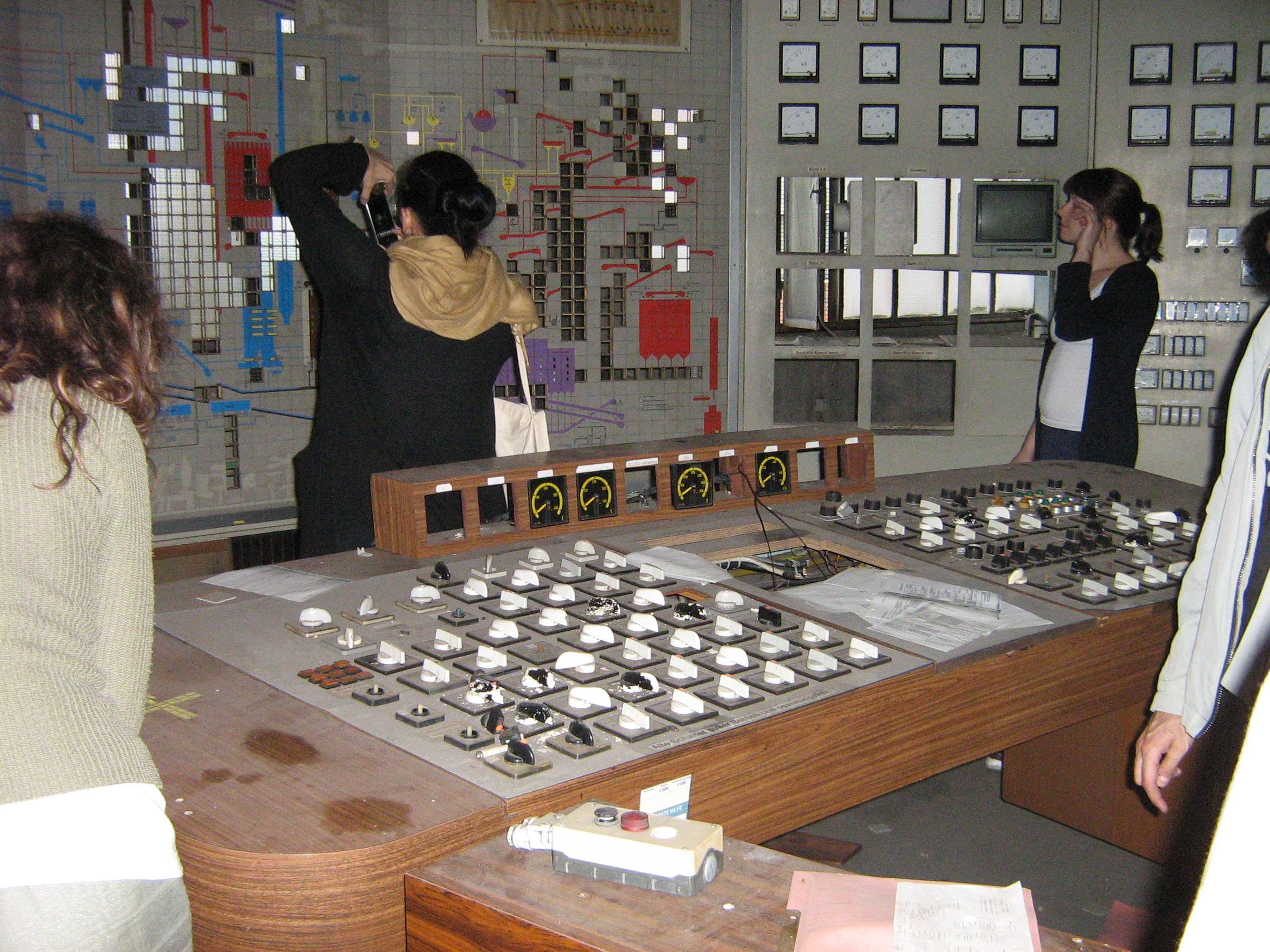
Some areas were less accessible and could only be entered by unlocking several gates (set up, one supposes, to protect the disused buildings from vandalism.) One such space was the main brain centre of the mine, and by far the most chilling of all scenes on the site: the central operations room. A board across one side of the room showed a graphic representation of the entire mine. A panel of radio control devices and dials covered the main desk. The floor was littered with notes, updates on the progress of the miners, reports and faxes. It seemed as though the normal operational procedures had simply been arrested mid flow, with no warning and no time to clear up, as though they fully intended to come back to work the next day. A power plant close by to the mine still functions. It uses solar energy generated by an adjacent solar field, but it also uses coal which is now imported from South America.
The central control room
Many of these buildings became the inspiration for work that emerged amongst the group members. Our surroundings, an empty relic of what was once a noisy industrial centre, now slowly being reclaimed by nature and newer, less dusty, enterprises, provided a rich source of material for our creative explorations. Sound and video pieces were developed by artists using the mine as their starting point. Others began working on pieces generated through their interaction with members of the group. The group began to organise itself in a more or less organic way, with small pockets of artists generating new collaborations that developed into new works. Ludmilla Pimentel and Bette Grebler (Brasil) created video dance works filmed on location. The fashion designer Michele D’Anjoux (UK) worked first with Bette Grebler and Sosanna Marcelino (France) on a video that involved climbing around a prominent stone jutting out of the small hill outside the lab space. She later went on to work with Sosanna Marcelino and John Richards (UK) on a new work incorporating wearable sound devices in choreography. Hana Ma (Germany) and Sonia Rodrigues (Portugal) collaborated on a video piece which was inspired by Hana’s pregnancy, in which a video of Hana moving on the grass was projected back onto her belly and re-filmed to create a video piece with an interactive sound component developed by John Richards (UK). Tania Soubry (Luxembourg) moved in and out of other projects before doing some work with her voice using short loops. Bernard Baumgarten (Luxembourg) created light sculptures and developed a video piece that grew out of his experiments with one particular light installation, where stage lights were reflected against a steel pane.
During my first few days I struggled with the general lack of direction in the group. As a participant I came to the lab with no preconception of what it would be like. I knew that I wanted to learn something and I wanted to immerse myself in a creative environment. I travelled there alone and I had not even met Johannes Birringer before I arrived on the Saturday night. During two evenings of participants’ presentations it became clear that few of the group members had much experience of working with technology, apart from the group of students from Saarbrucken who sadly became side-tracked by other work and gave up on the Lab early on. My initial frustration in being left to do whatever I wanted was not so much related to not having structure for its own sake, but a frustration with the limitations of my way of doing things. Recognising the need to at least start somewhere, I set up a work station in the main lab space where I projected onto one of the partition doors. Our group discussion earlier that day had concluded with the task of setting up a kind of algorithm in the form of some rules that could facilitate an interaction with the space/ object/ idea. A camera captured the movement in front of a second door in the space, which was projected back onto the first door with a short delay. The dancer’s task was to weave in and out of the two doors to create a situation where she seemed to be running after her own image.
We established two rules that led to the most interesting outcomes for the viewer:
1. You can go in front of wall 2 only after you go behind wall
BUT
2. If you go in front of wall 1 then you must go behind wall
I abandoned this project after the first day. Like most discussion points raised over the course of the lab, this idea of generating an algorithm disappeared into nothing beyond the first day. It is only with hindsight that I am able to recognise the value of this game like structure and wish I had kept on going further with it.
The group was joined by several guest artists. Marco Ciciliani joined the group at the start of the week. A musician and composer, Ciciliani’s recent research is in the combination of light and sound. He also creates some interesting compound tracks, where he superimposes all the tracks on a popular album over each other and slowly removes tracks bringing the initial noise down to just one song before building back up again. John Richardson carried out a dirty electronics lab, where the group used wires, batteries and empty tin cans to create instruments that use the electrical current through the body to activate when held in both hands. (Lifting off one hand would break the circuit and cut the sound.) We also had a presentation on the Kinect box. This inexpensive motion capture device has created quite a stir amongst digital arts communities. Whilst conventional motion capture devices remain beyond the reach of most arts budgets, this compact and cheap piece of hardware can be easily hacked into and used to generate data on the body’s location in space and time in a 3-D capacity rather than a regular camera’s 2-D. It still requires some programming knowledge to manipulate the data, and the main programme currently being used is Motion Builder, which is still beyond most artist’s budget, although it can be accessed for free if you work in an education context.
Three days into the lab a guest artist, Stefan Zintel started working with us on PD (Pure Data). This is the non-commercial version of Max MSP, available on open-source. Having worked with Isadora which is built on Max, this programme was like a raw version of the same thing. Whilst its language is slightly less user-friendly, it has many similarities to Isadora. We spent two days putting together these patches, during which time several participants simply gave up. For me these workshops were crucial. They allowed me a chance to look at interactive software in a slightly different way. One of my reasons for not working with a programmer and choosing to do the technical work myself is that, despite the less sophisticated patch work, having that hands-on time with the tools means that I cut out any potential filters in the form of another person’s pre-conceptions. Working with PD gave me a similar feeling. Whilst Mark Coniglio’s Isadora provides a number of interesting and easy to use tools, it has still been organised by him and, therefore embodies his viewpoint in some way. PD is slightly closer to a blank slate, less manipulated or tainted by another person’s ideas. Our very first patch on PD involved an ‘actor’ called a ‘Bang’. This generates an impulse when triggered, like many of the trigger actors on Isadora. To trigger the ‘Bang’ to send a signal to a note generator, we linked it to an impulse generator. The possibility of setting up an automatic trigger to carry out actions on a patch was always possible in Isadora. I later found the equivalent actor in Isadora, the ‘Frequency Generator’ in the sound tools, which formed the basis of another work which I will describe later. I also learnt how to develop a patch on PD for motion tracking and hope to be able to use this in future projects.
It was not until almost four days in to my stay at the Lab that a chance viewing of some video footage precipitated a conversation that then led to a collaboration between myself and two Luxembourgian artists Gianfranco Celestino and Anne-Mareika Hess. During those initial days I was not alone in my ramblings. Many artists moved around the space ‘scratching’ for an idea. During this time Celestino had taken some video footage of Hana Ma walking in a straight line in different locations of the mine. I instantly connected this image with an idea that had struck me whilst sitting in the Lab space on the morning of the first day as Birringer led a discussion amongst the group. Allowing my mind to wonder, I looked around the actual lab space and traced through all the available lines that the space had to offer. I then considered the possibility of filling in the gaps between the lines with video footage of the outdoor space and imagined a continuous walking pattern along these lines that would involve a dancer in the real space walking into a projection of themselves in the filmed space.
This rough sketch shows the setting for the MAG project with the intersections between the real space and the projected image
Over the next two days we set out to create MAG, a combination of projection in performance with a focus on drawing the design and architecture of the outdoor spaces into the indoor performance space. We created a story board of the different intersections that we wanted to create, based on the lines that we could see in the performance space. We then went outdoors to find the locations that fitted in with the lines we had identified. Whilst filming we aimed to achieve the neatest possible fit, so that in transitioning from the real dancer into the projected dancer the dimensions of the space and the height of the dancer remained consistent.
We found ourselves caught up in a conversation between the dimensions of the actual performance space and the perspective of the camera viewpoint. Our resulting work in progress was a very raw proposition. As a group we would like to develop this into a work that can be re-made on different buildings. We are also interested in the possibility of using an indoor space with projections of the outdoors during the daytime, and an outdoor space with projections of the indoors at night.
It was a natural reaction to the environment and the context in which we found ourselves to assume that all that was available was free to use. However, whether or not this applied to our own work, was not clear from the outset. The idea of using found objects, spaces and materials and re-presenting or re-contextualising them in an art work, was the basis of one particularly fractious interchange over the course of the lab. A dispute arose from the use of video footage taken by one artist of another artist’s work and being used as the raw material for a video installation piece. The specific details of the situation demonstrate the interwoven layers of relationships that resulted from the parallel creative practices – in itself an interesting result of our working structure. The video artist Sonia Rodrigues took some video footage of another participant, Sosanna Marcelino, wearing sound devices imbedded into a costume developed by Michelle D’Anjoux in collaboration with John Richardson. Rodrigues used the footage to develop a video piece that investigated the layering of images to produce a 3-D video effect. When the video piece emerged in the final showing, the costume designer D’Anjoux took umbrage at this use of her work without her knowledge, and requested that the work be removed and deleted from Rodrigues’ library on the basis of there having been no discussion on the usage of the footage. During a group meeting the situation was discussed resulting in a more or less unanimous agreement that the question of copy-right should have been raised at the outset of the lab. This could have been in the form of a contract signed and agreed by all on the nature of the forthcoming exchanges of information and ownership of material generated, shared and re-used by the group members in the course of the lab.
The group as a whole changed over the ten days, with people arriving at different times in the week and a large number leaving after just six days. In the final few days three UK based artists, Anne Laure Misme (France), Jennifer McColl (Chile) and Sandy Finlayson (UK) arrived with their video installation work that was projected onto a window pane in the lab space. They also began making a new work in the three days that they were resident at the Lab. As a result of the movement of people, the group dynamic changed several times, as did the relationships and conversations amongst the group members.
In the last few days, frustrations with the set-up of the lab came to the fore, with suggestions that some kind of structure could have facilitated a richer experience for all the members of the group. The key issue was the lack of consistency with which the term “autonomy” was applied. On the one hand the lack of formality was extremely liberating, but it was also at odds with the timetable of workshops and performances that required participants to at least work towards some kind of end. My own frustration lay in the way this ideal of autonomy, a concept that gripped and inspired me on my first evening at the lab, rapidly disintegrated. It gave way to a more sceptical concern that the term was being used in some way to justify a lack of any real plan. ‘Freedom’ and ‘control’ are difficult concepts to identify, and claiming to have either is never as straightforward as it may seem. To me freedom needs structure in order to support and protect it from being hi-jacked by known or unknown hierarchies. The problem with autonomy is that it requires an enlightened self-awareness, like an internal compass, to keep it on course against underlying currents.
Despite my frustrations with the lab, I am still re-assured by its existence and what it stands for. As an emerging artist I am often disheartened by the amount of applications and selection processes which seem to dominate my working practice. Money is short, and the number of makers is high. So selection is an obvious necessity. But it does feel important that there are spaces where artists can select to participate in a research project, as opposed to being selected by a panel. This self-selection is the basis for a bottom-up approach which I think will become increasingly important if we are to find a way to bypass the agendas and politics of organisations. By co-incidence, a few weeks after this Lab, I attended the Digital Futures in Dance Symposium in Bournemouth, where this notion of individual agency and empowerment was discussed in the context of open web platforms. Marlon Barrios Solano (a dance artist and founder of Dance tech. Net) called on artists to consider how they might make use of the web in order to generate and support a ‘Bottom –Up’ approach to the distribution of dance work. But this, he argued could only be achieved through some kind of ‘architecture of participation.’ My true disappointment with the Interaktionslabor was that it seemed ideally placed to provide a space for open interaction, but it lacked the direction to facilitate this in a meaningful and considered way.
By the end of my stay I began to view the space and its intention as a kind of proposition. It gave me one valuable resource that is hard to come by in London: time to think and try things out. During my last few days at the Lab I set up a series of patches on Isadora that involved delays, live capture and instant playback and used ‘Frequency Generators’ to trigger an automatic movement from one patch to another. Entering the first scene sets off a chain of impulses by which the software will automatically move from a delay scene, to a pre-recorded playback, to a real-time relay during which frequency generators start and stop a live capture and then returning to the first scene (the delay mode). Every time the second scene is activated a ‘Counter’ actor is triggered to increase the movie number by 1, which loads the movie recorded in the previous loop. When the movie comes to an end it triggers a jump to the next scene and so on. All this happens without the need for any manual actions on the keyboard. It generates a loop during which actions are played back, or recalled creating a constant forwards and backwards movement in the work.
On the final day of the lab Sosanna Marcelino worked with me for one afternoon to begin integrating this series of patches into a live movement piece. Due to the quick movement through the scenes, we focused on small gestures and decided to contain the projection and performance space by using a configuration of tables. We started off just placing objects on the table, an orange was added to the configuration and soon became one of the features of the piece. The choreography lay in the accuracy of timing and spacing with which we worked through the series of gestures and exchanges.
The set up for the final project
This all took place on the final day of the lab, when emotional and mental exhaustion were beginning to set in. It was also the hottest day of our stay, with temperatures of 33 degrees in the shade. But something of the neatness of the structure we were dealing with forced us to push through even though the work became increasingly complex. It grew to involve a dozen oranges, plates, knives and napkins. Our final sharing at 10pm that night, watched by the few remaining members of the group, Johannes Birringer, Claus Behringer, Sandy Finlayson and Sonia Rodrigues, concluded a journey through anxiety, frustration, inspiration, tensions and friendships that have come to define my ten day experience at this gem of a space. It was appropriate that this final work was set around a table and portrayed the exchange of food and thoughts. Our own eating space was a meeting place for ideas, cultures and practices, and so this virtual meal seemed a fitting note on which to end.
Notes and Credits
Interaktionslabor 2011 was held at:
Industriekultur Saar
Boulevard der Industriekultur
66287 Quierschied-Gottelborn
Germany
Photos taken by Marguerite Caruana Galiza and Klaus Behringer
Video footage by Marguerite Caruana Galizia
My attendance was made possible through a DanceDigital Bursary. The travel cost of this project was supported by the Lisa Ullman Travelling Scholarship Fund.









 Marguerite Galizia