DR 2

So in my last post I talked about the cause of a DR as the increased pressure against the abdominal wall from the inside out. Pregnancy is one example of why this might happen, however I am seeing, with considerable frequency, the same pattern happening in men. It seems clear that the main cause of the DR is posture. There are contributing genetic factors too, like hyper-mobility, which will make someone more prone to it. There are also occasions where a single event, like a sudden sneeze, coughing or lifting something heavy can bring about a hernia. However the chances are in both cases that the occurrence can be greatly reduced by maintaining appropriate tone in the abdominal wall and ensuring that you do not place too much pressure on it during habitual movement.

In my last post I identified four key areas that need to be addressed:

  1. Centering – asymmetry (unilateral imbalances) reduces the functionality of the Rectus Abdominis muscle. Before loading the abdominal wall you need to find centre.
  2. Releasing the shoulders – restrictions in shoulder movement leads to rib cage displacement. It may seem strange, but ensuring you have full ROM in the shoulder will reduce pressure on the abdominal wall.
  3. Release the rib cage – The ribs need to soften down. I drew a nice picture of this in my last post.
  4. Release the Hip Flexors – When the ribs are displaced, it makes it very hard to connect through the centre of the body, so when these clients do things like abdominal crunches with their legs in the air, they often tighten up in the Hip Flexors. This brings the pelvis into a forward tilt, also in my picture.

The following sequence is not a complete fix. It’s a starting point to address the main points mentioned above:

  1. Centering: start off by doing a low level centering exercise. My favorite is to lie down with pelvis raised onto one of those disc shaped wobble cushions, but a simple cushion does the trick too. You need to make sure that your ribs are not poking up to the ceiling so soften the rib cage and raise your head onto another cushion if needed. Start with pelvic rocks, then small clocks, rolling an imaginary marble around the pelvis. You can then draw one knee in and hold it with your hand and do a few knee stirs. Repeat on the other side. Then hold one knee in towards you to allow the other hip to open up. Change sides.
  2. Lateral Breathing: staying on the cushion but with both feet on the floor begin to breath into the sides of the ribs. As you exhale, allow the arms to lift up infront of you whilst you soften your ribs down. Then try to take one arm overhead, without displacing the rib cage. Keep softening the ribs down as the arm goes overhead. Repeat a few times to each side and then try this with both arms. Drop the ribs! Drop the ribs! Drop the ribs!
  3. You can now begin doing some low level abdominal work. Place your hands onto your belly, so that with each out breath you sink your belly away from your hands. Try drawing one knee in towards you at a time without swinging around on the cushion or collapsing your lower back into the floor. Then try to do the step up where you lift one leg, hold for an in breath and lift the second leg up to join it on the next out breath. Then reverse. Always breathing out when you either lift or lower the leg.
  4. Leg slides: With the pelvis still on the cushion and feet on the ground, you slide one leg down along the floor. As you do this try sinking the belly back towards the spine, breathing out all the way, and watch that the lower back doesn’t arch especially towards the end range of the knee extension. Hold the leg out there for an in-breath, and then press the heel into the floor, engage the muscles around the sits bones and drag the leg back in to the starting position. Repeat 3-4 times to each side, alternating legs.
  5. Bridge: press your heels into the floor as you raise the pelvis off the cushion. You want to think of lifting the pelvis from the muscles around the sits bones, keeping the ribs soft and opening the front of the hips. Remove the cushion from under the pelvis, and then roll the spine down to the floor bone by bone, focusing on releasing through the mid back. You can then repeat the bridge without the cushion a few times.
  6. Lunging HF stretch. Ok this one is just obvious, but don’t forget to avoid hanging into your lower back. As you lunge forwards you think of lifting out of the pelvis, keeping the ribs soft.

I’ve been busy writing this whilst suffering from a nasty cold, which means that I’ve had time to create a quick video of all of this (minus the lunge). It’s just a quick picture so that you know what to do when you’re on your own. Please excuse the red eyes and sore nose 🙂

Diastasis Recti

As some of you know, I’ve recently become intrigued by the number of men I come across with some degree of Diastasis Recti. A DR is a split in the abdominal wall, which we commonly come across amongst pregnant and post-natal women.

DR is accepted/ expected as a normal result of pregnancy. As the baby grows, the abdominal wall splits to make room for the growing bump. Post-natal Pilates focuses on re-knitting the abdominal wall by gradually increasing loads to tone the abdominals whilst encouraging the abdominal wall to sink downwards and inwards. It’s a tricky balance. If you load too much, the abdominal wall is pushed outwards, further exacerbating the problem. If you load too little the client finds it very hard to ‘feel’ anything in the abdominals and other muscle groups like the Hip Flexors begin to take over.

The good thing is that when you work with a post-natal woman, they know that their abdominal wall is vulnerable. So they don’t go for broke on big abdominal exercises. They (often) listen to my instruction to reduce loading if they’re in a big class, or engage with the issue rather than trying to ignore it. Men with a DR, on the other hand, have not just given birth. They don’t feel vulnerable, in fact many of them appear to be quite strong. They often show up in my classes because their physio recommended Pilates for their lower back pain…small wonder. Many of them simply don’t accept that the abnormal bulge in their abdominal wall is a problem at all. The literature out there backs this up, calling it harmless. But a split in the fascial sheets of the abdominal wall is not functional. Try telling a buff looking man that he needs to do post-natal Pilates….

Enter Katy Bowman.

Katy Bowman is a bio-mechanist. She looks at movement in terms of forces placed on the bones, joints, soft-tissue and even the cells. Her philosophy is to develop nutritious movement habits, varying the loads and directions of pull on the body so that we develop a varied movement diet, leading to all-round wellbeing. She’s a massive fan of the squat and hanging from trees, for example, movements that our sedentary culture has made very easy to forgo.

In her most recent publication Diastasis Recti, Bowman insists that DR is a whole body problem. She identifies that all occurrences of DR result from too much pressure on the abdominal wall. Whether this is because of a growing baby in your belly, or if, like a friend of mine, you just picked up something too heavy and literally ‘bust your guts’. From a bio-mechanical point of view, the cause is the same: too much pressure on the abdominal wall from the inside outwards, and though the onset may be sudden, the fault lines have slowly been creeping up:

 Slow sustained loads in a certain direction can deform tissues in a manner from which they cannot recover. Mechanical creep is the tendency of a material to deform slowly under a constant stress. The failure of a tissue in this case is called a creep failure. A diastasis recti or hernia is the result of creep failures.” Katy Bowman.

So Diastasis Recti is NOT just a natural result of pregnancy. It is the result of abnormal amounts of force on the abdominal wall, of which pregnancy may be one cause.

The abdominal muscles support the lower back. Poor tone or weakness in the abdominal wall results in a gradual wear and tear on the discs and intervertebral joints in the lower back. It’s obvious that a tear in the abdominal structures makes them a lot less functional (read: weak), which is why they really need to be addressed. I think that when medical professionals say that DR’s are ‘harmless’ what they mean is that they are not cancerous growths. But a DR is not something to ignore.

It follows that if the cause is the pressure on the abdominal wall, then just fixating on the location of the DR itself, as we tend to do with post-natal women, is a very limited way of looking at it. That doesn’t mean that specific, targeted abdominal work is not necessary. On the contrary, we do need to work to restore correct functioning of the abdominal muscles, but it needs to done within a program that considers the pressures on the abdominal wall brought about by the organization of the body as a whole.

If I hold a picture Doc - 28 Mar 2017 - 21-56in my mind of clients who have a DR, the picture is roughly this. The rib cage is flailed, compressing the mid-back area and the pelvis is in a forward tilt. This appears to create more space out the front, making it the favoured posture for a pregnant woman. I think that men who adopt this posture (if they are not obese) do so because they may be trying to sit upright, but don’t have the mobility in their upper thoracic area or shoulders, and therefor hinge on the mid-back section. Once you displace the ribs in this way, it makes it very hard to feel a connection through the centre, so any abdominal work is likely to go into the Hip Flexors or lower back.


Bowman goes through a very comprehensive program of exercises to address every detail around this posture type, (and I highly recommend her book to clients, especially men, who have a DR). However, one of the key factors that makes DR quite difficult for a post-natal woman is: asymmetry, which I don’t think Bowman has addressed sufficiently in her book. Having one leg longer than the other, or some rotation in the pelvis, or a scoliosis all lead to a weakening of the abdominal wall. Lack of alignment causes weakness in the surrounding muscles. So addressing this is just as important. Once the body is aligned, the hip flexors are released and the ribs are dropped, we can then progress to more targeted abdominal work focusing on sinking the abdominal wall. The trajectory is therefor: align the pelvis, release the rib cage, open up the hip flexors and then integrate low level abdominal loads.

My next post will go into more detail on each of these. 🙂


The Hip – Foot Sling

I’ve been talking about the Spiral Line, or how collapsing into the Spiral Line causes a downward spiral. I hope that what’s coming across is the fact that you are not just a series of parts fixed together, and that a holistic, whole body approach is necessary to address injury or pain.

Today I’d like to look specifically at the Hip and it’s role in the Spiral Line.

The hip is involved in the Spiral Line at two major points: the outer side, by the ASIS, and the back and lower side, by the sits bones. These two points are directly related to the arches of the feet via the Spiral Line.

If you put your hands on your ‘hips’, you’ve most probably placed your hands on the pelvic crests (The Illia). If you trace your fingers to the front of these two bones, that’s the ASIS. This point is connected fascially to the inner arch of the foot. The Spiral Line runs from the ASIS down the outside of the leg (the ITB), then crosses forwards from below the knee across the front of the shin and down to the inner arch (via Tibialis Anterior).

doc-21-feb-2017-12-09-1Tibialis anterior hooks under in the inner arch of the foot where it meets the tendon of Peroneus Longus at the base of the first metatarsal. Peroneus Longus runs from this point towards the outer side of the foot and up the outer (lateral) side of the shin bones. The line then continues towards the back of the thigh up the hamstrings and towards the sits bones (ischial tuberosities).
As you can see from the diagram, the tendinous insertions in the foot create a stirrup around the arch of the foot. However the really interesting thing is that this continuous line connects the pelvic placement with the arches of the feet in a sling like structure.

This is super important!!!!!!!!!!!

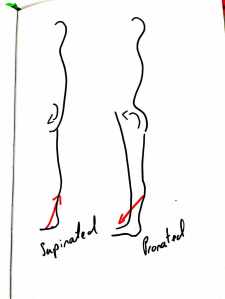
doc-21-feb-2017-12-10If the arches are dropping inwards there is a fair chance that your knees are rotating inwards and that your pelvis is tilted forwards. If you’re rolling onto the outside of your feet, there’s a fair chance that your knees bow outwards and your pelvis is in a backward tilt (also known as tucking under).

Remember that these are simplifications and no body is 100% of one thing.There are millions of variations of the above. Sometimes one side of the line is tight on one leg and lax on the other leg. (I will talk about this later when I look at whole body movement and the spiral line.)

Since my series has been focusing on the “Downward Spiral”, I will give you a few tips on how to work with the first of these patterns, where the arches are dropped and the pelvis is in a forward tilt.

  1. Do not stretch the hamstrings!* I often come across people with this pattern who insist that their hamstrings are tight. Actually, if your pelvis is in a forward tilt, then your hamstrings are too long, ie: they are in a constantly lengthened position under load. If you stretch them any more then they will just tighten up against this. They are actually too weak and need to be strengthened to encourage the pelvis to come more towards a neutral alignment. I’m sorry to say that this is a really tricky thing to achieve because the Hip Flexors at the front of the hip are often tight and therefore stop people from being able to access the gluts and hamstrings in exercises that should target these areas. Unfortunately, what tends to happen is that people just arch their backs instead, which just causes more problems. So before you can tackle the hamstrings themselves you will need to:
  2. Lengthen the Hip Flexors. The kneeling lunge is probably the best option, however if your knees are dodgy you can lie on your back with your pelvis slightly raised on a cushion and hug one knee in towards you.
  3. Engage the sits bones. Now obviously the sits bones are bones and cannot contract, but this image, that you often hear me give in class, is a key one for the functional integration of the hamstrings and gluts in hip extension. When you ‘narrow the sits bones’ you engage the top attachments of the hamstrings and the lower fibres of the gluts. This anchors the lower end of the pelvis so that the front of the hip can let go. You need to find this connection first before going into hip extension exercises like the bridge. My favourite exercises for this are either footwork on the Reformer or the matwork version which is supine leg slides.
  4. Do the Bridge.

It’s so difficult to describe these exercises in any detail. So ask me in class if you’re not sure about any of these.

*Generally speaking, if you notice that you have one area of your body that constantly feels tight, it’s a sign that it is being asked to do more than its fair share. A muscle that is constantly tight is essentially very weak. Stretching constantly is not a good idea. By looking at whole body alignment you can learn to achieve a more functional distribution of effort so that no one area ever feels constantly stiff. But that’s a point for another post altogether.


Piggy in the Middle

Do you remember that game where two people throw a ball to each other over the head of another player who is standing in between them? The ‘piggy in the middle’ has to run around like mad trying to intercept the pass, whilst the others play all sorts of tricks like ducking  or switching directions at the last moment. Yep, well, the piggy in the middle is a great metaphor for the knee.

When the ankle joint receives weight it is normally in contact with the ground. This restricts the movement possibilities within the ankle, providing a relatively stable base on which to stand (‘relatively’ being the operative word here). The hip joint is structurally stable being both deep inside the pelvis and reinforced by layers of strong tendons. In relative terms, the knee is in a much more precarious situation. In the downward spiral (my term, not a technical one), the knee has to accommodate the torsion created by deviations / restrictions above (in the hip) or below (in the foot) or both.

However, the knee is not designed to rotate! It’s a hinge joint. It is designed to allow us to flex in the lower limb. This decelerates the fall of the body, reducing the impact of the ground’s force when our weight is met by a hard surface. It should only move forwards (flex) or lengthen (extend – as opposed to hyper extend (that’s another story)). Restrictions around the ankle and hip force the knee into inward (knock knee) or outward (bow legs) rotation (- bow legs is not really a result of the Spiral Line collapsing, I’ll cover that on another post). Continuous torsion over time ultimately leads to injury. It’s the piggy in the middle, and all it can do is scream in pain.

doc-17-feb-2017-07-51-2

It is very rare that a knee injury is directly the result of poor functioning in the knee itself! (Dislocation and hyper extension are obviously an exception.) And yet the tendency is just to treat the knee with medications, massage and exercises that directly relate to the knee alone, instead of addressing the underlying cause of the torsion which may be in the ankle, the hip or both. No, I’m not saying you shouldn’t strengthen the VMO and release the ITB (if you have dodgy knees you’ll have come across these terms already). Unfortunately, we often only know about the pattern when the knee starts to create some noise, by which time damage within the knee itself has already taken root. So we then have a situation where we do need to treat the knee to relieve the pain. But the knee pain is a symptom of a wider pattern.

So how do we identify restrictions that may be putting a torsion strain on the knee before we get to that point of injury, and what can we do to reduce them? Here are some suggestions:

  1. When you next walk up a flight of stairs, look at how your knees move over your toes. Do your knees roll inwards or outwards? Both of these are a sign of some compensation. Try sending your knee directly forwards over your toes. It may feel strange, or effortful at first, but by gradually encouraging better alignment you start to unlock the poor pattern.
  2. Listen out for noise. It’s obvious enough, but constant cracking, popping and crunching in the knee is not a good sign. If it is on one side but not on the other (unilateral) then this could be a sign of whole body torsion (again, my term not a technical one), which is particularly common for people with a scoliosis or some other asymmetry (like a leg length discrepancy). Working to reduce the impact of this structural asymmetry on the soft tissue will help to reduce the constant pulling on the knee. You need to do a well rounded class that includes release and stabilisation for the pelvis and spine. Attacking the leg alone with a foam roller may just exacerbate the situation.
  3. Decompress the knee. If you are hearing clicking sounds in the knee and starting to experience pain you need to focus on decompressing the knee joint. The typical thing to do is to strengthen the VMO (the lowest fibres of the inner most quadriceps muscle) which helps to lift the knee cap, whilst releasing the ITB (the tough tissue on the outer side of the leg). You should also look to lengthen the hamstrings. (My next post will look at functional use of the hamstrings.) But you cannot ignore the lower leg. The muscles in the lower leg also tend to tighten up, especially the ones around the outer side (the peroneals), these are particularly hard to stretch, and are often by-passed in people with dropped arches. The Feldenkrais variations of calve stretching described in the video on my previous post will massively help to relieve this tension. Try to avoid really tough stretching. Work on creating glide between the layers of muscle instead.
  4. Strengthen the muscles around the hip. This will be covered on my next post.

Warning: Listen to your body. The aim is to move without pain and no blog can really tell you how to assess and correct your movement. Speak to a professional and get them to give you some feedback on your knee tracking. Just remember, the cause is not normally in the knee.

🙂

My next post will look at the hip – foot sling.

Bunions

Not the loveliest of thoughts, but if you’re reading this then chances are you may well have one or possibly even two.

A bunion (hallux valgus) is a condition where the big toe points inwards towards the other toes. It is a deviation at the metatarsophalangeal (MTP) joint of the big toe. It makes the inner edge of the first tarsal bone jut out to the side which rubs on shoes and can become inflamed and painful.

Unfortunately, treatment often tends to be quite superficial. It’s true that it can be caused partly by wearing poor footwear, and that the tendency can be hereditary. But more often it is the result of how you are moving. So fixing the aesthetics without addressing the underlying problem will only lead to recurring issues.

In my last post I spoke about the Spiral Line: one of the fascial continuities defined by Thomas Myers.The spiral line allows us to move forwards with greater efficiency, by using the torque created by the cross lateral co-ordination of arms, trunk and legs during walking and running.

Relying on this torque without the underlying support of the inner line of the body (the core), causes a downward spiral, where people are literally twisting around their joints. The bunion is a symptom of this twisting.

(Small interlude here: I have come across at least one client for whom the bunion resulted from an adjustment in her gait pattern due to inflamed sesamoid bones in the big toe joint. So if correcting the alignment of the toe, by using your fingers to pull the toe back into alignment, and trying to roll over the big toe joint, causes pain, it may be that the rotation around this toe is an adjustment and that there is an underlying problem that needs to be addressed. Even so, the management described below would not hurt.)

There are two things that need to be addressed to correct the deviation of the big toe joint:

  1. Tone the muscles within the spiral line to bring more stability into the joints of the lower limb. (Please see my Spiral Line – Practical post to learn more about how to bring tone to the Spiral Line.)
  2. Address the movement restrictions in the other lines which may be causing you to take the spiral pathway in the first place.

I just want to pick up on this second point because it’s often left out. What I see quite a lot with people who have some degree of bunion is that their sagittal plane movement (forward and backwards) around the ankle and toes is restricted. They find it hard to do a standing knee bend (a plie) without letting the heels come off the floor, or they have a restriction around the metatarsal joints during push off. Whereas collapsing into the spiral line is a problem of tone, using it to by-pass forward/ backward movement is a problem of mobility.

So do we just need to stretch? Yes A simple calve stretch will help to increase mobility in the angle joint. My favourite is Katy Bowman’s rainbow calve stretch and the soleus stretch here. However, I’m tending to move away from stretches in general because they can sometimes be quite counterproductive and just lead to more stiffness. My favourite mobilisations around the ankle joint are the Feldenkrais variations of footwork. I try to include some of these in my classes from time to time but here’s a little sequence for you to try out:

(Apologies for my very basic filming skills and for the shadows under my eyes. I’m really not made for the camera!)


If you notice, I basically haven’t said much about targeting the big toe itself. That’s partly because there’s so much stuff out there about specific toe exercises. I just don’t think the toes are really the cause. My feeling is that it is often stiffness around the ankle joint and collapsing into the arches that changes the push off during walking so that instead of articulating forwards through the big toe and second toe metatarsals people are twisting around the big toe which brings about the bunion. The exercises described above and in previous posts may help to bring some tone and release into the foot and ankle joint which will help to unlock this pattern. But bringing your awareness to how you’re moving will also help.


The Downward Spiral – Practical Tasks

In my last post I talked about the Spiral Line and the danger of collapsing down into it. Here are some very practical things you can do to get out of your downward spiral.

  1. Stand on one Leg. That’s it. you’ll find that it’s impossible to balance unless you bring your weight into the outside of your feet and get the outside of your hip to fire up.
  2. Send your knees over your toes and engage your buttocks when walking up and down stairs. Don’t let your knees roll inwards or outwards. Yes it is that simple.
  3. Do clams, ok but this one comes with a massive warning sign: you need to ensure you are doing them properly so speak to your Pilates teacher if you’re not sure.
  4. Do some Lazy Angels, also known as ‘around the worlds’ where you lie on your side and circle an arm around. This really helps to bring some movement into the shoulder blade area which is often quite sticky in downward spiral clients.
  5. Releasing the ITB and the calve muscles with a foam roller.
  6. Do some basic core stability, keep it really simple. If you’re lying on a foam roller and keep falling off you’re just going to be gripping to stay on it. Don’t be ambitious about it! The important thing is to do something that will require you to engage your inner line, do some knee floats or arms on a roller. Something to get your centre to wake up.

And finally: stop blaming your grandmother! Yes genetics do play a part, but we all know these days that nature is only half the story. The other half is in your hands. 🙂

The Downward Spiral

I’ve been thinking about it for ages and today I will finally begin tackling a problem that I have seen with increasing frequency: deviations in the big toe (bunions) and knees (knock knees), both of which I think are a result of a collapse in the spiral line.

So many times I come across clients who tell me they’ve had surgery on both big toes to correct bunions, and yet the bunions recur. I come across many runners with chronic recurring knee pain, normally treated with massage and insoles in their shoes. Over time the wear and tear builds up until they cannot run at all. Make no mistake about it: walking around against gravity does put load on our joints. Good alignment means that the loads get channelled through efficient pathways. Poor alignment leads to stresses and therefor injury. But fixing the issue by repositioning bones will achieve nothing unless the underlying movement pattern that is causing the deviation is addressed. Form follows function, you are how you move.

The other thing you need to do is stop thinking about the body as a number of separate parts stuck to each other. Your little toe is connected via fascial pathways all the way up to your neck and face. No it’s not Woo Woo. It’s fact.When we talk about holistic movement practices this is what we mean. It’s an approach to the body that sees it as a whole, interconnected structure. Key to this approach, is an emphasis on connective tissue, the stuff that literally connects every cell within the body. In 2001 Thomas Myers identified specific lines of pull across the fascial web, pathways around the body that he called ‘myofascial trains’. One of these is the Spiral Line.

Rather than take you through the anatomical details of this pathway, it might be easier to just look at this very short video of the spiral line, narrated by Thomas Myers. The line runs along specific muscles that are fascially connected so as to create one continual line along which tension is transferred and distributed. They’ve drawn the line on just one side, but obviously this is also present on the other side of the body too. The lines cross the body and create a stirrup around the foot.

I think this is such a key fascial line because it moves across a number of planes. The front and back lines are mainly involved in forwards and backwards movement, the lateral line stabilises the sides of the body. They are the ‘simpler’ lines in this sense. But the spiral line works with or against rotation making it a more complex one. Forward, backward and side ways movement never really is simply forwards, backwards or sideways. When we walk we don’t just move forwards. We’re actually moving in spirals. The problem occurs when there simply isn’t enough support from the other lines, in particular from the inner line of the body (the core) and lateral line (the gluts) which means that rather than using the spiral line to make our movement more efficient, many of us are hanging into our spirals.

When you do not lift out of the spiral line from the feet upwards, you place the rotational force on the vulnerable joints of the knees, ankles and toes. The knees knocking inwards and big toes pointing outwards are adjustments to the force of body weight being channelled downwards and inwards when we attempt to move forwards. I’ve come to think of this as the downward spiral and its effects can be pretty debilitating.

Spiral line issues do not only affect the legs. When clients complain of knee pain there is often a degree of ‘fuzzing’ (a build up of fascial tissue) under the opposite shoulder blade to the affected knee. This is because the inefficiency of the lower limb puts strain on the line higher up the body. You don’t run or walk with your legs only, your arm swing and rotation in the spine is all part of the movement too. This is why a long distance runner can get shoulder pain when they tire.

So how does one pull out of the downward spiral?

First of all, stop thinking about the parts in isolation. You need to look at your overall movement. Clients often get a bit confused when I start teaching a standard class and don’t simply focus on the ‘bad’ bit. The truth is that the painful area is rarely the  source of the pattern. It is more likely to simply be the area that has compensated the most. So yes we do need to work to relieve the stress on the area. However the re-training focus needs to be on what’s happening above and below the point of torsion. Also note that sometimes relieving one part of the structure involves just leaving it alone! The thoraco-lumbar fascia (in the lower back) is one area in particular that should not be stretched around.

Secondly, we need to work the muscles. Sounds obvious enough, but it’s surprisingly difficult especially for hyper-mobile clients. Connective tissue itself (which includes tendons and ligaments), cannot be contracted. We cannot really change the elasticity or rigidity of connective tissues. But we can control the tone of muscles which lie within the fascial lines. As James Earls says in ‘Born to Walk’: “the muscles are essentially the fine tuners of the system, adding or subtracting  tension when needed, via the fascial tissues of the body.”

And finally, if you are moving in a way that causes the deviation, then that ‘way’ is also going to feel the most natural. Most of us stand and move more or less unconsciously so changing a pattern requires increasing your body awareness so that you notice when you are falling into a bad habit in the first place. Increasing awareness takes time and requires some kind of external feedback system too, ie: we need someone else to tell us how we are moving. Going to an exercise class where a teacher is able to look at how you are moving and give you regular feedback and corrections is essential.

I’ve learnt from working with various clients that there is no quick fix, in my next post/s I’ll focus on a few key areas and offer some suggestions of things you can do alone to stop the downward spiral in its tracks 🙂

Habit

I have a lovely aunt who was known for playing tricks on her teachers and siblings as a young girl. When my grandmother was out shopping or running errands, the children would take the opportunity to run amuck, until they heard their mother’s familiar footsteps. The particular rhythmic clicking of her heeled shoes against the paving stones, the lifting of the front gate lock, the slight tread of the shoe as she approached the front door, all these signalled time to quickly organise and pretend to be doing homework by the time their mother walked through the door. On one occasion, my grandmother left the house wearing a new pair of shoes, leaving her old shoes in the hallway. My aunt spotted an opportunity. She quietly took the shoes and creeped out of the door. Putting on the shoes, she then replicated her mother’s walk up to the front door. Her brothers and sisters inside were shocked by the sudden return and scrambled to get to their homeworks. The door opened, and there was Evelyn.

The little idiosyncrasies of our movements both define and are defined by our character, how we feel, our social and geographical environment. Like the clothes we wear, the body is firstly informed by its own material make up, the intrinsic qualities of the fabric. It is molded not only by the intended mechanism of our early development, the general pattern of conception, foetal growth and birth that you read about in medical books, but also by the unexpected idiosyncrasies that are inevitable in any live process. Even from the womb our bodies are receiving information to which we adapt in some way.

Have you ever tried to iron a top and realised that no matter what you do, the seams just don’t meet easily? The fabric molds to the shape and movement of its wearer. As we grow into who we become we make constant adjustments according to our internal and external environments. The fabric becomes stretched in some places, twisted in others. Our bodies develop patterns of movement in response to our need to negotiate all the ingredients that make us functioning human beings.The intrinsic qualities of the fabric and cut are only half the story. The other half is movement.

You are how you move.

The one rule that we all follow unconsciously is to make things easier for ourselves. The particular drag and click of my grandmother’s tread was not a deliberate choreographic sequence. It was a habit. Habits accumulate to reduce cognitive and muscular output. They become ingrained to the point that they are no longer questioned. They just become the norm. Now, this is not all bad. If a habitual pattern is a good adaptation for someone’s particular situation, if it is effective and not causing excess strain or injury, then it may be a beneficial habit. It only becomes a problem when it stops us from accessing our full movement potential. Remember, if a habit is developed out of need for efficiency then you are using less muscular effort, read: lowering your basic metabolic rate during that activity. This is very helpful if you have a marathon to run to save your life, but less helpful if you only tend to get around the block once in a working week. What we need to do is trick the body out of that tendency to economise and we do this by consciously (mindfully) moving ourselves out of habitual patterns.

So, how can we move more consciously?

  1. The ABC of good movement habits is awareness. We need to start by listening to our bodies. Switch the music off when you do that run. Tune in instead of tuning out whilst you swim. Do Feldenkrais…. that one’s worth repeating: do Feldenkrais.
  2. Throw a spanner in the works: you realise your weaknesses when you do something that you are not used to doing. Try a new class, change the cross of your legs, change your workstation around, listen to something you would not normally listen to. Don’t just go towards the familiar, nudge yourself out of your mindless habits even if it feels a little superficial.
  3. Your movement classes should be a conversation. No I don’t mean that you should spend the whole session discussing your mother in law and the state of the country. The art of effective teaching is to facilitate learning. I don’t have all the answers. I have a set of tools, a paradigm for approaching movement. How this interacts with your own knowledge and movement capacity is highly individual. For me to be able to help you, you have to help me. It’s a collaboration that we both learn from.
  4. Reflect. I know, like we have time to sit down and endlessly journal about things! But having some kind of written statement can help you catch your own habits. It doesn’t need to be a long thing. Write a line each day about what you did differently and how you felt. Reflection is an important feedback tool, there’s nothing like your own words to tell you how it is!
  5. Find a compass. If our roads were not straight, we’d all go around in circles. We all need some kind of compass, an external marker to tell us where we are. Ideally something quantifiable. Weight and BMI don’t give you the whole story, but as a rough guideline they provide some kind of compass to keep us on track. Don’t be obsessed. Just weigh in once a month or so.
  6. Injuries are the best wake up call. Most injuries, unless related to a specific accident like a sudden fall or a road traffic accident, are micro-traumatic. They are the cumulative effect of constant over use and micro-tears. That really long post-Christmas lunch walk may have triggered a new surge of pain, but the pattern that caused it was long ingrained. Don’t just treat the pain. Find the pattern that caused it.


Where to start…?

I have literally been staring at that question on my screen for 30 minutes. That ‘rest’ that I “really needed” has come, and gone. There are so many loose ends sitting in my inbox that it feels like I’m facing a pile of spaghetti as a to do list. My body has turned to mush thanks to successive colds and too much food and, helpfully, the entire world has shifted into hyper New Years Resolutions selling mode. Great. Welcome to January.

Still, pauses are useful, beginnings are hopeful and there is something to be said for taking stock and thinking before you leap back into the same old thing. Here’s my bit of New Year’s wisdom:

  1. It is always useful to make use of the ‘space’ that a holiday brings to create some perspective. When you’re outside of your regular doing mode, you realise that perhaps the things that you are doing are not making you happy. Or maybe you realise that something just has to change. I think it’s always good to notice how you feel about going back into working mode and think about how you can adjust things to make your working experience a little better. Or if you realise you are deeply unhappy about yourself or life in general, find a professional to talk to.
  2. I always find that the best time to get rid of a bad habit is after a holiday, because the change of routine has created an interruption in your habitual behaviours. This is another reason why holidays are not only nice, but also extremely important. They lift us out of the rut of bad habits that we accumulate just to get by. The key is to be aware of the tendency to slip back into them once you return to working mode. There’s no need to be cynical about a New Year’s Resolutions. Now is the time to make the shift. Is the habit just covering up a deeper rooted fear, unhappiness or boredom? If so, refer to no.1.
  3. If you really want to get back into exercise then the best option is to join a class. If possible try to pay upfront for a course of classes. That way you’ll show up every week. Doing it alone takes a lot more discipline and ultimately other work commitments will take over and seem more important. Busting your guts in the gym for one week is the best way to secure an injury that will just hinder you for the next 6 months. The little and often approach is more sustainable and ultimately more effective.
  4. Try something new. Everyone needs an outlet for creative play. This is something I’ve really struggled with, mainly because the activities that many people associate with recreation, (dancing, music, yoga, etc) are all kind of work related for me. So last term I decided to join a choir. I went along to the first session and paid my subs for the term. I felt completely lost. I almost didn’t return to the second session. But by the third and fourth session I was totally hooked. It’s been quite a challenge for me to just do something for fun. I had to let go of a lot and just get on with it. I still cannot read music to save my life, but who cares. There are so many things to do in London and they don’t need to cost an arm and a leg. I love initiatives like Write&Shine, which is a pre-work creative writing class plus breakfast. Book clubs are quite fun too, but then try to do something that involves meeting new people if you can. The social aspect is part of the benefit.

Finally, and I say this more to myself then to anyone else, the key is to just start somewhere. Don’t be a perfectionist about it, it doesn’t have to be your best yet. It’s just a start.

Happy New Year!


On Presence

Sometimes I think that the word ‘mindfulness’ is a little unhelpful. It conjures up an image of sitting quietly for hours everyday, silencing your thoughts and listening to your breath. Apart from the fact that this is not a realistic target for most people, I think it can give a very ‘brain centred’ image of the practice.

When I first came across the word in yoga 15 or so years ago, it seemed to me to be the opposite of mindlessness. Rather than moving without attention and awareness, moving mindfully is about consciously engaging in the movement, being present in the movement, ie: not switching off and thinking about your Tesco’s shop whilst doing a downward dog. The practice of mindfulness has been abstracted from this into a practice on its own. The goal is to be fully present as opposed to absently allowing the mind to drift into the past or future. It suggests a way of achieving the ‘Zen’ without the acrobatics, making it more accessible. But in a way this approach just propagates the dualistic mind-body split that we seem to be addicted to in our culture.

To be fair on the mindfulness practice, they do often use the body and breathing as an anchor to meditative practice. But I just find the static nature of the task to be quite painful. Don’t we spend enough time sitting?!

When I first started teaching I struggled with how much to expect clients to listen and follow my directions. I guess that, because Pilates involves lying on your back for a while (or at least to begin with), it can seem like an opportunity to switch off. Sometimes people show up for a class and spend most of it trying to sleep. (Of course I don’t mind that: if they are really that tired then they absolutely should sleep.) Then there are people who just want their bodies to be taught whilst their minds drift off. Funny ha? But surprisingly common too. They treat their bodies a bit like they treat their cars: they’ve no idea how they work, they just need them to function. When they don’t work, they rock up at the mechanic and ask for it to be fixed. This split of mind and body is a deeply ingrained attitude that the fitness industry has tended to reinforce. I’m sorry to break it to you, but there is no dream set of exercises that will fix your knee pain, give you back that flat stomach or make you lose that weight. The reason for this is that we are genetically pre-disposed to economise, to cut corners, to cheat. Mindless movement is just giving license to all your bad habits which are usually the reason for your pain in the first place. The only way to achieve pain free movement and a healthy weight is to wake up and be present in your movement, which is why concentration is one of the principles of Pilates.

Now I also know some people who use exercise as an opportunity to switch off and genuinely believe that this “dream time” does them good. Well, there is a reason that mindfulness has become so popular and that’s because the evidence suggests that being ‘present’ is key to our general sense of happiness. I recently came across this article by Maria Popova where she quotes Alan Watts writing in 1951! I don’t think I’ve heard the argument for presence articulated so well:

What keeps us from happiness… is our inability to fully inhabit the present… our primary mode of relinquishing presence is by leaving the body and retreating into the mind — that ever-calculating, self-evaluating, seething cauldron of thoughts, predictions, anxieties, judgments, and incessant meta-experiences about experience itself.

I speak here simply from the point of view of a movement teacher, from my own experience of different exercise forms, and from my own battles with silencing the endless chatter in my head. This is what I think: if you are mindfully engaged in your movement practice, not only do you move better and achieve more, but you will also be happier.

Here are a few suggestions for being more present in your movement:

  1. Join a class – Being in a class gives you some kind of anchor (the teacher’s instruction, verbal cues and hands on correction) that keeps you mindfully engaged in what you are doing. In this state you are more likely to work effectively because you cannot switch off and slip into the easier habits that you have unconsciously learned in order to minimise effort. The good news is that by listening in, staying in tune as it were, you are not only going to gain more physically, you will also be practicing mindfulness.
  2. Choose classes and teachers who will support your mindful practice – So this one is a bit of a tricky one because there are a few teachers who, to my mind, have forgotten the point of the practice. I’ve experienced and witnessed many teachers taking clients through a practice whilst chatting away nineteen to the dozen about their kids schools, what they did on the weekend and the state of their garden, intermingled with “now sink your belly and wrap the backs of the legs together…”. I know I sometimes joke about how I take my Pilates very seriously, but I’m sorry there is a balance and too often it’s being tipped away from mindfulness. By it’s very nature, the equipment studio and private sessions are a more relaxed, informal environment than the matwork class, so it’s natural (and right) that teachers develop a relationship with clients. My philosophy on this is to allow the client to lead this. It may be that they really need to get something off their chest, or they’re lonely and I’m the first person they’ve spoken to that day. But after giving some space for this, I try to gently encourage them back to the practice. Luckily for me, this is what I’m good at, teaching. I’m terrible at small talk. But if you have a teacher who keeps drifting into chatter, I suggest closing your eyes and focusing on your breathing. You could also ask a question about what you’re doing. It takes some discipline, but if you stop engaging with the conversation, they’ll soon get the message. It’s your class after all!
  3. Change something – If you always go to the same class, run the same route, do the same sequence of swimming strokes, then mix it up. Not only is this better for your body, but it requires a different attention.
  4. Practice Awareness through Movement – So you know how much I constantly go on about Feldenkrais? Trust me it is pure genius. The deepest way to learn about your own movement is by listening to your body. Yes Pilates is good for you, but Feldenkrais is like the abc of moving. You could join a class (check out the Feldenkrais Guild Website) or, for the time poor, you can access free classes online. The Feldenkrais Guild website has a number of short audio classes on their resource page. If you do a short session before you go off for your run or swim, you’ll tap into something different.

Let me know what you think and how you get on!