#datadance – Our Technical Journey

Sicchio Galizia

#datadance is a collaboration between Marguerite Galizia and Kate  Sicchio, supported by South East Dance. This blog post was Written by Kate Sicchio

When starting this project, we really didn’t think that retrieving and inputing data would be the main issue we would come across. But of course, what you don’t think will go wrong, will go wrong. The main problem is around translating data into Open Sound Control (OSC) so it can be sent to Isadora where we are triggering sound clips that give instructions (the score). We want this to happen in real time and use a score of data where the information is updated regularly.

Temboo (https://temboo.com)
One idea in the beginning was to try to use Temboo, which is a website that has a library of APIs and will actually write code for you to use that API in a number of coding languages (SDK). One SDK is Processing, which in turn could then turn that API into OSC data. Or at least that was the hope. But the problem with Temboo is that most of the available APIs are not updated in real time or regularly or the ones that are require permissions. For example, one idea was to use Google Analytics and use the amount of traffic on a specific site as way of generating a number that would in turn play an instruction in the dance. However, getting permissions for Google Analytics actually prevents using this as a system. We would need to find a heavily trafficked sight that would be willing for us to use there data. Some of the Temboo APIs which are available and update in real time just don’t send enough data. One of these is the weather (temperature or severe weather warnings). But there is just not enough information coming in to change the score of a 15 minute dance piece. This data might work in other contexts such as determining something about the piece before it starts, or perhaps in a longer durational work. But in the process of changing a score in real time it is not as useful.

Other forms of data
Another approach we considered was GPS and how location of a person could change the score. However, GPS trackers tend to have a 60-200 feet of distance from the actual location. This means that location in a small space, such as a dance studio or theatre would not be tracked. But if someone was to get on a bus or travel around another place in the world, their information may be useful. But then there is a question of what these numbers are and if they are just slightly increasing and decreasing, would this make an interesting dance?

Satellites (http://science.nasa.gov/iSat/iSAT)
We found a source of satellite data from NASA that tracks the location and speed of various satellites. This site actually takes a list of data (http://science.nasa.gov/media/sot/tle/SMD.txt) and then calculates where the satellites are based on this data. It’s not real time but a real time simulator. So we found this data and we see how it changes on the website (the real time aspect is a seperate issue that we will need to address) but now we need to take this information and find a way to produce OSC data with it in order to create (trigger) the score within Isadora.

Javascript → OSC via Socket.io
Through Github (https://github.com/automata/osc-web) I was able to find a way to bridge web information to OSC via node.js in a programme called Socket.io (http://socket.io). And I was able to send messages by either clicking a button (such as in the Github example) or through refreshing the web page. This means that there must be a way to send further data, such as from a txt file or an updating txt file. And this is where we are stuck – without knowing much about javascript it is hard to understand what to code to allow this function to happen. More experienced coders I am sure could figure this out quite quickly. And it is most likely just one line of code we need for this to happen. But in the week we have had, this has eluded me.

When it all works
Once we have this bridge from the web to OSC then we can open up more explorations of data sources. For example, there is a txt of Solar Wind from NOAA (http://www.swpc.noaa.gov/ftpdir/lists/ace/ace_swepam_1m.txt) that updates every minute. This could use the same technical set up but send a different data set (this is also the data used in Helen White’s piece Solar Wind Chime http://blogs.wcode.org/2013/08/solar-wind-chime-listening-to-the-sun-using-spacecraft-electromagnets-and-x-osc/). But of course, this leads us back to one of our original questions in this work – what kind of data do we need? And how will that data effect our score?

Supported by South East Dance SED_Blue_298_Master_logoPRINT

Datadance Residency @ South East Dance Part 2

#datadance is a collaboration between Marguerite Galizia and Kate Sicchio, supported by South East Dance. @margueritecg @sicchio @SouthEastDance

Today was our fourth day at South East Dance’s studios and our first opportunity to share our work so far with the SED team and other members of the dance community in Hextable. Kate has managed to get some kind of link from the web-browser to the programming software, but we have not been able to specify the information (data) that we need. Kate has put out more calls for help on forums and through her contacts. We’ve had a number of suggestions from the programming community, including trying out a Java Script Actor in Isadora, for which we had high hopes. However, so far, none of the options have delivered what we’re looking for. For anyone out there with any technical knowledge or experience of this set up, Kate has written a detailed post HERE where she outlines her technical journey. Any comments and suggestions would be much appreciated! 

Having resigned ourselves to the fact that linking real time data to our software may not be possible this week, we spent most of the last two days focusing on the movement score.  Using Isadora, we simulated the sort of intervention we hope to be able to facilitate once our technical knowledge catches up with our artistic ambitions.* I’ll give a brief description of what this involved, although it may simply be easier to watch a video of it:

Kate and I sit on chairs in the centre of the space facing the audience. Isadora is running on a computer which is plugged into the sound system. The patches we’ve set up involve an impulse generator sending a trigger at a fixed rate to a random number generator. The random number is fed into a scaler that limits the maximum and minimum output value according to the group of sound files that we select to use for that particular scene. The output value is sent to the sound player actor which plays the corresponding sound file. We have a total of around 40 sound files, each involving one instruction. There are different categories of instructions: movement (slide, push, roll); directions (stop, start again, end); and non-movement (talk, speak). Every instruction is recorded in both of our voices. The rule is that when we hear our own voice giving an instruction, then we have to follow it. To give the score some variation and shape, we’ve limited the sound files used in different scenes so that, for example, Kate might receive a lot of movement instructions whilst I receive non-movement instructions or vice versa. To control the length of time we spend in any one scene we’ve used ‘envelope generator’ actors that basically keep time up to 2 and a half or 5 minutes for each scene, triggering a scene change when they reach the end of that time frame. We’re both committed to perform the score to the best of our ability, so that we follow the instructions as faithfully and as clearly as we possibly can. At times the score frustrates us, stopping us from getting into a flow, interrupting our explanations etc. Other times the score feels as though it’s taken hold of our bodies, like we’ve surrendered all reason or sense of control in our commitment to just do. We aim to keep our ‘output’ real and in real time, to react in the moment, speak honestly about what we are thinking, engage in the task here and now. When we attempt to repeat ideas that surfaced in previous performances of the score, the delivery seems contrived and less authentic.

Our sharing revealed a number of areas that we needed to attend to. The first was the fact that Isadora appears to be ‘catching’ so that the timing is more interrupted than we intend. It also means that a scene that is only meant to take 2 minutes can sometimes take a lot longer, due to the constant glitches. (We’ve tried using a sound pre-load actor to speed up the processing time, but this didn’t seem to make much of a difference, so we’ll need to think about how to get around this issue to move the work forwards.) A second issue was to do with how we interpreted the instructions, whether we should aim for consistency or if it might be interesting to use each performance of the score to develop alternative interpretations of the instructions, giving the performance a more authentic and playful feel and keeping the movement fresh. The question of movement vocabulary opened up further conversations around how we could source other movement ideas by work-shopping the score with different groups of people building a database of movements that we could draw on in performance. Other points raised included: our relationship (do we make contact or relate to each other during the performance); rate of change (how we can embed some difference in the rate of change within the score itself); switching off the sound so that the audience does not hear the instructions; what format the final work would take (performance, installation, durational) and the different layers that each of those formats might bring to the work.

I’ve tried to summarise the feedback we received for this post, but several of these points resonated strongly with our thoughts. We were grateful for the interest in the work even considering the fact that what we had created was just a simulation, rather than the actual real-time data dance that we’d imagined. We feel that whilst that final link in the chain may be missing, and whilst making that link may well change the score completely, what we have created is a score that triggers a real time process. It requires physical and mental effort and it is this effort aspect that gives it authenticity and ‘real-ness’. At points we felt like puppets being controlled by an external brain, giving up all faculties of thought other than those required to fulfil the task at hand.

On my train journey home I came across a call out for performance works on one of the many email lists to which I subscribe. This particular brief was for work on the themes of ‘women and nature’.  What we need, I thought, was to find a way to channel data from a.) the tracking of a natural phenomenon and b.) the number of hits on a porn site, creating a commentary on the control of women by the combined forces of natural cycles and sexual politics…

* Our research suggests that most sources of ‘real time’ data on the internet are actually just ‘recent’ (ie: snapshots of the data taken on an hourly basis) or (as in the case of the NASA satellite data) just calculations running continuously on websites that describe an activity (like the movement and position of satellites) but aren’t actually being relayed from that activity in real time.

Datadance Residency @ South East Dance

#datadance is a collaboration between Marguerite Galizia and Kate Sicchio, supported by South East Dance.


I met Kate Sicchio during a “Dance Hack” event hosted by South East Dance in September 2013. During the 24 hour hackathon we set out to create a score for a dance work using data streamed in real time from the internet. This remains the premise for our work this week. Our motivation was a desire to use digital interfaces to bring about a choreographic intervention as opposed to the more typical, reflective uses of digital technology in performance. Simply put, if reflective uses are like the wallpaper on a building (aesthetically pleasing but otherwise unnecessary) then we wanted to use the digital technology as the foundations: the underlying structure for the choreographic building.


This week was our first opportunity to get back into a studio together since the dancehack. Once again our work is being hosted by South East Dance who are supporting our research through space in kind, at their studios in Hextable, Kent.


Our research so far has involved two key elements, the first of which is: sourcing data. For this we’ve accessed a number of sources via the Temboo website, which provides ready made “choreo-bundles” that grab data from websites such as NOAA, twitter, facebook etc and creates processing patches that can relay specified data to any other software. Our initial excitement at finding this resource was soon tempered by a recognition that the type and frequency of the data in these ready made bundles isn’t really useful for the kind of score we envisaged. For example, whilst we were able to stream tweets with a specified key-word, the data was only accessed ever minute or so and would include tweets from the last 24 hours. Recent and relevant if you wanted to run a simple search application, but useless for our score which required a constant updating of data. We encountered the same difficulty with most of the choreo-bundles supplied by temboo, so whilst we haven’t completely abandoned the site, we began to search for live data directly from websites. Here again, this data is readily available. We could find real-time info on satellite positions, for example, but we encountered another problem with how to take data from a website (Java) and input this into the programmes that we were using (Isadora and Processing). Kate spent much of this afternoon searching the internet for a tool to allow us to do this. A ‘Bridge’ application appeared to work but only updated when we manually hit the update button. After abandoning that idea we returned to Isadora and the Izzie community where we found a forum stream that appeared to offer some insight. We await further info here…


As is so often the case in any creative process, starting from the beginning isn’t always the most efficient way to work. Think of our end goal, a dance work, as a new motor car, a car that, unlike any other, will run on a new source of carbon neutral fuel, whatever that might be. Ofcourse the key innovation may be in how the fuel interfaces with the car’s engine to generate power and move the vehicle. It’s tempting to hang around like lemons waiting for the researchers to deliver the new fuel before we begin designing the engine. But perhaps it’s possible to come up with some mock-ups that might help the scientists in the lab by working out what the ‘fuel’ (data) needs to achieve.


Whilst the live stream of data would create a constantly changing set of co-ordinates or numerals, how will those numbers translate into movement? This brings us to the second key element of the work: the movement score. Our approach so far has been to record verbal instructions for a movement vocabulary: slide, roll, fall, point, for example, and then use a simple Isadora patch to play the sound file that corresponds to a number input. We have committed to one specific rule: it seems important that during this translation there is as little manipulation of the data as possible, so that the relationship between the data and the movement is a literal one.


This simple tool allows us to give choreographic ‘meaning’ to the data. But without the live data all we can do is simulate the activity. We began to think about what the data might look like, for example: the satellite co-ordinates gave the latitude, longitude, speed and height of the satellite in orbit. As the satellite moves in one direction around the earth, the latitude and longitude data moves up or down the scale, increasing or decreasing sequentially. Pretty obvious really. In fact if you think about the tracking of any actual object then you will always end up with a sequential string of numbers moving up or down a scale and the reason for this is that an object cannot relocate itself by doing some magical vanishing trick. Even if it suddenly accelerates or decelerates, it will still have to move sequentially on the scale. So even without having the real time data we can imagine what this structure would do with our movement score: it would play the movement instructions in an ascending or descending order at a rate of roughly 1 per second. This may be fun, but doesn’t really seem to offer anything other then a string of numbers, and it may even just be easier to use a random number generator than to go through the rigmarole of streaming this live data. We noticed that the height and speed of the satellite, however, was more variable. Once again it is limited in that it essentially increases or decreases sequentially, however its rate of change was less constant and therefor far more interesting. It would be useful to find our what actually controls the changes of speed and height of a satellite…

Follow us: @katesicchio @margueritecg @SouthEastDance #datadance


Right Left Sit

In September 2013 Marguerite Galizia and Kate Sicchio met as participants in South East Dance‘s ‘Dance Hack‘. The experiment brought together dance artists and computer programmers for 24 hours of sharing,  talking, developing and trying out. The work initiated by this interaction is the seed for a new collaboration between Kate and Marguerite, due to begin with a residency at South East Dance’s studios in Hextable in February 2014.

Kate Sicchio


Our starting point for this work was a common interest or desire to demonstrate a use of digital technology in performance that was more than purely ‘reflective’. We stole that word from Mark Coniglio who describes ‘reflective’ digital dance works as that in which the technology offers a reflection of the performer’s movement in the form of a digitally modified image / sound output. For example, when a digitally modified image follows a dancer around on stage. (Yes, we’ve all seen plenty of those kinds of pieces!) This is not to say that the ‘reflective’ use of digital technology is not in itself a valid artistic approach. But it does somehow always leave the viewer wondering whether all the fancy stuff isn’t just an effect. In his ‘Choreographer’s Handbook’ Jonathan Burrows offers a similar observation on the use of spectacle, nudity, loud music, lighting or any other theatrical effect that is too big to be ignored and may even obscure the point of the work. He refers to this as “a large hat”.

So, large hats aside, our aim was to create a work where the digital technology had some ‘intervention’ (Mark Coniglio’s terminology again) within the movement creation or performance. <‘intervention’ from the verb ‘intervene’: To involve oneself in a situation so as to alter or hinder an action or development> Simply put: how can we make our computers tell us what to do? This is easily achieved using algorithms of course. But again, simply programming a computer to give us instructions seemed like a fairly inefficient use of time. Could it not be simpler to ask another performer to stand at the side and shout commands at us? And…isn’t that what choreography normally involves afterall? If we were to achieve any meaningful ‘intervention’ we would have to use the computer to give us access to possibilities that we could not achieve without the computer:

A.) its ability to process large amounts of data in a short space of time

B.) its ability to deliver instructions without bias or interference of biological factors. (hmmm, computers however make very unreliable performers, prone to crashes half way through etc. I did have one mentor who swore that her computer not crashing half way through the performance depended on how many chickens she’d sacrificed.)

So, large hats and sacrificed chickens aside, where does this leave us?

In February 2014 we’ll head back to South East Dance’s studios in Hextable to thrash out ideas for a week. We will import live data in real time into software. We want to create a choreographic score that can be controlled or built around data generated by a completely unconnected activity taking place somewhere else in the world. Our mock up, Right Left Sit, in the dance hack used a touch OSC app to send real time accelerometer readings to a computer. So whilst Kate walked around the room with her phone relaying information to my computer, I sat, stood, paused, put my right hand up, or left, or both according to the instructions generated by the combination of data interacting with the algorithms on my computer. But what other data could we use? Will the data we use have some impact on the subject matter of the work as a whole? Will all the sacrificed chickens achieve something? Or will it all just be one large hat?

Kate and Marguerite will be in residence at South East Dance’s studio in Hextable from the 17th – 22nd February 2014. You can follow our process online via our blogs or twitter feeds. Local dance artists with an interest in the work can come along to our Open Studio sessions every day from 3pm-5pm or to our sharing on Thursday 20th February at around 4pm.

Twitter: @margueritecg @sicchio #RightLeftSit

“Where am I?”

A conversation between performer Dan Watson and a Talking Space developed in collaboration with Simon KatanA dancedigital commission conceived and directed by Marguerite Galizia.

Our digitally connected world increasingly places us in spaces beyond our natural reach. Where do we locate ourselves when we are able to exist in more than one space?

Inspired by Dan Dennett’s philosophical experiment, this ‘conversation’ piece attempts to illuminate the issues of body/mind dualism, personal agency and control.

Whether you engage with the deeper philosophical underpinnings of the work, or just enjoy the downright confusion that results as performer Dan Watson wrestles with the ideas and with the space itself, “Where am I?” will leave you scratching your head.

What: Performance as part of Go Live Festival

When: 27th and 28th September 2013

Where: The Giant Olive @ The Lion and Unicorn Pub Theatre, 42-44 Gaisford Street Time: 7.30pm

Other: Tickets £10-£15 use the promo code: camdendance to get £10 tickets     when booking online:

http://www.lionandunicorntheatre.com/golive.php

#Iamastrangeloop

This week I headed into the studio again with my new collaborators, Daniel Watson and Simon Katan, to create the first of a two-part work looking at how we think of ourselves, ie: consciousness.

How on earth will I make a dance piece about ‘consciousness’? You’ll just have to stay tuned to find out….#Iamastrangeloop

“I Am a Strange Loop” is a two part dance performance / installation production. It involves movement, interactive digital software and live video projection. The work is inspired by Douglas Hofstadter’s book ‘I am a Strange Loop’: a reflection on the nature of consciousness.

The Speaking Space – Research to be carried out at Clarence Mews (London) and University of Bedfordshire (Bedford)

This will be constructed with a Kinect camera and purpose built software that registers movement in a designated space and draws on a bank of verbal cues by which it ‘responds’. The set up has parallels with dualistic attitudes towards mind and body, where the speaking space appears to be the brain, and the live performer its body. We’ll be playing with the boundaries between describing and instructing, so that it becomes less clear whether the dancer is controlling the space or being controlled by the space. We hope the resulting loop will tie us up in knots.  

I am here – Research to be carried out at LICA(Lancaster)  and Jerwood Space (London)

A continuation of work carried out at live@LICA in 2012, this piece will use real-time video processing software to create a visual feedback loop: overlapping live movement with the projected movement. My aim is to extend the ‘loop’ to involve the viewer in a recursive structure. The outcome will be a performance installation that plays with the viewer’s sense of space and perspective.

My collaborators are Daniel Watson (Dancer), Simon Katan (Artist, Coder and composer) and Marina Tsartsara (Dance and Video Artist).

The research is supported using public funding by the National Lottery through Arts Council England, by dancedigital through the Associate Artists Scheme and through space in-kind support from Clarence Mews, Jerwood Space and live@LICA.

Sharings / Performances:

Sunday 11th August 8pm – Clarence Mews Hackney: Informal sharing of work in progress for a small audience of artists and friends.Thursday 29th August – Chipping Ongar: Performance of work and discussion with fellow dancedigital associate artists. Friday 27th and Saturday 28th September – Lion and Unicorn Pub, Kentish Town: Performance as part of Donald Hutera’s Go Live dance and performance platform.

dancedigital Box blkPrint grey big subsidy

Making Frames Commission 2012

I’ve been working on a new project at Lancaster Institute of Contemporary Arts (LICA), based at Lancaster University. The commission from live@LICA was to create work that involved the use of a series of PD-Net screens across campus and which combined the areas of film making and performance. The work is still in progress, and due to be completed and performed on the 10th and 11th May as part of the Curate the Campus Festival.

The work is called: Where am I? Four thoughts on displacement. It consists of 4 stations. Each station is located at a different space on campus.
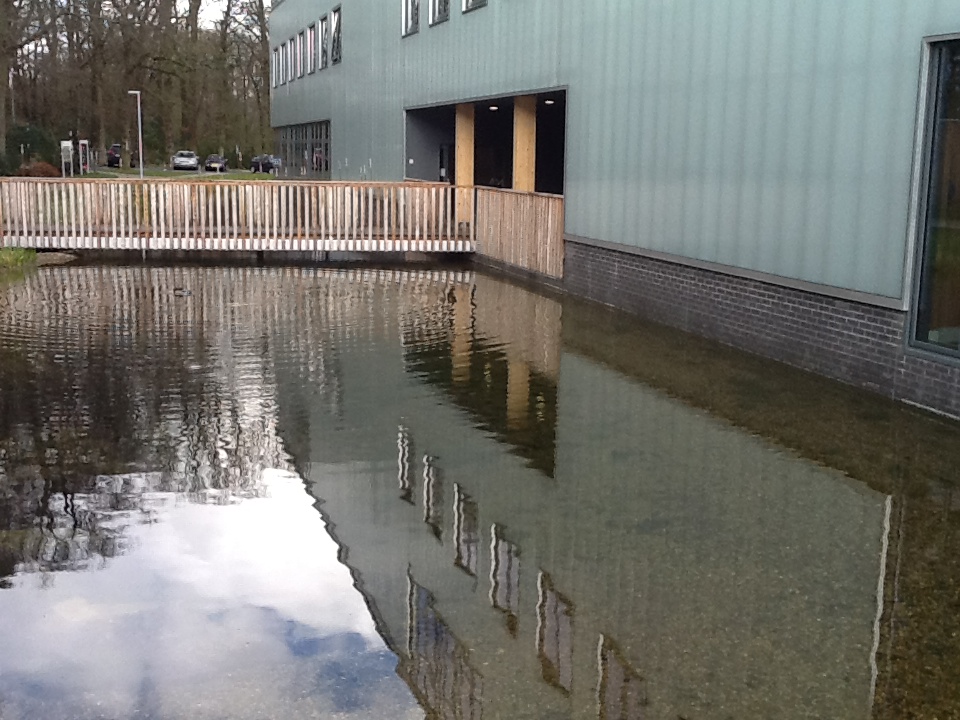
The first is set at the LICA building. The audience stands on the bridge outside. a dancer can be seen in the lobby area of the building. She is filmed by a camera above her. Her movement describes a space she is trying to get out of, looking up to the camera as though she is stuck beneath a glass surface. her image is projected onto the water, so that it looks as though she is trapped below the water’s surface. the audience can see both a profile of the dancer in real life and in real-time and her projected image on the water.
The second in outside the Nuffield theatre, where I use two false window frames (ie frames that are set into the stone work, but then filled in with bricks) as the frame for the image. A dancer stands below a tree in the adjacent square. She is captured from a camera in a window above the audience’s standing area. Her image is projected into the frame of the window. She moves as though she is looking down into the audience’s space from above them, and holds onto the side of the window ledge etc watching as people move below her – eventhough she is actually only to the side of them. Watch a video of this here:
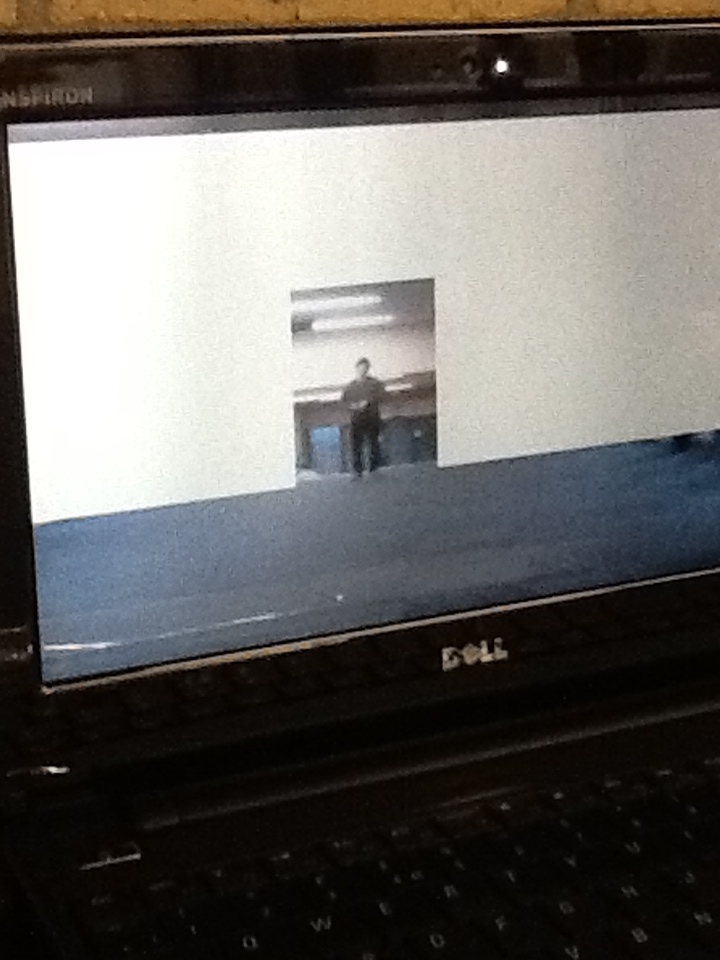
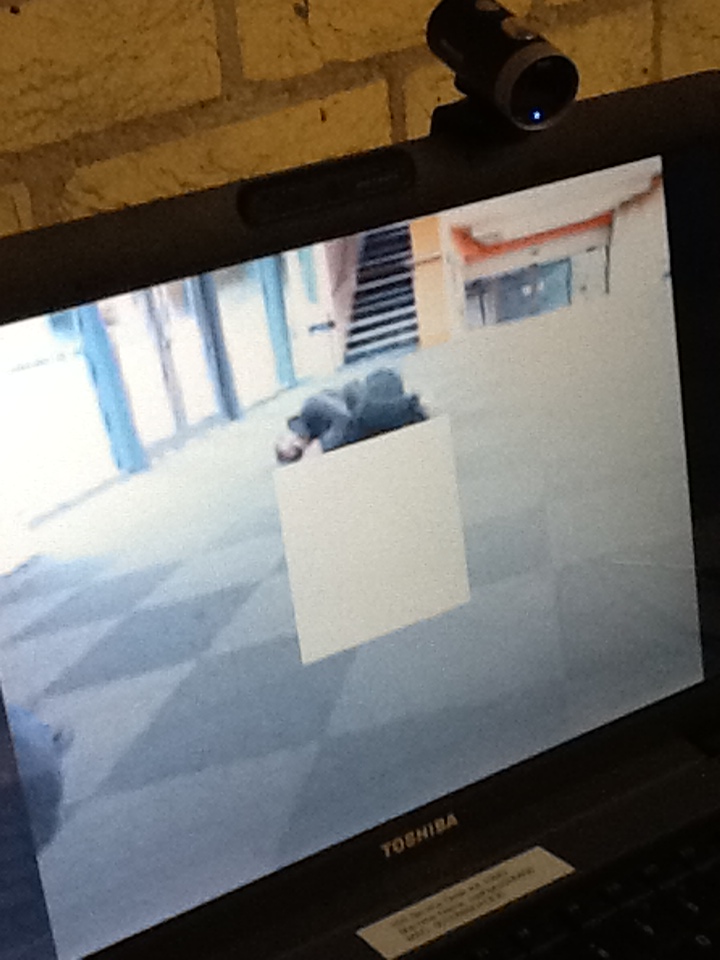
The Faraday foyer. the attached image of the screens shows the set up here. Three adjacent LCD screens show a camera view of the space infront of them. The pics A B and C show the image that is shown on each screen. In A an imaginary door frame is superimposed on the image of the real space. In B a Box is placed in the space. In C a frame. The dancer has to interact with each “object” without losing the illusion in the space.
View a video of this here:
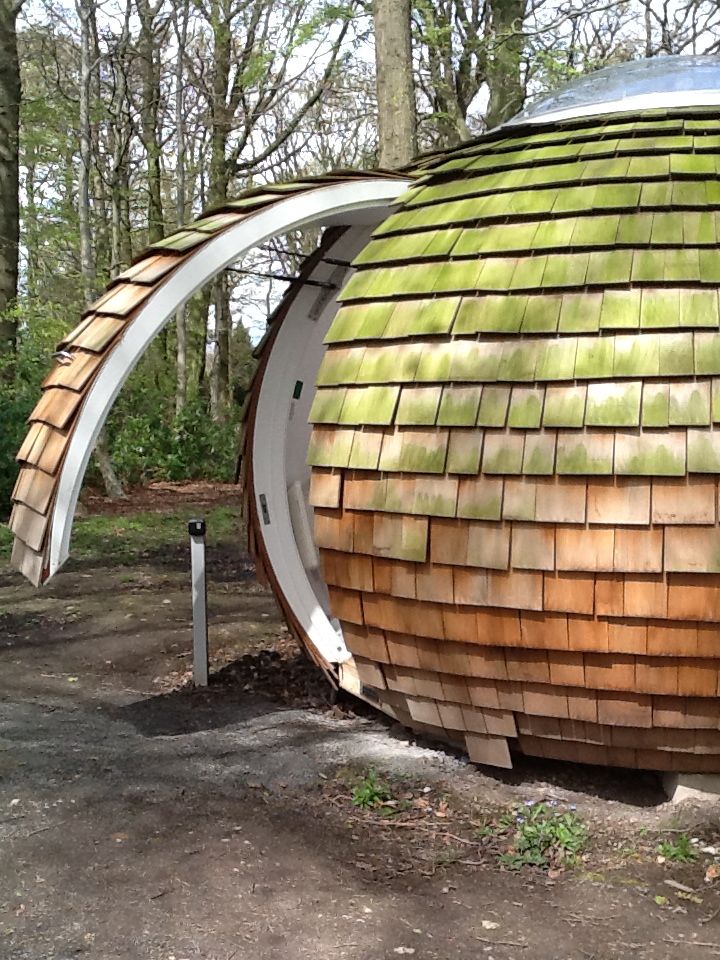
The last installation is set up in a POD (see outside view picture). The picture of the actual piece was taken in daylight so is perhaps less effective. here I decided to use pre-recorded material taken inside the LICA building, where the dancer is looking up at the camera. I will also be capturing some material from the nuffield window to place onto the card shape. I still have some work to do on this set up, since I’d like to find an object that really holds the shape of the movement. My idea here was to take the same idea of using the projected surface / structure as the motivation for the movement, but on a small scale, investigating the space offered by the objects, as mini structures in themselves.
View a video of this material here:
The theme through the piece is this notion of displacement between the live movement in the real space and the space that it appears to interact with, ie: the projected space. I am interested in how the set up directs the dancer’s movement.  Watching the dancer attempting to fit into the spaces, for example, the way she feels restricted even though she is standing in an empty space. It gives her movement a task based quality, and her performance presence a feel of concentration and focus. It’s performance but with a very real and necessary motivation, as opposed to having a dancer just moving around in arbitrary patterns.

Support a New Arts Project and say WeDidThis

This is a Square, Strange Loop May 2011

Ten days ago I launched a fundraising initiative through the crowdfunding platform WeDidThis. I am aiming to raise £2,000 towards the production costs of Strange Loop. Last year I received some funding to carry out the research for this project. The work just needs a little extra money to take it up to production level. I am aiming to show the work at different venues around the UK over the course of 2012, but I need your help to get it out there!

Please take a moment to watch the pitch video on the WeDidThis website:

strange-loop

Crowdfunding allows members of the public to make small donations directly to artists to help them develop a new work. Contributions can be as little as £10 and result in a reward that is linked to the project outcome.

Now I know how annoying it is to be hassled for money. I can assure you that having to ask for money is just as frustrating. My heart sank at the prospect of having to turn into a sales person for my own work. But this is not just about raising the money.

Like many artists out there I spend around 80% of my time filling out applications for funding, opportunities to carry out research, opportunities to perform work…. After spending the better part of three months writing endless applications, all of which were unsuccessful, I realised that crowdfunding was, perhaps, the only way forwards. The reason for this is that so many selection processes boil down to personal taste, perception and who you are up against, all factors that are beyond anyone’s control. If you’ve read Leonard Mlodinov’s The Drunkards Walk, how randomness rules our lives, you’ll understand how so many of the decisions being made about what book gets published, which film is produced or which actor gets the job are rarely based on good judgement alone. More than that, their success is not always down to a trained eye, or good decisions, but are more often the result of statistical processes. I won’t go as far as to say that our whole lives boil down to where we figure in a sequence of numbers, but well, that is almost very much the case.

So how do you escape your own statistical destiny? Luckily, there is such a thing as personal agency: our ability to stand up against the bad numbers and tell them where to go. Crowdfunding is about just that. It’s about cutting out the middle men and institutions  (bound by their own selection criteria, politics and institutional aims*), and supporting work just because it ticks your box. Watch the video, read the pitch. If you like the work then help it get off the screen. You can be a part of a project that reaches more people around the UK and Europe and have a chance to say that You Did This.

Thank you

Marguerite

* This is not to say that institutions are wrong to have these limitations, or that they are not effective as a result of them. On the contrary, many arts organisations aim to help as many artists as they possibly can. They’re simply oversubscribed, so they can’t be expected to produce absolutely everything 🙂

Strange Loop

Introduction

In April and May 2011 I carried out a research project, Impossible Spaces. The research received backing from DanceDigital and the Arts Council England and resulted in a work in progress, Strange Loop.  The work involves live projection in performance, where the projection is a live relay of the performance space, slightly adjusted by the use of interactive software, to create small differences between what is happening live and what is shown on the projection. My aim was to use the flatness of the projected image to extend the real space and bring about relationships that would not be possible in a 3-D environment. The resulting work in progress was a play on cause and effect, confusing the viewer’s sense of space, time and perspective.

An interview by Dance Digital explains the ideas behind my work with excerpts from Strange Loop:

What is a Strange Loop?

When I started developing this work I called it “Impossible Spaces”, a modification of Escher’s “Impossible Buildings”. Whilst rummaging around for material on Escher I came across Douglas R. Hofstadter’s thesis entitled “Godel, Escher, Bach: An Eternal Golden Braid” In it he describes the notion of “Strange Loops”:

The “Strange Loop” phenomenon occurs whenever, by moving upwards (or downwards) through the levels of some hierarchical system, we unexpectedly find ourselves right back where we started. (Hofstadter, 1979)

In plain language a ‘strange loop’ is an object, a statement or a situation that contains a contradiction in itself. The most well known strange loop is the liar’s paradox, summed up in the statement: “I am lying”. If I was actually lying then I am not actually lying. But If I was saying the truth then the meaning of the statement must be false. The Mobius strip is another example, as are several of Escher’s sketches.

Strange Loop, a work in progress, May 2011

So what did it look like? Here’s a short clip of the work in progress:

Moving On

It’s been five months since the project was wrapped up. In the meantime I have been to the Interaktionslabor in Saarbrucken and the fabulous Digital Futures in Dance Symposium hosted by DanceDigital, Southeast Dance and Pavilion Dance in Bournemouth. Whilst watching, listening and thinking about the way forward, I feel that I’ve finally been able to pin down my own specific identity within this broad field of technology and live performance.

  • At the moment my work involves an integration of live video projection in a performance context. Dance is my background, the body is my starting point, but it’s a body placed in space and sometimes defined, perceived and manipulated by that space. The idiosyncracy of the work derives from this re-examination of the body’s relationship to the space it inhabits.
  • I use some digital technology to carry out real-time video processing. But the emphasis is on facilitating an interaction between the live dancer and their virtual counterpart.
  • I do not use the projection to create a new space behind the dancer. I do not project a dance film behind a live dancer and aim not to use any pre-recorded material in the performance.
  • Throughout the work the audience should witness an intersection of the two spaces: the real space with the virtual space.
  • I am concerned with developing an interdependency between the real dancer / space and the projected dancer / space, so that they both need each other in order to exist.
  • I question what this relationship does to the movement exploration. How does it expand the performer and viewer’s perception of space? What effect does this new space have on the dancer’s movement and performance presence? How can these be amplified and extracted?

Impossible Spaces – a digital dance research project

Introduction

During 2011 I will be working on a digital dance work as a bursary artist at Dance Digital, Essex. My aim for this project is to develop an interactive performance / installation, that explores the notion of “Impossible Spaces”.

Inspired by M.C. Escher’s impossible buildings, the Impossible Space will use the two dimensionality of the projected image to extend the real space and bring about relationships that would not be possible in a 3-D environment. The projected image will show an aspect of the real space, put into a configuration that reacts differently to the ways we expect. The main technical challenge will be working out how to make this set up interactive, so that the environment changes with the movement in the space. Artistically I face the challenge of bringing to life the self-reflexive situation, bending the logic of space through the intersection of different planes, like a Möbius strip that folds back on itself. Escher is a key influence, however so are the works of the visual artist Dan Graham, such as Present, Continuous, Past(s) (1974) which uses mirrors and live video relay on a short delay to bring about an interaction between the viewer in the present and immediate past.

The process will be documented on the dedicated blog page of Dance Digital which can be accessed on the following link:

http://margueritegalizia.dancedigital.org.uk/

Impossible Spaces is made possible through a Dance Digital Artist Bursary and is supported by the National Lottery through Arts Council England.