In August 2011 I will be travelling to Gottelborn in Germany to participate in the International Interaktions Lab, lead by Johannes Birringer.
Located in a converted coalmine in the West German region of Saarland, the centre is equipped with technical facilities as well as live-in accomodation for artists attending the lab. It was set up by the multi-media performance artist Johannes Birringer, who co-ordinates and leads the annual research lab event.
During ten days in August, the international Interaktionslabor in Göttelborn collaborates with XMLab and Donlon Dance Company on creating a new PERFORMANCE ACADEMY, a shared platform of workshop spaces and research facilities for performance-media design, interactional and wearable concepts, and investigations of gestural processes, protocols, and social choreography.
With its partners XMLab and Donlon Dance Company, Interaktionslabor shares the sense that the concept of research should be opened up (again), and aims to acknowledge the relevance of experimental treatments of actuality – of forms of collaborative creation – that may take us beyond the perspectives and protocols of (established academic) inquiry as we know it. Which is why we have chosen gesture as focus of the inaugural workshop – gesture as practice that is at once aesthetic, corporeal, and political.
Interaktionslabor is a laboratory for interactive media, design, and performance, founded by Johannes Birringer in 2003 on the site of the former coal mine Göttelborn (Saarland), and developed over the past nine years into an annual summer residency-workshop for performers, media artists, filmmakers, engineers and writers from different artistic and cultural backgrounds, always open to participants’ ideas, processes and project proposals that nurture collaboration and research as well as the building of transcultural networks. At the end of the workshops, which are housed in the beautifully renovated industrial spaces of the Coal Mine (participants also live in new Guest House on the mine campus), Interaktionslabor has exhibited works in progress as well as co-produced new installations or performance later premiered in other countries. The lab has been invited to Brasil and the US, and now enters into a new phase of collaborative research exchange and partnership in the Greater Region.
Interaktionslabor 2011 Press Release
Birringer’s focus on the artistic questions that arise from working in a digital environment are particularly relevant to my work at this stage. My ten day stay will be documented on this blog.
The travel cost of this project is supported by the Lisa Ullmann Travelling Scholarship Fund. The research laboratory itself is covered by a bursary from Dance Digital.
Whilst watching Siobhan Davies and Matthias Sperling in rehearsal last week, I began thinking about the reasons / implications of this way of working. For those of you who did not see it, Davies and Sperling’s hour-long rehearsal / discussion was broadcast live via web link. The public was able to follow the discussion and contribute to it by posting their questions. I couldn’t help being intrigued by the number of questions that arose from two people talking about a dance performance that no one had seen. (because of course it has not been performed yet.)
At the moment several choreographers and companies are trying to open up that studio process by allowing the public to interact via live screening of rehearsals. But does the time in studio constitute all of what we do? Many of us are lucky to be able to get into a studio and try things out, without having to fork out money to pay for space. So a lot of our process has to happen else where. Of course the time in the studio is important. But so too are all the endless hours leading to and preceding the work in the studio. A number of questions have come out of these thoughts. Have you got any answers?
How do you arrive at making?
I know Siobhan Davies proposed a similar question in a series of talks last year. My question is really based on physical exploration. How do you bring yourself to that creative space that is grounded in movement? Do you go to classes? Do you watch dance works? Do you think about movement?
How do you keep the studio time open?
How often do you invite external feedback into your process? How do you maintain some form of perspective? How do you remain relevant to the current dance scene?
In December 2010 I attended a workshop with Joao Fiadiero in Real Time Composition. Here were my thoughts immediately following this workshop:
This week I attended a research lab with a dance artist called Joao Fiadiero. He calls his work Real Time Composition. It has some resemblance to a group improvisation or a devised theatre piece, however he insists on some very particular details. The idea is that as a group we work to develop a line of thought (emergence) and sustain that to the point of collapse. Communication is completely non-verbal during the actual composition. However after the process he would dissect each move and discuss whether it was the strongest option or not.
We had a lot of problems with various members in the group either willfully or unknowingly sabotaging the work with their own ideas. Luckily towards the end of the week this somehow resolved itself with these individuals becoming quieter, participating less and in one case not returning to the sessions.
The process of composition involves making choices. In a group situation this is complicated by the question of others intentions. To remove this problem Joao has three rules. The work starts with someone providing an initial image / idea / action. It’s direction is not clear. So the first rule is to inhibit one’s impulse to act on a situation, to consider all the possible next steps and then to decide how to contribute. Of course if your initial idea still seems to be the best option then you can go with that. In the mean time someone else may have already contributed a second action. This second action gives the first action some direction. In this instance everyone has to re-adjust their minds to the situation and take in this new information, letting go of the previous idea. Letting go is a second rule. A third action confirms the direction and establishes a line of thought, what Joao calls a “Tube”. Now the whole group contributes to this tube of thought taking it to the point of exhaustion or collapse. The third rule is to do with making a change. The tendency will be to try to see something different, to originate a new idea before the previous thought is completely exhausted. If everyone did this then the direction of thought would never be established, the work would keep falling apart at the third action. So Joao’s third rule is to do with when a change should take place. This, for him, should not be a question of individual choice. It should be a necessity. You can initiate a change when you run out of resources, when an accident happens that changes the situation or when the material begins to loop. An accident could also mean that someone in the group misinterprets an action generating a new line of thought, for example. Or if something placed in the space accidentally falls. This brings about a divergent strand of thought, a new paradigm, which grows into another tube.
This notion of emergence and divergence occurs naturally in evolutionary and social theory. And of course it has many obvious applications to composition, creativity, scientific research etc. But I felt it resonated strongly with the question of choices in life. If 90% of your life is out of your control, then the question of autonomous decision-making needs to be adjusted. You cannot expect all the things that you want to happen, or all the things you work for to pay off. You could keep attempting to construct your life, but the truth is that this would take a lot more energy then necessary and it is simply inefficient. So the best solution is to make decisions based on the way things are, and to learn how to let go of your intention when accidents arise, to learn how to reconsider your options in the light of this new information and to discern whether it would still be valid to continue with your original intention or if that pathway has now ended and your energy could be more efficiently used in another direction.
The clarity of this image has resonated strongly with me on both an artistic and a personal level. During the course I was running off to teach every evening. One evening, following the second day of workshoping I realised how deeply I had been invested in the work. The whole day had been spent practicing RTC by breaking down every single move. Analysing each contribution, and inhibiting every impulse to act. That evening I turned up to teach my class, intending to go through my usual class format. At the end of the class I realised that I had only been able to get through what would normally take up only 15 minutes of the class. My sense of time had been completely distorted, and the number of options at each stage in each exercise had multiplied tenfold.
I know Joao’s workshop will have a long-lasting effect on me and my work.
During 2011 I will be working on a digital dance work as a bursary artist at Dance Digital, Essex. My aim for this project is to develop an interactive performance / installation, that explores the notion of “Impossible Spaces”.
Inspired by M.C. Escher’s impossible buildings, the Impossible Space will use the two dimensionality of the projected image to extend the real space and bring about relationships that would not be possible in a 3-D environment. The projected image will show an aspect of the real space, put into a configuration that reacts differently to the ways we expect. The main technical challenge will be working out how to make this set up interactive, so that the environment changes with the movement in the space. Artistically I face the challenge of bringing to life the self-reflexive situation, bending the logic of space through the intersection of different planes, like a Möbius strip that folds back on itself. Escher is a key influence, however so are the works of the visual artist Dan Graham, such as Present, Continuous, Past(s) (1974) which uses mirrors and live video relay on a short delay to bring about an interaction between the viewer in the present and immediate past.
The process will be documented on the dedicated blog page of Dance Digital which can be accessed on the following link:
Another Dance Umbrella season, another chance to witness the world’s most renowned dance artists packed into a month-long festival. It’s easy to get lost in this dance maker’s heaven. Whilst I’m still mesmerized by Trisha Brown’s repertory evening and still laughing from Matteo Fargion and Jonathan Burrow’s ‘Cow Piece’, one work that struck a deep sounding chord for me was Ros Warby’s performance of ‘Monumental’ last night.
I say “last night” with a specific intention. The performance tonight will be different. It’s an indeterminate work. Warby’s association with the American choreographer Deborah Hay resounds strongly in her creative practice. Like Hay, Warby refuses to fix material. Instead she works through the piece, generating material as she goes along. To do this she says she is constantly reading the layers of elements that inform the present moment: the space, the audience feedback, the projected images (birds in flight, birds crashing into the sea, birds dying) as well as the thematic elements. She uses the structure (lighting cues, costume changes, visuals and sound) to frame her performance explorations. The piece retains its identity through these fixed markers but it also remains open to differences capturing the vulnerability of the moment of making, its rawness and the hightened performance presence that this brings to the work.
I was particularly interested in the way she classified this work. This, she says, is not the same as improvisation. For Warby, an improvisation is a tool for searching material from the body. The awareness is more open to anything. Whereas, her performance practice has a more channelled focus. She doesn’t call herself a choreographer either. She says that choreography is what results from the interplay of the elements of the work, in which her collaborators play an important role.
Warby’s approach to making work is one to envy. She never starts from a concept. In her own words, themes “arise from the floor”. One member of the audience asked very poignantly how she is able to secure funding for a work that has no definite starting point. Her reply was that her applications talked about the basis of her approach and the importance of her collaborators.
I spent some time trying to work out how my own work fits in against that of Warby and Hay. This is what I think: Whereas Warby’s work is clearly indeterminate, it is not about indeterminacy. Like Swan Lake, for example, is not about the ballet technique, but about the tragic love story, so Warby’s ‘Monumental’ conveys the themes of strength and vulnerability in the imagery of soldiers and swans, through the medium of an indeterminate performance practice. Does our knowledge that the work is not fixed affect our appreciation of it? Would the work resound as strongly if it were all set? Rhetorical questions perhaps. In TV solo I am trying to draw out the indeterminacy as a key feature of the work. It would be like making a ballet piece about the process of making a ballet piece, to use the same comparison. The question I can’t help asking myself is: am I just years behind Warby, or am I simply on another track?
This solo work started off as a research concept during a residency at Clarence Mews in August 2010. Having scraped the surface of the notion of indeterminacy I took my first steps towards developing a solo that involved some degree of indeterminacy within its structure. More details of the work will be coming soon. I am aiming to perform the work informally at some point in October – November 2010.
Impossible Spaces
I am very excited to announce that I have been offered a bursary from Dance Digital in Essex, to develop an interactive performance / installation on the notion of “Impossible Spaces”. Inspired by M.C. Escher’s impossible buildings, an “impossible space” is one that does not add up. It makes use of recognisable elements put into a configuration that reacts differently to the ways we expect. My interest is in identifying how we navigate and re-orient ourselves in a space that is both recognisable and different.
I am really looking forward to this exciting opportunity to develop my work with projection in performance. The project will start in November 2010 and run till the end of May 2011, with performances towards the end of the research phase. I intend to keep a running log of this project on my blog page, so watch this space for further details!
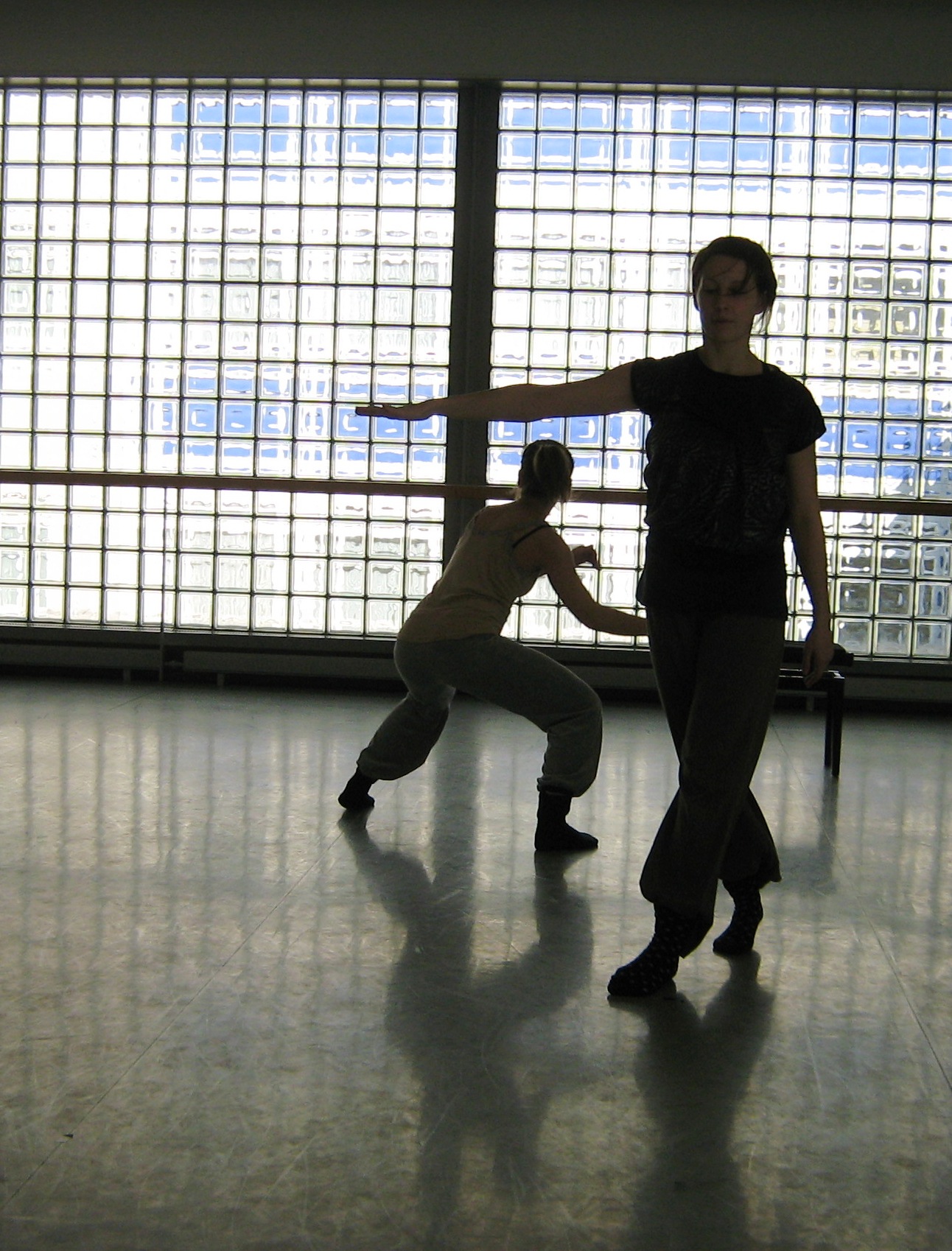
Sami Cotton and Andrea Just in rehearsal for Score for Four
Introduction
In June 2010 I completed my Masters in Choreography at LCDS. It was a process fraught with the stress of attempting to create a substantial work, to develop a clear and distinct artistic vision for the future, whilst working in practically impossible circumstances. These restrictions and expectations bore down heavily on my process and clouded my approach in a way that overshadowed the potential of the work. After a few months of rest I feel a renewed excitement in the concept of the work and feel the need to engage with it on another level. One of the major disappointments during the process was that I was unable to engineer some kind of peer feedback. This left my thought process incomplete and tangled. I feel that articulating creative practice is an essential aspect of making. It places work in a context and challenges you to develop stronger methods of communicating, and ultimately achieving, your aim for a work. I set out here to redress this, by offering my thoughts on this process and inviting your own comments on the scope of this work. This is slightly different to asking for feedback on a piece. I’m asking you to engage with this work on a conceptual level. My main aim is to answer the question: what is ‘Indeterminacy’? What does it mean to me? And why I do I feel that it offers a fresh approach to choreographic and performance practice?
Solid Vs Liquid
It’s tempting to throw the term “indeterminacy” around like some catch phrase on a marketing pamphlet. But I argue here that the term has a very specific meaning which, in application, has had a profound impact on my creative practice and my thoughts on the identity of art work. Firstly, something that is indeterminate is not unspecified; it can have very clearly defined properties. However, unlike something solid, that has a fixed shape and size, an indeterminate object has boundaries within which it operates in a state of flux. It is dynamic, fluid, unpredictable. So too is performance art, dance, live music and live acting. All events that take place in real time are open to indeterminacy. Can any two renditions of a dance piece be exactly the same, even if the choreography is completely set? When visual artists refuted the commodity value of art works they turned to performance practice to develop work that was ephemeral. It seems strange that dance artists attempt to solidify their work by turning it into repertory, attempting to reproduce the same thing on each performance. I acknowledge that there is historical value in reproducing past works and appreciate that repertoire is an essential factor in developing a commercially viable practice. However, I wanted to highlight the instability of performance practice. I wondered if I could do this whilst still making a choreographed work.
Improvisation
How is this different to improvisation? Improvisation is clearly indeterminate. It offers parameters within which an interchange takes place. These parameters maintain the identity of the work, they give it shape. The number of times people wrongly assume that improvisation is totally free displays a widespread misunderstanding of the form. It takes an extremely experienced artist to be able to read the space and contribute effectively without falling into habitual, self-indulgent waffling. My vision for my own work was to retain the immediacy and engagement of improvisation within a choreographed work. I visualised the pre-set, choreographed piece as an intricate weaving line, contained by a set shape. It carves around the space; it is intentional, known, and impermeable. The improvised work looks like an empty square. It invites, proposes, allows the dancers to bring in their own purpose, it is unknown, a potential. I wondered if I could impose my own squiggles, lines and purpose without fixing the actual shape of a work, like drawing something on a canvas but then allowing the frame to be fixed at random. This was the image that drove my experiments with four scores, resulting in Score for Four (2010).
This work was not, however, the clearest example of the scope of indeterminacy. I complicated my brief by selecting too many scores in the first place and created some confusion as to whether or not I was creating a piece based on scores or an indeterminate work. But before I go into this let me clarify what indeterminacy means in relation to historical avant garde practice.
Composition Indeterminacy
The term indeterminacy is applied to many different applications of “randomness” in the performance or process of making a work. The notion of “randomness” derives from the fact that choices are made that are in some way beyond the control of the maker and result in outcomes that could not have been achieved otherwise. There seem to be two main categories within this field. Firstly, a work may involve indeterminacy in the process of making. This means that rather than making choices about every detail in a work, the artist refers to some other mechanism by which components are structured. John Cage and Merce Cunningham’s experiments with Chance Operations are a clear example of this form of indeterminacy.
The chance procedures used by Cage in the early 1950s, exemplified in his seminal work Music of Changes (1951), displaced his control on some aspects of the composition by referring to the Chinese Book of Changes or the I-Ching. To do this he generated three 64 cell charts which related directly to the 64 Hexagrams of the I-Ching. The three charts related to “sonority, duration and dynamics” (Pritchett, 1993, p 79). Every aspect of the music was determined by throwing three coins. Cage consulted the I-Ching to find the associated hexagram, leading him to the equivalent cell, which determined the sounds to be played. Through these complex procedures Cage removed his subjective inclinations from the process of composition allowing sounds to emerge from beyond his pre-conceived ideas. (Pritchett, 1993, p.83).
(Excerpt from my MA Dissertation, June 2010)
Cunningham / Cage
Merce Cunningham carried out similar strategies to generate his dance works resulting in the decentralisation of space and a movement vocabulary that defied a dancer’s instinctive sense of flow. However, like Cage’s early chance experiments, Cunningham’s choreographies were always set before the performance. The dancers were not involved with making decisions in performance. It is true that the combination of sound, movement and set was left up to chance. Cunningham did not rehearse his work to Cage’s music. The different components shared the same space and time, resulting in chance combinations in performance. Did these combinations change from one performance to the next? Cage’s later works did move away from completely set scores, allowing some room for difference, however Cunningham’s choreographies never ventured into this territory. I argue that the Cunningham / Cage equation did result in some surprising, random combinations of music and movement. However, the significance of this was in the liberation of one from the other, the idea that any visual could accompany any sound. It did not penetrate the dance performance itself. In fact the two remained defiantly separate.
Performance Indeterminacy
This brings me to the second category of indeterminacy: performance indeterminacy. Cage himself describes this in his 1958 essay. This second category requires aspects of the work to be left open to the performer’s choices in performance. It results in works that differ from one rendition to the next, although the extent of this difference depends on the amount of control retained by the artist or renounced to the performer. The European composers Pierre Boulez and Karlheinz Stockhausen, for example developed ‘Aleatoric’ scores where set motifs are given to the performer who navigates the score at will in performance. This leads to recognisable material occurring in a number of different combinations, a format also used by Trisha Brown in Locus (1975). More radical examples of performance indeterminacy occurred in the ‘Open Form’ work of the composer Earle Brown and the later works of John Cage.
In summary, performance indeterminacy results from the creation of possibilities within a score, in order to facilitate variations between the different performances of the work. To dissect this further, if the elements comprising a composition can be separated into content and structure then it follows that there are three possible combinations that could result in indeterminacy: structure can be open whilst the content is set (as in Stockhausen’s Klavierstrück XI andBrown’s Locus); structure can be set, whilst the content is mobile (as in Morton Feldman’s Intersection 3); both structure and content are open (as in Earle Brown’s Four Systems).
(Excerpt from my MA Dissertation, June 2010)
Scores
Note the relevance of scores in this context, an aspect that greatly complicated my own investigations. In musical composition the score embeds the composer’s purpose for the work. Using ambiguous visual scores was one means of bringing about difference in performance. (As in Earle Brown’s December 1952). I was greatly influenced by the work and writings of Fluxus artists, especially that of Ken Friedman, who offers his scores freely for reproduction. He calls the difference in each reproduction of the work its “musicality”. Another influence on my study was my exposure to Matteo Fargion’s work with scores. Fargion’s ethos is to ground choreography in more objective compositional choices, rather than simply playing around with material in space and seeing what happens. During a workshop with the composer, he asked us to write out a score by which two people walk across a space and back. Even within this limitation a number of possibilities become available. The difficulty is to introduce each change at the right moment, preventing the audience from losing interest in the work as it develops. I wondered whether it was possible to achieve this same rate of change without actually setting it. This involved displacing my control through the use of rules. In this way a dancer’s decision to move from one vocabulary into the next was determined by the activity of their corresponding partner. By introducing conditions by which a dancer could chose to make a change, I retained some sense of cohesion throughout the work, whilst allowing for some mobility from one performance to the next.
Rules
This shift from the word ‘Score’ to ‘Rules’ is an important one. A rule is bound to the material by which it can be realised. The rules to a game of monopoly will make little sense to the chess player. Musical scores abide by a set of rules by which they can be interpreted. So the score itself is not necessarily the rule book. This is highlighted by the fact that many Fluxus scores are accompanied by several composers’ notes to aid the performer in their interpretation (the rules of play). Had I noticed this earlier in my process I might have abandoned my talk on the use of available scores, and sought to illustrate instead the ways in which what I was actually attempting to do was change the rules by which those scores had been developed.
The Identity of Indeterminate Works
This notion of rules brings me to my final question. When a piece is performance indeterminate, where does its identity lie? Does the actual work exist in the form of its multiple possible realisations, or in the rules that bring them about? This question could be applied to Deborah Hay’s Solo Commissioning Project, during which dance artists commission Hay to develop a solo using the blueprint of one of her own works. The differences between the solos result from the artists’ individual choices within the given structure bringing about solos that are specific to the individual choreographer / dancer. These different solos are given a character, flavour and title by each artist. They result from the same rules. Are they the same, or are they different?
Conclusion
I’d like to leave that question open, partly because I know I am under-qualified to address Hay’s work and partly because I know that this solo format differs slightly from my own interests. I know that my aim is to create works that are complete, finite and identifiable as themselves, but which allow for some mobility from one performance to the next. My reasons for this are not simply to challenge the question of choreographic authority or ownership, though this certainly seems to hang around the notion of indeterminacy. I feel confident that my voice is clearly evident in the rules that I prescribe. But in expecting the performer to work with those rules within the performance, I hope to draw out a more realistic and engaged performance presence and to develop works that are, to some extent, unknown to me, liquid, permeable. My last work touched on ways of achieving difference. I set material and opened up the structure. I set the structure and opened up the material. I also applied the possibility of difference through the errors of memory. My research concluded as follows:
The point of this research is to demonstrate that indeterminacy can be integrated in the process of composition and in the performance of choreographed works. This can lead to unpredictable outcomes and a more engaged performance presence, which were my main interests in this work. In its more radical interpretation, indeterminacy presents questions of identity and authorship due to the contribution of the performers. The re-instatement of my control at various points in the process removed this concern in Score for Four. There is, however, a further conceptual aspect of indeterminacy which makes this approach significant to me, relating to its ability to present more than one outcome. This challenges the assertion that an artwork must present a single, completed and pre-selected perspective. Instead it presents multiple possibilities by which the work can be explored, highlighting the notion that a work’s identity lies somewhere between the artist’s intention, the performer’s contribution and the viewer’s perspective.
a research piece that explored the relationship between real and virtual space through an integration of projection on a live relay loop with live performance. Placing a camera and live projection within a performance space resulted in a multiplication of spaces and time frames, and a fragmentation of experience
Whilst maintaining a fairly simple use of effects, small adjustments were used in order to create differences which facilitated an interplay between the live and projected movement. Continuing my own artistic practice, TriAd displayed an interest in the geometry of the space brought about by the material and immaterial lines and patterns generated by the different elements of the work. Whilst my initial aim was to integrate the two spaces, I became interested in the decidedly A-centred nature of the piece, where the layers were never fully reconciled to each other. The incorporation of camera, lights and projector within the stage set created an interest in the operational space and a consideration of the role and positioning of operators within the piece.




 Marguerite Galizia