The Wit(h)ness Scores


When I first began to work solo, I was driven by a need to reclaim my identity as a dance-maker and to ground my making in the material of my performance. The crafting of dance, so often credited to the authoritative notion of a ‘choreographer’ (detached, aloof, all-knowing) and the performance of that dance which is so often left to the dancer (the people who get their hands and feet dirty….literally), could not be separate anymore. I called this approach to dance-making the practice of self-choreography, where ‘self’ is both the material and the relational starting point (though not the end point) of a choreographic process.

When I began to perform these self-choreographies, another hierarchy emerged: it was the hierarchy that placed me, performer/ maker, at the centre of an audience/ viewer’s attention. After all, if you are the only one dancing, what else might you expect? I had a feeling that this, too, was undesirable. An audience that came to watch me dancing solo might be disappointed at the ordinariness of my movement. (Rainer’s Trio A, 1966, beautifully challenged/s this expectation). Another layer is added by the mere fact of being a woman dancing solo, bringing up questions around the male-oriented gaze, the disconnection, confrontation and objectification that might result… even when that audience/ viewer is another woman/ women. How could my self-choreography be an invitation to a wider awareness? How could it challenge our ways of seeing, by making a proposition to be with instead?

A series of hunches and accidents led me to two specific approaches that gave me a way in, a vocabulary to address this problem.

The first were Mary Overlie’s Six Viewpoints practices, which I learnt through Deborah Black’s virtual viewpoints workshops (Oct-Dec 2021). Black’s virtual sessions began with 5 minutes of rolling around on the floor, bringing the brain down onto the same level as body in a symbolic grounding, before focusing on one specific ‘viewpoint’. Overlie identified 6 ‘viewpoints’ of performance: Space, Shape, Time, Emotion, Movement and Story (the 6 SSTEMS ) constructing various exercises through which the performer foregrounds one mode of attention. Black describes it as an ‘er’ practice, a pre-practice.

Working through the practices I noticed that dance is often only ever focused on one of the materials: movement … no surprise there. Dance performance and dance-making often prioritise moving and movement as the primary focus of the choreography… but what about the other materials of performance? By swapping my focus from my movement to my presence within space/time, by swapping my attention from myself as a shape-maker to myself as just another shape-time within space, suddenly the potential for a horizontal attention opens up, and by extension, an awareness of others-in-space/ others-as-space, others-as-time, others-as-emotion etc. Overlie described the audience as a piano, but I would go further, I would say that in the practice of self-choreography, the audience is the relation to and through which the choreography emerges. They are another material of performance.

Which takes me to the second influence in this process of articulating my practice: the writing of the feminist artist, psychoanalyst and theorist Bracha Ettinger. I came across Ettinger’s writing by chance. It was a google search around my key word: ‘witnessing’ that led me to an online article discussing our consumption of images of war. Ettinger was exploring how the notion of a ‘matrixial gaze’, one that is open to resonances from the other, differs from the disconnection of the phallic gaze. Coming back to that text over and over, I realised that there might be something here that needed a serious amount of my time. So I decided to step out of my reading on ‘post-modern improvisation practices’ and read as widely as I could around Ettinger’s work.

Ettinger reclaims the feminine imagery of the Matrix, etymologically linked to the uterus, to describe the situation of ‘relations-without-relating’, a process of ‘wit(h)nessing’ via/through the ‘matrixial borderspace’. Extending the practice of ‘witnessing’ into one of being with via the term ‘wit(h)ness’ naturally resonated with my intention as both a performer and witness to my own performance. I had noticed that my performance was different when confronted (a deliberate term) by an audience. I was acutely aware of them in the space with me, sharing the same ground. I described this awareness as a ‘bi-directional witnessing’.

The term ‘witnessing’ has a strong link to somatic movement practice, especially through the framework of Authentic Movement, which leads to the development of the ‘inner witness’. In their CAP process the dance-artist-researchers Jane Bacon and Vida Midgelow talk about developing a ‘dual awareness’. There is a shared language across these practices and what Ettinger is describing, perhaps not unusual seeing as Ettinger and Authentic Movement are drawing from / contributing to the field of psychoanalysis. Yet, I am aware that I need to tread carefully into the lesser known territory, knowing that my engagement with these ideas is still naive.

The result of these two influences has been the development of what I call my ‘wit(h)ness scores’. Performed-with a mobile/ semi-mobile audience, the score aims to draw attention to a wider field of awareness in which the performer is only one point of relation. Yes there is a distillation of the practice (I hope) through my performance. But I am not necessarily in the foreground. My question to my with-nesses is: in this shared Border-Space, am I really the only one dancing?

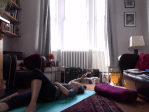
Image: ‘Am I really the only one dancing?’ – performance of a ‘Wit(h)ness Score’ at the SPA Conference 2023, Valletta, Malta
The Wit(h)ness Scores

When I first began to work solo, I was driven by a need to reclaim my identity as a dance-maker and to ground my making in the material of my performance. The crafting of dance, so often credited to the authoritative notion of a ‘choreographer’ (detached, aloof, all-knowing) and the performance of that dance which is so often left to the dancer (the people who get their hands and feet dirty….literally), could not be separate anymore. I called this approach to dance-making the practice of self-choreography, where ‘self’ is both the material and the relational starting point (though not the end point) of a choreographic process.

When I began to perform these self-choreographies, another hierarchy emerged: it was the hierarchy that placed me, performer/ maker, at the centre of an audience/ viewer’s attention. After all, if you are the only one dancing, what else might you expect? I had a feeling that this, too, was undesirable. An audience that came to watch me dancing solo might be disappointed at the ordinariness of my movement. (Rainer’s Trio A, 1966, beautifully challenged/s this expectation). Another layer is added by the mere fact of being a woman dancing solo, bringing up questions around the male-oriented gaze, the disconnection, confrontation and objectification that might result… even when that audience/ viewer is another woman/ women. How could my self-choreography be an invitation to a wider awareness? How could it challenge our ways of seeing, by making a proposition to be with instead?

A series of hunches and accidents led me to two specific approaches that gave me a way in, a vocabulary to address this problem.

The first were Mary Overlie’s Six Viewpoints practices, which I learnt through Deborah Black’s virtual viewpoints workshops (Oct-Dec 2021). Black’s virtual sessions began with 5 minutes of rolling around on the floor, bringing the brain down onto the same level as body in a symbolic grounding, before focusing on one specific ‘viewpoint’. Overlie identified 6 ‘viewpoints’ of performance: Space, Shape, Time, Emotion, Movement and Story (the 6 SSTEMS ) constructing various exercises through which the performer foregrounds one mode of attention. Black describes it as an ‘er’ practice, a pre-practice.

Working through the practices I noticed that dance is often only ever focused on one of the materials: movement … no surprise there. Dance performance and dance-making often prioritise moving and movement as the primary focus of the choreography… but what about the other materials of performance? By swapping my focus from my movement to my presence within space/time, by swapping my attention from myself as a shape-maker to myself as just another shape-time within space, suddenly the potential for a horizontal attention opens up, and by extension, an awareness of others-in-space/ others-as-space, others-as-time, others-as-emotion etc. Overlie described the audience as a piano, but I would go further, I would say that in the practice of self-choreography, the audience is the relation to and through which the choreography emerges. They are another material of performance.

Which takes me to the second influence in this process of articulating my practice: the writing of the feminist artist, psychoanalyst and theorist Bracha Ettinger. I came across Ettinger’s writing by chance. It was a google search around my key word: ‘witnessing’ that led me to an online article discussing our consumption of images of war. Ettinger was exploring how the notion of a ‘matrixial gaze’, one that is open to resonances from the other, differs from the disconnection of the phallic gaze. Coming back to that text over and over, I realised that there might be something here that needed a serious amount of my time. So I decided to step out of my reading on ‘post-modern improvisation practices’ and read as widely as I could around Ettinger’s work.

Ettinger reclaims the feminine imagery of the Matrix, etymologically linked to the uterus, to describe the situation of ‘relations-without-relating’, a process of ‘wit(h)nessing’ via/through the ‘matrixial borderspace’. Extending the practice of ‘witnessing’ into one of being with via the term ‘wit(h)ness’ naturally resonated with my intention as both a performer and witness to my own performance. I had noticed that my performance was different when confronted (a deliberate term) by an audience. I was acutely aware of them in the space with me, sharing the same ground. I described this awareness as a ‘bi-directional witnessing’.

The term ‘witnessing’ has a strong link to somatic movement practice, especially through the framework of Authentic Movement, which leads to the development of the ‘inner witness’. In their CAP process the dance-artist-researchers Jane Bacon and Vida Midgelow talk about developing a ‘dual awareness’. There is a shared language across these practices and what Ettinger is describing, perhaps not unusual seeing as Ettinger and Authentic Movement are drawing from / contributing to the field of psychoanalysis. Yet, I am aware that I need to tread carefully into the lesser known territory, knowing that my engagement with these ideas is still naive.

The result of these two influences has been the development of what I call my ‘wit(h)ness scores’. Performed-with a mobile/ semi-mobile audience, the score aims to draw attention to a wider field of awareness in which the performer is only one point of relation. Yes there is a distillation of the practice (I hope) through my performance. But I am not necessarily in the foreground. My question to my with-nesses is: in this shared Border-Space, am I really the only one dancing?

Image: ‘Am I really the only one dancing?’ – performance of a ‘Wit(h)ness Score’ at the SPA Conference 2023, Valletta, Malta

Sitting with…Trisha Brown’s ‘Watermotor’ (1978)

In the last few years I have been pondering what it means for a dance-maker to walk into a space on their own and choreograph a dance on themself, to be performed by themself. I wonder about the techniques we bring to bear on our solitary work, the ways we practice and the motivations that compel this self-determination. My question: ‘what does it mean to self-choreograph?’ aims to capture the more-than of the dance’s creation, its significance beyond its own making, even when its making appears insignificant. My research has become an endless practice of ‘sitting-with’ in the (for the most part) unknowingness of what’s there. And so here I’m extending this practice by ‘sitting-with’ a distinct work that might illuminate my personal enquiry. In the spirit of this open-ended sitting, I am not offering these thoughts as a historical or analytical investigation. My ponderings are textured by my current thinking and practice. When I sit-with a work, I’m not trying to ‘know’ it, I’m mostly allowing it to speak in its own space/place/time and acknowledge/ bring to light the dialogue that I’m having with it.

Part of this dialogue is knowing where the work is sitting in relation to me. A chance ‘share’ of Watermotor on facebook, reminded me of this. Amongst the adverts of Facebook attempting to sell me ‘smart oven gloves’ (don’t ask…), Trisha Brown’s youthful dancing, captured in Babette Mangolte’s 1978 filming of Watermotor, bound me to the screen. It’s a weekday morning and I’m supposed to be ‘being productive’ with a reading of Erin Manning, but instead I’m trapped down this rabbit hole searching through link after link to remind myself of the back-story, or, as academics like to call it, the context of its making. I learn from Trisha Brown’s company website that whilst they list the work as ‘Water Motor’, Mangolte’s film writes it as Watermotor. Both, it says, are acceptable. And this makes me think of the ways that works, and the ways we talk about them, can never be fully pinned to any original form. I settle on using ‘Watermotor’ feeling the drive of the dance rushing through one word into the other, too impatient to wait for one to end for the other to begin. A liquid train. 

Watermotor is listed both as a dance and as a dance film created by Mangolte, which confuses me at first. Wasn’t Mangolte’s filming a record of the dance? A documentation? I’m not sure if it matters. As I watch through the film, I feel drawn into the very space. It’s candid, unadulterated. I could be sitting there. Commentators have applauded Mangolte’s ability to allow the dance to be, to ‘trust dance’s capacity to create its own story’ (Crimp, 2011). I learn that the filming took place at the Merce Cunningham Studios which must have been evident to the dancers of the time who were familiar with those spaces. I think how familiar this scenario is, and how many of our current day works ‘live’ as records against the familiar stomping grounds of our profession. I think at some point the ‘recognisability’ of Chisenhale’s studios became concerning enough for them to ask artists using their spaces for filming to first seek permission…     

Mangolte describes her ‘chance’ meeting with Brown that led to the creation of this film (Mangolte, 2017). She explains how Brown was working on the piece in her loft apartment, chiming with the working-from-home situation that we are now very familiar with thanks to the pandemic. In some ways (my thinking drifts) this pandemic has been good for many of us, forcing us to make space for our work in our homes and local parks, as opposed to relying on studio spaces. When did we allow our work to become so dependent on the dance studio? My loft being considerably smaller and somewhat precarious to get to, I was consigned, in the early days of the pandemic, to working in the porous space that is my living room. I remember finding it incredibly frustrating to work with the sounds of everyone else around me. Still, I counted myself lucky that I had the space that I had, which reminds me that space itself is such an important resource for the dance-maker, and one that often excludes many makers from making. 

I imagine Brown working through her dance, or is it dancing? As I watch her free-flowing movement, both direct and open, driving forwards in multiple simultaneous directions, I’m drawn by how un-choreographed both her movement, and the dance, appear. Her very flesh seems buoyant, un-held and yet somehow contained by the skin of her dance. It seems almost formless, multiple, both simple and complex. I come across Susan Rosenberg’s description, echoed in many other descriptions of Brown’s dancing, which aptly captures my thoughts: 

Water Motor,…, demonstrates its originator’s idiosyncratic virtuosity and unprecedented physical intelligence: her relaxed, direct ability to activate movement and energy, as if out of nowhere, and to access her dancing’s jouissance as choreography. (Rosenberg, 2012, p.153)

I cannot imagine remembering it. Did she work through accumulations? Did she film herself improvising and then re-learn it? (Unlikely…) I imagine her following her movement, noticing, repeating, interjecting it, (incidentally, all practices I now associate with the process of self-choreography). Of course I have no idea how she went about choreographing it, I can only imagine her letting rip and then attempting to capture her dancing, without taming it. The choreographer driving through whilst the dancer danced? Rosenberg sounds like an authority on the dance as she chimes in with more back-story: the dance recalled a physical trauma that Brown had experienced. But whether this was the active intention of the dance, or whether it arose from/through her dancing is unknown?     

One thing I am aware of: it would be wrong to think of Brown’s dancing as ‘free’. Much like the controversy surrounding any form of improvisation as ‘free’, (or any kind of movement, for that matter…) Brown’s style was itself a practice, a technique. Again Rosenberg refers to this in reminding us of the body/mind practices that Brown engaged with at the time. 

When I watch these seminal works from the era that redefined the notion of dance virtuosity, I cannot help imagining my old ballet teacher watching. I think she might gawk at the lack of ‘finesse’, the lack of ‘lines’, the lack of anything resembling her notion of ‘technique’. ‘This is just free falling, free dancing’ I imagine her saying, unimpressed. And perhaps those words are just my own, my old training still creeping in, still offended by the freshness of this dancing. If I were to dance this work, I think, I would find it impossible to let go of all that baggage, partly because my flesh is so stubbornly bound to my bones, and partly because I am stubborn too! 

And then there comes the question of the choreography… where is it? Again Rosenberg agrees: the choreography ‘appear[s] to disappear’ in the dancing (2012, p.152). Is this, then, a piece of dancing, or a piece of choreography? How much of her own baggage did Brown have to off-load to allow this dance to be, to emerge? The most striking thing to me is her ability to allow it, to recognise it and to be with/in it.      

As I watch Brown’s dance, captured by Mangolte in 1978, and flicking across my screen here in 2022, my mind, full of Erin Manning’s writings, cannot help but invite them into this sitting too. They pull up a chair. (I’m not an expert on Manning so I don’t pretend that she is sitting with me, but my memory of her words are). Manning describes movement’s preacceleration: ‘like the breath that releases speech, the gathering-toward that leaps our bodies into a future unknowable’ (Manning, 2009, p. 25). She argues against the notion of ‘body’ as ‘subject’ and instead describes the ‘becoming-body’: ‘a body that is involved in a reciprocal reaching-toward that in-gathers the world even as it worlds.’ (Ibid. p.6). Manning’s words, whilst not specifically directed at Brown’s dancing in Watermotor, sum up that sense of being in the moment of moving-with, never arriving, never known, always in-relation that capture the spirit of self-choreographing. Something about movement being so close to its maker/ originator that it almost remains unknown. It has to be ‘captured’ in some way, like this work captured by Mangolte on a winter’s day in 1978.

References:

Brown, T.(.). (2011) Watermotor 24 Images.

Crimp, D. (2011) You Can Still See Her:  The art of Trisha Brown. Available at: https://www.artforum.com/print/201101/you-can-still-see-her-the-art-of-trisha-brown-27046 (Accessed: 31 January 2022).

Mangolte, B. (2017) The Making of Water Motor. Available at: https://www.babettemangolte.org/maps2.html (Accessed: 31 January 2022).

Manning, E. (2009) Relationscapes. Cambridge, Mass. [u.a.]: MIT Press.

Rosenberg, S. (2012) ‘Trisha Brown’s Water Motor: Forever, Now, and Again’, TDR : Drama review, 56(1), pp. 150-157. doi: 10.1162/DRAM_a_00150.

Taylor, R. (2010) Trisha Brown Water Motor. Available at: https://www.tate.org.uk/art/artworks/mangolte-trisha-brown-water-motor-t14764 (Accessed: 31 January 2022).

Capturing Practice

I’ve become obsessed with trying to pin down what I’m doing, to find a way of describing my practice without using my words and to find a way of seeing myself so that I can ‘know’ what I’m doing or at least know that I am ‘doing’.

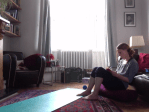
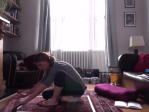
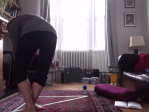
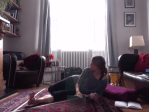
Following on from my last thoughts where I considered ‘choreography’ as a form of capture and therefore attempted to ‘choreograph myself’ by ‘capturing myself’, this week I took the notion of capture one step beyond the practice of choreography. My aim was to capture my practice itself, to capture what it was I did when I ‘practiced’. I felt that the short term capturing 1 minute apart was too ‘close’ and that I was too aware of practicing for the camera. So Simon created a programme that allowed me to capture my practice by taking a photo every 5-10 minutes.

Unlike Capturing as Choreography, capturing practice required a real letting go of control. Firstly the wider time frame makes it harder to stay with something long enough to capture it. I therefore have to let go of things I might have liked to capture and accept that something less interesting might make the cut. This lack of control becomes all the more evident when my practice involves engaging in another ‘choreography’ that absorbs my attention as in the documentation below. The first set of images document my practice over a 1.5 hour period during which time I ‘warmed up’, thought about what I wanted to do, set up a ‘choreography’, ‘performed’ a choreography and watched back the choreography in order to repeat the cycle. (Further images of this process were captured, however the programme shut down before they were downloaded!)    All words enclosed in ‘scare quotes’ above are written so to remind myself to think more about how I am using them in the context of my practice research.

The second set of images are the resulting ‘choreographies’ captured by my phone running an app set to take a photo every 1 minute. Unlike the previous experiments, I was not able to see the framing of the space or have some sense of when a photo might be taken, resulting in a less intentional choreography. I worked on my living room carpet with white masking tape to once again draw out the framing or enframing within the frame of the camera. The framing of the collage took place post practice and was almost accidental, however the appearance of white lines both between and across each picture draws out another possibility for choreographic interplay.


The Creative Articulations Process

Breathe out slowly. Write the Movement. *

I came across the Creative Articulations Process (CAP) whilst researching for my PhD proposal a few years ago. My own area of interest is solo practice, and finding ways to resource the solo artist to enable that practice led me to the Choreographic Practices Journal and CAP. Up to that point I had worked with Halprin’s RSVP cycles (which I wrote about here) and had nurtured a particular interest in the notion/s of ‘resource’ and/as ‘disruption’. My initial encounter with CAP, via an article in the Choreographic Practices journal, left me perplexed. I understood and was drawn to the idea of unpacking the creative process, but didn’t understand the focus on language and “languaging”. I parked the thought somewhere in my mind that I should look into this further, but for the meantime I worked with a simpler version in the form of Josiah Hinks’ 5 facets process (which I worked with and wrote about here). Having since started my doctoral research, I looked up CAP again, saw this workshop coming up and instantly booked. And there I was.

Sit still for 10 minutes, mark the page

The workshop was led by CAP creators Vida Midgelow and Jane Bacon at Dance4 in Nottingham and ran over two weekends in November/ December 2019.

Sit upside down, record the view

I write here as a visiting tourist to this practice, my aim is to capture to the page the final resonances of the work, mainly so that this writing might become a resource for me in the future. However I am still new to this place and I write this more as an excited traveller might write home to describe a wonderful place they’ve just seen. It’s incomplete and likely full of errors. But it is where I start.

Take a few steps, write the story

CAP consists of 6 facets through which one cycles in a creative / somatic process. The facets are: Opening, Situating, Delving, Raising, Anatomizing and Outwarding. Each facet employs different modalities: movement (or being in the body),  languaging (which might be written or spoken) and the slightly indirect expression on the page via drawing or mark making.

Opening – Arriving, noticing, being present to the now, settling

Situating – What do I bring to this space? What stories and histories are present?

Delving – What’s there? Plunging into the dark and rummaging around.

Raising – Pulling something out. What draws your attention?

Anatomizing – Shaking it up. Letting go of whatever you’ve found and looking at it differently. What else might it be?

Outwarding – A temporary conclusion. What is this thing right now?

The process is rhizomatic: any number of facets might be present at any one time.

CAP is not a scripted form. It is mobile and can interface with other practices or processes with which you work.

Feel into words before they hit the page, let them dance their way there.

CAP may be practiced as a daily / weekly hour-long practice which the creators call “the ground form”. Or it can be practiced in its expanded version, which might stretch out over hours, days, months, years.

The ground form is a structured and time limited means by which to practice the qualities of each facet. It involves spending 10 minutes in each facet. 5 of those minutes are spent in the body and 5 are spent on the page. It can be used as a means of generating resources for a longer practice or as an isolated practice in itself.

The expanded version may or may not be time limited. My sense is that the expanded version offers a framework (via the labelling of facets) by which to move through and articulate where one is within a process. One might spend days cycling through just two facets (such as Delving and Raising, Delving and Raising, Delving and Raising) and perhaps knowing that this is happening might be a useful prompt to shift forwards, towards Outwarding or backwards to Opening. Perhaps…

Close your eyes, write a secret dance

It’s not just about the individual facets. CAP is also an approach and key to this is the notion of “dual awareness” which underlies the work. To describe this Jane offers the following mantra: “I have a body and I know I have a body”. So whilst I am moving I am also witnessing myself moving, whilst I am sensing, I am also witnessing myself sensing, whilst I am writing I am also witnessing myself writing and whilst I am speaking I am also witness to my speaking. The aim of this dual awareness is to bring attention not just to the outcome of (or reality of?) our doing, but to the ways in which we carry out those “doings”.  How do we move? How do we sense? How do we write? How do we choose? How do we talk? This is achieved through a constant internal and external tracking. This notion of internal witnessing comes from Authentic Movement, and also has strong phenomenological underpinnings.

Another fundamental aspect of CAP is bringing awareness to our ways of speaking when we are immersed in a somatic practice. The CAP approach employs a way of articulating that comes from the body/movement / sensation rather than talking about the body/ movement/ sensation. This notion hints at discussions around Practice-as-Research (PaR). Fighting to maintain the primacy of the practice, artist researchers are seeking ways of writing that places writing/ articulating as another modality within their practice, rather than simply as a means of documentation. However the discipline of writing or speaking from the body rather than about the body has clear benefits beyond PaR. It presents writing, mark making and drawing as a dialogic partner within the movement practice. This writing might be vague and oblique at the start of the process and move towards a more concrete and deliberate form in Outwarding. As artists we often encounter a need to language our work, whether that’s to complete a funding application, or to explain our work to that distant relative (who we don’t think will understand anyway). It felt good to be challenged to speak differently.

Spin until dizzy, mark the page

As we cycled through the ground form I noticed my desire to get to the page or get off the page. “There’s a discipline in delaying” they said.

Look around, record the room

On the second Saturday evening a participant spoke about their desire to have a “lucky dip” of prompts that would encourage her to write or mark make in different ways, disrupting the natural propensities that pull us towards habitual ways of doing.

The notion of disruption might be a third underlying principle in this work, since the form ultimately generates shifts and tracks them in order to generate meta shifts.

A thought was aired by Jane (I think): When is a disruption a positive encouragement to shift and when does it get in the way?

We were given a task in Anatomizing where we offered something from our process to two other participants, without explaining it. The other two participants reflected on the offering and then gave back a response in the form of either movement, writing or mark making, again without explanation. This resulted in a shift for me that absolutely could not have been possible on my own. One participant referred to the exercise as a “somatic wash”.Sit still for 10 minutes, collect your dance

When I left Dance4 I think I nearly ran for a train. I just wanted to get home. Quickly. But I wish I had lingered. It felt as though I had found some real grounding in the practice and I wish I’d savoured that space for a little longer. This morning, filled with resolve, I picked up the collection of “resources” that I had spent years gathering and had since stuffed into the depths of mess that is my desk drawer. I went into a studio and I practiced the ground form… alone. I noted with amusement:

If you have the mindfulness app on your phone, the green one, (not the blue one) you can set it for an hour’s unguided meditation and it will ping every 5 minutes. The perfect companion to the Ground Form. 

Breathe out slowly, write the movement

*Quotations are taken from “Skript” by Jane Bacon and Vida Midgelow

More about CAP can be found at https://www.choreographiclab.co.uk/creative-articulations-process-cap/


An Iterative Choreographic Score

Whilst working alone in the studio, I’ve become interested in the traces of remembered movement. How can I build material from the ground up, using only my body and muscle memory as my resources?

Just move

What’s there?

Notice movement

Pick a movement

Turn it over, like a pebble in your hand, know every part of it.

Remove anything superfluous

Once you have it in essence and form, begin to play with it.

Change it’s shape

Stretch, condense it, reverse it(?)

Now hold on to the framework of that material and move in and out of it

Now let it go and…

Just move

What’s there?

and so on….

The Elephant in the Room

Last night I watched / played / participated in what is undoubtedly the best immersive theatre work I have ever come across: The Justice Syndicate at Battersea Arts Centre. In brief, 12 audience members sit around a table as ‘jurors’ and proceed to review evidence in a case, discuss their thoughts and then go on to cast their vote of “Guilty” or “Not-Guilty”. Apart from highlighting the flaws in the judicial system (or are they flaws?) the work brings to the fore the nature of decision making itself, and especially the dynamics of decision making within a group of people. At the end of the performance the neurologist, who advised the company in the making of the work, talked through the particular patterns of decision making that have been observed in this work. A key point was the interplay between intuition and reason in the making of decisions.

Dr  Kris De Meyer explained that intuition is like an elephant and reason is a small rider sitting on the elephant’s back. What most people would like to think is that their decisions are governed by reason, who tells the elephant where to go. But in fact this is seldom the case. For most of us the elephant is calling the shots, with the little rider on top making up stories for why the elephant is moving in one direction or another. To take the reins back into reason’s hands involves an active engagement with a different perspective, causing moments of dissonance. It is interesting to note that neither reason, nor intuition are necessarily right or wrong. Ignoring intuition can be just as harmful to us as ignoring reason. De Meyer pointed out the significance of this in the current political climate, where an in / out vote on the EU, led to entrenchment on both camps and a thoroughly divided UK.

********************************************

Dissonance.

Our ability to disrupt our patterns of choice, to embrace the uncertainty of not knowing, of accepting our own fallibility, our inclinations towards manipulation and coherency. To really see ourselves. These are all aims of the solo practice I am developing, using the process of disruption as an awareness generating tool. The aim is not to hang in perpetual uncertainty, but to understand why we make the choices we make, not just as artists but as individuals.

Not Knowing

Over the last couple of months I have committed myself to a weekly solo practice session. I spend three hours per week alone in the small studio at Chisenhale Dance Space. As you walk into the reception a sign-in sheet asks you to tick off why you’re using the space: Rehearsal, Workshop, Performance etc. Somehow I find it hard to tick the ‘rehearsal’ box, because I don’t feel as though I’m rehearsing. The word ‘rehearsal’ suggests something known, linear, attainable. But when I walk into the space I never feel that I “know”. Instead I feel immersed into a constant inner dialogue of self-doubt, frustration, boredom. When you’re on your own in a space you are confronted with yourself on every dimension. What I’ve learnt to do is settle into the process, accept the chatter and self-doubt and be present to the space. I carry words into the space with me, because words have a comforting clarity when all else you have is form and motion. This week I was buoyed by a line from John Cage:

Not working = Knowing

Working = Not Knowing”

– John Cage


Play

It’s apt that the two buildings I have worked creatively out of this week, are surrounded by the sound of children playing. It’s an appropriate sound track to creative practice, the sound of play, messy, loud, unintelligable and yet distinct in its cocophony. For school children play is a moment of relief, where the urge to move, to imagine, to role play, to create, is finally allowed freedom to express itself. And, importantly, this expression is unstructured and messy and you probably wouldn’t pay to sit and watch it.

Is it the money, and the expectations that come with it, that turns creativity into work, or is it just the extension of creativity into art that requires the focus of work? And if the answer is both, in different ways and at different times, then is there a way to be at play as we work? To sustain the openness and joy of play as we create, inspite of expectations, both internal and external, or the weightiness of what we make?


Outwarding

Today is the final day of my residency at Dance City in Newcastle. Well, technically it’s “tomorrow” because I’m cheating and writing this a day earlier to save time for the looming deadline of Friday’s “sharing”. In Hink’s Five Facets model of creative processes, Assaying is followed by Articulating. ‘Articulating’ is the stage where the work becomes known, established, defined. But it simply doesn’t feel right to suggest that this is where I’m at. It feels impossible to know what a work is until it’s been “seen”. Which is why I’m skipping to Outwarding and placing Articulating aside for the final evaluation.

I normally find sharings more terrifying than performances. The work is always messy and unfinished and there really is no hiding behind stage lighting. The bare bones are revealed for… dare I say it… judgement..? And it’s all of you out there that people are watching, in-between lunch and a cup of tea.

This is where I’ve found Hink’s description of Outwarding most useful. He frames it as a part of the process, a chance to see “if the work lives beyond me and brings liveness to others”. The idea of empowering artists to gain and manage useful feedback in a way that supports their process, is well-known in the dance world, thanks to the excellent work of Liz Lerman and her Critical Response Process. But Hink’s poses questions that highlight the process of Outwarding itself:

Is it important to you that your work is seen?

If so, do you have a more precise sense of what it might be like for it to be seen more? What might come from that for you?

And do you have a sense about who you would like to see your work?

If so, how can I introduce this work to its right audience? How can I help it find its lovers?”

Whilst sitting in another artist’s sharing yesterday, I realised the importance of this last question. A member of the marketing team, sitting in on the sharing, offered her description of the work that we had just seen. Not in a judgemental way, but as a means of explaining the importance of clearly articulating the work so that it found its right audience. I had never considered this before. I just thought, and still do to some extent, that good work is just good work. But of course it’s pretty hard to know whether something is actually good or not. All we can know is that we’ve put something out there. In Seth Godin’s words:

Here, I made this. I hope it changes you.”