When I first began to work solo, I was driven by a need to reclaim my identity as a dance-maker and to ground my making in the material of my performance. The crafting of dance, so often credited to the authoritative notion of a ‘choreographer’ (detached, aloof, all-knowing) and the performance of that dance which is so often left to the dancer (the people who get their hands and feet dirty….literally), could not be separate anymore. I called this approach to dance-making the practice of self-choreography, where ‘self’ is both the material and the relational starting point (though not the end point) of a choreographic process.
When I began to perform these self-choreographies, another hierarchy emerged: it was the hierarchy that placed me, performer/ maker, at the centre of an audience/ viewer’s attention. After all, if you are the only one dancing, what else might you expect? I had a feeling that this, too, was undesirable. An audience that came to watch me dancing solo might be disappointed at the ordinariness of my movement. (Rainer’s Trio A, 1966, beautifully challenged/s this expectation). Another layer is added by the mere fact of being a woman dancing solo, bringing up questions around the male-oriented gaze, the disconnection, confrontation and objectification that might result… even when that audience/ viewer is another woman/ women. How could my self-choreography be an invitation to a wider awareness? How could it challenge our ways of seeing, by making a proposition to be with instead?
A series of hunches and accidents led me to two specific approaches that gave me a way in, a vocabulary to address this problem.
The first were Mary Overlie’s Six Viewpoints practices, which I learnt through Deborah Black’s virtual viewpoints workshops (Oct-Dec 2021). Black’s virtual sessions began with 5 minutes of rolling around on the floor, bringing the brain down onto the same level as body in a symbolic grounding, before focusing on one specific ‘viewpoint’. Overlie identified 6 ‘viewpoints’ of performance: Space, Shape, Time, Emotion, Movement and Story (the 6 SSTEMS ) constructing various exercises through which the performer foregrounds one mode of attention. Black describes it as an ‘er’ practice, a pre-practice.
Working through the practices I noticed that dance is often only ever focused on one of the materials: movement … no surprise there. Dance performance and dance-making often prioritise moving and movement as the primary focus of the choreography… but what about the other materials of performance? By swapping my focus from my movement to my presence within space/time, by swapping my attention from myself as a shape-maker to myself as just another shape-time within space, suddenly the potential for a horizontal attention opens up, and by extension, an awareness of others-in-space/ others-as-space, others-as-time, others-as-emotion etc. Overlie described the audience as a piano, but I would go further, I would say that in the practice of self-choreography, the audience is the relation to and through which the choreography emerges. They are another material of performance.
Which takes me to the second influence in this process of articulating my practice: the writing of the feminist artist, psychoanalyst and theorist Bracha Ettinger. I came across Ettinger’s writing by chance. It was a google search around my key word: ‘witnessing’ that led me to an online article discussing our consumption of images of war. Ettinger was exploring how the notion of a ‘matrixial gaze’, one that is open to resonances from the other, differs from the disconnection of the phallic gaze. Coming back to that text over and over, I realised that there might be something here that needed a serious amount of my time. So I decided to step out of my reading on ‘post-modern improvisation practices’ and read as widely as I could around Ettinger’s work.
Ettinger reclaims the feminine imagery of the Matrix, etymologically linked to the uterus, to describe the situation of ‘relations-without-relating’, a process of ‘wit(h)nessing’ via/through the ‘matrixial borderspace’. Extending the practice of ‘witnessing’ into one of being with via the term ‘wit(h)ness’ naturally resonated with my intention as both a performer and witness to my own performance. I had noticed that my performance was different when confronted (a deliberate term) by an audience. I was acutely aware of them in the space with me, sharing the same ground. I described this awareness as a ‘bi-directional witnessing’.
The term ‘witnessing’ has a strong link to somatic movement practice, especially through the framework of Authentic Movement, which leads to the development of the ‘inner witness’. In their CAP process the dance-artist-researchers Jane Bacon and Vida Midgelow talk about developing a ‘dual awareness’. There is a shared language across these practices and what Ettinger is describing, perhaps not unusual seeing as Ettinger and Authentic Movement are drawing from / contributing to the field of psychoanalysis. Yet, I am aware that I need to tread carefully into the lesser known territory, knowing that my engagement with these ideas is still naive.
The result of these two influences has been the development of what I call my ‘wit(h)ness scores’. Performed-with a mobile/ semi-mobile audience, the score aims to draw attention to a wider field of awareness in which the performer is only one point of relation. Yes there is a distillation of the practice (I hope) through my performance. But I am not necessarily in the foreground. My question to my with-nesses is: in this shared Border-Space, am I really the only one dancing?
Image: ‘Am I really the only one dancing?’ – performance of a ‘Wit(h)ness Score’ at the SPA Conference 2023, Valletta, Malta
When I first began to work solo, I was driven by a need to reclaim my identity as a dance-maker and to ground my making in the material of my performance. The crafting of dance, so often credited to the authoritative notion of a ‘choreographer’ (detached, aloof, all-knowing) and the performance of that dance which is so often left to the dancer (the people who get their hands and feet dirty….literally), could not be separate anymore. I called this approach to dance-making the practice of self-choreography, where ‘self’ is both the material and the relational starting point (though not the end point) of a choreographic process.
When I began to perform these self-choreographies, another hierarchy emerged: it was the hierarchy that placed me, performer/ maker, at the centre of an audience/ viewer’s attention. After all, if you are the only one dancing, what else might you expect? I had a feeling that this, too, was undesirable. An audience that came to watch me dancing solo might be disappointed at the ordinariness of my movement. (Rainer’s Trio A, 1966, beautifully challenged/s this expectation). Another layer is added by the mere fact of being a woman dancing solo, bringing up questions around the male-oriented gaze, the disconnection, confrontation and objectification that might result… even when that audience/ viewer is another woman/ women. How could my self-choreography be an invitation to a wider awareness? How could it challenge our ways of seeing, by making a proposition to be with instead?
A series of hunches and accidents led me to two specific approaches that gave me a way in, a vocabulary to address this problem.
The first were Mary Overlie’s Six Viewpoints practices, which I learnt through Deborah Black’s virtual viewpoints workshops (Oct-Dec 2021). Black’s virtual sessions began with 5 minutes of rolling around on the floor, bringing the brain down onto the same level as body in a symbolic grounding, before focusing on one specific ‘viewpoint’. Overlie identified 6 ‘viewpoints’ of performance: Space, Shape, Time, Emotion, Movement and Story (the 6 SSTEMS ) constructing various exercises through which the performer foregrounds one mode of attention. Black describes it as an ‘er’ practice, a pre-practice.
Working through the practices I noticed that dance is often only ever focused on one of the materials: movement … no surprise there. Dance performance and dance-making often prioritise moving and movement as the primary focus of the choreography… but what about the other materials of performance? By swapping my focus from my movement to my presence within space/time, by swapping my attention from myself as a shape-maker to myself as just another shape-time within space, suddenly the potential for a horizontal attention opens up, and by extension, an awareness of others-in-space/ others-as-space, others-as-time, others-as-emotion etc. Overlie described the audience as a piano, but I would go further, I would say that in the practice of self-choreography, the audience is the relation to and through which the choreography emerges. They are another material of performance.
Which takes me to the second influence in this process of articulating my practice: the writing of the feminist artist, psychoanalyst and theorist Bracha Ettinger. I came across Ettinger’s writing by chance. It was a google search around my key word: ‘witnessing’ that led me to an online article discussing our consumption of images of war. Ettinger was exploring how the notion of a ‘matrixial gaze’, one that is open to resonances from the other, differs from the disconnection of the phallic gaze. Coming back to that text over and over, I realised that there might be something here that needed a serious amount of my time. So I decided to step out of my reading on ‘post-modern improvisation practices’ and read as widely as I could around Ettinger’s work.
Ettinger reclaims the feminine imagery of the Matrix, etymologically linked to the uterus, to describe the situation of ‘relations-without-relating’, a process of ‘wit(h)nessing’ via/through the ‘matrixial borderspace’. Extending the practice of ‘witnessing’ into one of being with via the term ‘wit(h)ness’ naturally resonated with my intention as both a performer and witness to my own performance. I had noticed that my performance was different when confronted (a deliberate term) by an audience. I was acutely aware of them in the space with me, sharing the same ground. I described this awareness as a ‘bi-directional witnessing’.
The term ‘witnessing’ has a strong link to somatic movement practice, especially through the framework of Authentic Movement, which leads to the development of the ‘inner witness’. In their CAP process the dance-artist-researchers Jane Bacon and Vida Midgelow talk about developing a ‘dual awareness’. There is a shared language across these practices and what Ettinger is describing, perhaps not unusual seeing as Ettinger and Authentic Movement are drawing from / contributing to the field of psychoanalysis. Yet, I am aware that I need to tread carefully into the lesser known territory, knowing that my engagement with these ideas is still naive.
The result of these two influences has been the development of what I call my ‘wit(h)ness scores’. Performed-with a mobile/ semi-mobile audience, the score aims to draw attention to a wider field of awareness in which the performer is only one point of relation. Yes there is a distillation of the practice (I hope) through my performance. But I am not necessarily in the foreground. My question to my with-nesses is: in this shared Border-Space, am I really the only one dancing?
Image: ‘Am I really the only one dancing?’ – performance of a ‘Wit(h)ness Score’ at the SPA Conference 2023, Valletta, Malta
In the last few years I have been pondering what it means for a dance-maker to walk into a space on their own and choreograph a dance on themself, to be performed by themself. I wonder about the techniques we bring to bear on our solitary work, the ways we practice and the motivations that compel this self-determination. My question: ‘what does it mean to self-choreograph?’ aims to capture the more-than of the dance’s creation, its significance beyond its own making, even when its making appears insignificant. My research has become an endless practice of ‘sitting-with’ in the (for the most part) unknowingness of what’s there. And so here I’m extending this practice by ‘sitting-with’ a distinct work that might illuminate my personal enquiry. In the spirit of this open-ended sitting, I am not offering these thoughts as a historical or analytical investigation. My ponderings are textured by my current thinking and practice. When I sit-with a work, I’m not trying to ‘know’ it, I’m mostly allowing it to speak in its own space/place/time and acknowledge/ bring to light the dialogue that I’m having with it.
Part of this dialogue is knowing where the work is sitting in relation to me. A chance ‘share’ of Watermotor on facebook, reminded me of this. Amongst the adverts of Facebook attempting to sell me ‘smart oven gloves’ (don’t ask…), Trisha Brown’s youthful dancing, captured in Babette Mangolte’s 1978 filming of Watermotor, bound me to the screen. It’s a weekday morning and I’m supposed to be ‘being productive’ with a reading of Erin Manning, but instead I’m trapped down this rabbit hole searching through link after link to remind myself of the back-story, or, as academics like to call it, the context of its making. I learn from Trisha Brown’s company website that whilst they list the work as ‘Water Motor’, Mangolte’s film writes it as Watermotor. Both, it says, are acceptable. And this makes me think of the ways that works, and the ways we talk about them, can never be fully pinned to any original form. I settle on using ‘Watermotor’ feeling the drive of the dance rushing through one word into the other, too impatient to wait for one to end for the other to begin. A liquid train.
Watermotor is listed both as a dance and as a dance film created by Mangolte, which confuses me at first. Wasn’t Mangolte’s filming a record of the dance? A documentation? I’m not sure if it matters. As I watch through the film, I feel drawn into the very space. It’s candid, unadulterated. I could be sitting there. Commentators have applauded Mangolte’s ability to allow the dance to be, to ‘trust dance’s capacity to create its own story’ (Crimp, 2011). I learn that the filming took place at the Merce Cunningham Studios which must have been evident to the dancers of the time who were familiar with those spaces. I think how familiar this scenario is, and how many of our current day works ‘live’ as records against the familiar stomping grounds of our profession. I think at some point the ‘recognisability’ of Chisenhale’s studios became concerning enough for them to ask artists using their spaces for filming to first seek permission…
Mangolte describes her ‘chance’ meeting with Brown that led to the creation of this film (Mangolte, 2017). She explains how Brown was working on the piece in her loft apartment, chiming with the working-from-home situation that we are now very familiar with thanks to the pandemic. In some ways (my thinking drifts) this pandemic has been good for many of us, forcing us to make space for our work in our homes and local parks, as opposed to relying on studio spaces. When did we allow our work to become so dependent on the dance studio? My loft being considerably smaller and somewhat precarious to get to, I was consigned, in the early days of the pandemic, to working in the porous space that is my living room. I remember finding it incredibly frustrating to work with the sounds of everyone else around me. Still, I counted myself lucky that I had the space that I had, which reminds me that space itself is such an important resource for the dance-maker, and one that often excludes many makers from making.
I imagine Brown working through her dance, or is it dancing? As I watch her free-flowing movement, both direct and open, driving forwards in multiple simultaneous directions, I’m drawn by how un-choreographed both her movement, and the dance, appear. Her very flesh seems buoyant, un-held and yet somehow contained by the skin of her dance. It seems almost formless, multiple, both simple and complex. I come across Susan Rosenberg’s description, echoed in many other descriptions of Brown’s dancing, which aptly captures my thoughts:
Water Motor,…, demonstrates its originator’s idiosyncratic virtuosity and unprecedented physical intelligence: her relaxed, direct ability to activate movement and energy, as if out of nowhere, and to access her dancing’s jouissance as choreography. (Rosenberg, 2012, p.153)
I cannot imagine remembering it. Did she work through accumulations? Did she film herself improvising and then re-learn it? (Unlikely…) I imagine her following her movement, noticing, repeating, interjecting it, (incidentally, all practices I now associate with the process of self-choreography). Of course I have no idea how she went about choreographing it, I can only imagine her letting rip and then attempting to capture her dancing, without taming it. The choreographer driving through whilst the dancer danced? Rosenberg sounds like an authority on the dance as she chimes in with more back-story: the dance recalled a physical trauma that Brown had experienced. But whether this was the active intention of the dance, or whether it arose from/through her dancing is unknown?
One thing I am aware of: it would be wrong to think of Brown’s dancing as ‘free’. Much like the controversy surrounding any form of improvisation as ‘free’, (or any kind of movement, for that matter…) Brown’s style was itself a practice, a technique. Again Rosenberg refers to this in reminding us of the body/mind practices that Brown engaged with at the time.
When I watch these seminal works from the era that redefined the notion of dance virtuosity, I cannot help imagining my old ballet teacher watching. I think she might gawk at the lack of ‘finesse’, the lack of ‘lines’, the lack of anything resembling her notion of ‘technique’. ‘This is just free falling, free dancing’ I imagine her saying, unimpressed. And perhaps those words are just my own, my old training still creeping in, still offended by the freshness of this dancing. If I were to dance this work, I think, I would find it impossible to let go of all that baggage, partly because my flesh is so stubbornly bound to my bones, and partly because I am stubborn too!
And then there comes the question of the choreography… where is it? Again Rosenberg agrees: the choreography ‘appear[s] to disappear’ in the dancing (2012, p.152). Is this, then, a piece of dancing, or a piece of choreography? How much of her own baggage did Brown have to off-load to allow this dance to be, to emerge? The most striking thing to me is her ability to allow it, to recognise it and to be with/in it.
As I watch Brown’s dance, captured by Mangolte in 1978, and flicking across my screen here in 2022, my mind, full of Erin Manning’s writings, cannot help but invite them into this sitting too. They pull up a chair. (I’m not an expert on Manning so I don’t pretend that she is sitting with me, but my memory of her words are). Manning describes movement’s preacceleration: ‘like the breath that releases speech, the gathering-toward that leaps our bodies into a future unknowable’ (Manning, 2009, p. 25). She argues against the notion of ‘body’ as ‘subject’ and instead describes the ‘becoming-body’: ‘a body that is involved in a reciprocal reaching-toward that in-gathers the world even as it worlds.’ (Ibid. p.6). Manning’s words, whilst not specifically directed at Brown’s dancing in Watermotor, sum up that sense of being in the moment of moving-with, never arriving, never known, always in-relation that capture the spirit of self-choreographing. Something about movement being so close to its maker/ originator that it almost remains unknown. It has to be ‘captured’ in some way, like this work captured by Mangolte on a winter’s day in 1978.
At some point in the last year, I had a sense that learning Yvonne Rainer’s 1966 solo, Trio A, needed to be a part of my artistic research and practice. I’m not really sure how I came to this decision. Perhaps it was the fact that it appeared physically accessible to me, or the fact that, having a clear means of learning it ‘correctly’ via the handful of official transmitters, made it possible to learn the dance in a way that honoured Rainer’s original work and her rightful ownership of it.
The decision jarred with the other practices I had been learning through my mentors, notably working with Rosalind Crisp with her practice of ‘choreographic improvisation’, and more recently working with the UK based dance maker Amy Voris, devising through a slow accumulation of material over time. Both these approaches to self-choreography* involve improvisation as the primary format. ‘Are you sure Trio A fits in here?’ was the question put to me by my academic supervisor. I could see her point, but does it follow that all self-choreography must be improvised? Or that all ‘set’ choreography is somehow not ‘selfed’ enough?
Listening to Sara Wookey (one of Rainer’s ‘transmitters’) describe the process of what she calls ‘holding the dance in her body’, you get the immediate sense of a work that is in a constant process of coming into being. The live-ness of its transmission allows it to remain ‘slippery’, to use Wookey’s words. I think it was this very slipperiness, this idea of a work constantly being brought into being, that drew me to learning it. That, and the fact that it’s such an important piece of work in the postmodern dance lineage that learning it, embodying it, is like tasting history, biting into a chunk of it and feeling its textures and flavours.
After some emails backwards and forwards, an opportunity came about for me to learn Trio A from Sara via an online workshop organised in collaboration with SITI company in New York. The sessions were spread over two weeks, meeting daily from 6-8pm UK time via zoom. There were 9 other participants, including Barney O’Hanlon from SITI company who led daily warm ups, and Melina Bielefelt who expertly co-ordinated and hosted the workshop. People joined from across several time zones in one of the ironic achievements of a pandemic that has introduced the term ‘social distancing’ into our language: to bring together a bunch of people on opposite sides of the globe.
Even with this convenience of just opening your laptop, it’s funny to think how hard it is to make the space in one’s life and diary. At first I thought I’d have to turn the opportunity down. May was super busy. I had just started working with Amy, perhaps I should focus on that? I’d have to shift or cancel all my evening teaching, which is not an easy thing to do when you’re a freelancer in a pandemic. And then there was the small matter of getting married on the second Tuesday of the workshop. Could I really get married in the morning and learn Trio A in the evening?
Yes you can, and I did.
I’m not writing this to give a full academic account of Trio A or my understanding of it. The resonances are still too new to be really known. But I want to note, right now, whilst the ‘all’ of the experience is still present to me, the things that carried my attention whilst I learnt this dance.
As my learning of Trio A overlapped with my work with Amy, I couldn’t help oscillating these two practices inside myself. I found that one rubbed against the other, making their edges both more distinct and more porous. For clarity I’d like to briefly describe the process that I had begun with Amy, before explaining how this came to resonate with my learning of Trio A.
In my practice with Amy before the start of my Trio A experience, we had begun a process of: opening into moving, recalling, or what Amy describes as ‘harvesting’ (after Nancy Starks-Smith), and then returning to material in order to ‘deepen’ understanding of it. The three step process, is the core of Amy’s accumulating choreographic process, which draws on the framework of Authentic Movement. After a period of moving, or waiting for movement to arise, we sit down to remember what happened, recalling shape, feel, texture, image, thought or anything that arose in the experience of those moments. Amy responds to my recollections with her own observations and reflections, before inviting me to return to whatever might be calling. Amy describes this process as follows:
‘The process of harvesting writings and drawings cultivates sensitivity and clarity toward the embodied memory of moving which, in turn, gives rise to certain verbal and visual markers that serve to simultaneously reflect, project and in a sense thus ‘re-invent’ that experience.‘ – Amy Voris, 2018
Amy clarifies that ‘returning’ remains open, it is not a closing down of possibilities, but a honing in on a potential area of interest, so that something can grow from there. I struggled with the idea. Surely the point of improvisation is that it cannot be returned to, in a way? I wondered whether I could actually return to something after the event. Surely the spontaneity requires me to let it go?
A snapshot of my ‘Harvesting’ notes from 13th May 2021
With this question sitting on the shelf of my mind, I started learning Trio A. It’s been a long time since I learnt set material, I wondered if I was going to struggle to remember. It turns out that the ability to learn movements is still there, (once I worked out the zoom mirroring thing). Sara reminded us of the labelling of corners 1,2,3 and 4 and I chuckled at the memory of learning this in my Cecchetti Ballet theory (I think it was followed by walls 5, 6, 7 and 8). I had completely forgotten all of that! But another curious experience was the feel of the process of memorising, or is it the process of embodying? Learning?
Each day we recalled the previous days’ section and added on a new bit of material. And each day I was aware that the new stuff was in a different place in my body-mind to the material we had learned previously. I suppose this was the difference between short and long term memory. Although a few days difference probably doesn’t quite count as ‘long term’ enough. I wondered: perhaps I didn’t really ‘know’ the material until I had returned to it? Perhaps there’s something about learning that starts off as being superficial, or unconscious copying, until it is re-learned, re-encountered?
I found that when I returned to the new material on the next day, I was experiencing it through this half known feeling, and that made me aware of what aspects of the material I had not consciously learned. It’s like an initial imprint that doesn’t quite sink into the sand deep enough to be sustained, so that when the day’s weather passes over it, what remains is just the points of contact that were most assured, most present, most known? I cannot find the right word. So when I return to the imprint a day later, I can feel what’s missing, what’s smudgy, and then I re-imprint, placing footprint over footprint, carefully noticing what I missed and being interested in finding ways to make those movements more acknowledged, more known. Sara encouraged us to find ways to annotate the dance for ourselves, which I began with the drawings below. On subsequent days I found myself adding more information to the initial drawings, using different coloured pens to indicate the new information and creating a way of tracking my own learning, that mirrored my practice with Amy.
A snapshot of my notes from my learning of Trio A with Sara Wookey, May 2021
If I bring that realisation back to my work with Amy, I notice that in some sense, there is a similar process at play. I’m relieved by the thought that returning-to might not lead to a dilution of the original, but is, instead, a more conscious kind of knowing. It’s as though the space/time provided by re-encountering, gives enough perspective for the material to be approached through new eyes. Perhaps where the two diverge is that with each re-encounter with Trio A there’s a deliberate attempt to re-imprint a specific shape, whereas in Amy’s practice, it’s inherent slipperiness is the very means by which material emerges: the imprint is allowed to shift, to stretch and compress as it’s honed over time.
Either way, the deepening of the imprint remains a constant quest, a ‘never arriving’.
I had a strong sense of this idea of ‘carrying the torch’ throughout these two weeks. Both Sara and Barney described their lineages, their love for their mentors and their desire to share their work in as undiluted a form as possible. It made me think of Douglas Hofstadter’s idea of consciousness that he describes in ‘I am a Strange Loop’ (2007). Born out of his grief on the death of his wife, Hofstadter, a physicist and cognitive scientist who famously wrote ‘Godel, Escher, Bach: the eternal golden braid’ (1979), wonders whether our consciousness is really so solely located in our physical bodies. Instead he posits the thinking that perhaps consciousness is more like a resonance that is at its most undiluted in a person’s being, but which, through communication, can be embodied, in a less pure sense, by someone else.
It is no wonder that we naturally assign consciousness to the living. It has to move, to resonate, for it to be present, in much the same way that a dance needs to be danced for it to be present. I find it interesting that Rainer states that the 1978 filming of her performing Trio A, (which is available on You Tube), is not an accurate record of the dance. Rainer’s insistence on the transmission of the dance through people with whom she has had direct contact, also seems to echo this ‘liveness’ or ‘lived’ process. And surely within that decision is the realisation that, as with any live process, it becomes open to dilution. All of which problematizes the idea of Trio A as a set choreography, or what it means for choreography to be truly ‘set’. The way I imagine it is as a work that is always trying to be asserted. If Rainer’s original performance is like a tightly closed fist around the work (which can never be a complete vacuum), then subsequent learners offer increasingly looser holds around it, until it eventually is just about contained within a space. I find it interesting that Rainer describes the process of re-asserting the work as a ‘tune-up’, a re-tightening of the grip, re-enclosing of the gaps around it. And, as with Voris’ process, each returning involves a deepening of the performer’s relationship to it, so that conscious re-imprinting engages a different level of knowing and learning.
What I found most encouraging, and most interesting about the workshop, was that it was itself a holding of space, a container for people to meet within. The point of focus was clearly delineated, but around that there was this emergent process of diverse practices, knowledges and experiences that was forming into its own locus. The group emails, which at the start of the workshop mainly contained links that contextualised Trio A and Rainer’s work, started to shift into notes that recorded all the diverse responses and the webs of ideas that people brought up in discussions or daily check ins. I have to say it’s both incredibly liberating, and heart warming, to be able to plug into a wider field and find a new sort of belonging. I want to make space for that going forwards.
A phrase that recurred in my mind as I went through the workshop came from one of my first sessions with Amy, where I wondered what to do with the busy-ness of my mind as I moved. Amy responded that ‘it was all welcome’ which seemed to capture the democracy inherent in the learning of Trio A too. It seemed to suggest that all of this is present, (the fear of losing income, getting married, the anxiety of meeting new people, the alternating practices) and all of this is welcome, just as long as you stick to the dance.
*In carving out this field that I describe as self-choreography, my intention is not to hold rigidly to the delineations of improvised versus set material, but instead to locate ‘choreography’ within a wide range along that spectrum.
This short study was created during the Covid-19 lockdown. Reflecting on my own isolation and need to reach out and touch the world, I created this duet with a Mirror, building on my research with Mirror in 2017. I was initially drawn to the way the mirror created an external ‘partner’, with the crop of my arm seeming both connected and disconnected from my body. In the final section I play with the perspective and framing of the camera, which mirrored that of the mirror itself creating a double dialogue and commentary on the ways we are contained and ‘enframed’ by our real and virtual spaces.
There’s a great quote in an interview with Philip Decoufle where, asked about his solo work, he states:
“There is no choreography in a solo. Choreography begins when there are three dancers. When there are one or two I don’t believe it’s choreography. ” (Pakes, 2004)
And yet here I am, as I think are many others in this Covid world, seeking to do what Decoufle states is impossible: to choreograph on myself. To the countless artists for whom working alone is an ongoing fascination and choice, Decoufle’s words possibly say more about the expectation of what it means to choreograph, then the impossibility of self-choreographing,…perhaps?
Which leads me to wonder: what does it mean to ‘self-choreograph’? And, more to the point, why does it feel so difficult?
Perhaps so much is made out of the difficulty of being alone in a space, that we allow ourselves to be consumed by the emptiness of it? I know my challenges are not so much around what to do, but why I do it. Why this leg instead of that leg? Why now and not later? What’s the point of it? Who wants to see this? Why would anyone want to see this?
Which is why the question, ‘what does it mean to self-choreograph?’ is not just a question of definition. Of course it feels significant that I describe it as ‘self-choreography’ and not simply ‘solo choreography’. Solo choreography can be performed by another after all. By self-choreography I mean to forefront the authorship over the singularity of the performer, I mean to direct the viewer not just to the presentation of a dance, but to the self-choreographed nature of a dance. And there-in lies it’s stickiness.
Self-choreography involves engaging with the multiple facets of ‘self’ (a loaded term, for sure). It involves recognising the different voices that are present in the mind when one starts dancing alone. The alone-ness, the emptiness, the silence may feel like a harsh denial, but, like meditation practices, it’s simply a momentary restriction on stimulus that allows those voices to become really present. And don’t they know it! Working alone is difficult because it acquaints us with ourselves. At this point I recall Ben Spatz’ question in ‘What a Body Can Do’: ‘Is this theatre or therapy, spirituality or research?’ (Spatz, 2015)
The answer depends on what you do with it.
For me, the emptiness is filled with a single strident critic. Working with my mentor, Rosalind Crisp, I’ve become aware of the gazillion ways ‘that voice’ stifles my dancing. Nothing I do is right for her, nothing interesting, nothing good enough. She embodies every single person who has told me I’m no good, every programmer who turned me away, every bad application outcome. She has a bloody loud voice, she’s cynical, critical and deeply unhappy. That bit’s the therapy.
But now someone else walks in. She tells the critic to shut it and sit down over there, tells the dancer to stop fussing over her clothing/ the cold floor/ her hair and ‘just get on with it’, whatever that is. And then she invites the choreographer to watch.
The choreographer suggests something. She offers an intersection, a disruption (large or small) that contains, directs the moving dancer. Each suggestion comes with a caveat: try it first, you can always leave it. The dancer is not bound to do exactly what the choreographer says. The dancer can make choices within the rules she is dancing with. The choreographer watches, and stretches the spaces around the rules. She clarifies, brings more nuance to the rules, more layers, more textures. She holds the dancer to those spaces, and then she lets her go and watches again, watches as the imprint reveals itself in the dancer’s movements, watching the echoes of that exercise dissipate, collect, re-collect.
The comparison with therapy is not so far off. My mentor and teachers are currently stand-ins for my own choreographer. They enter the space like a gardener, weeding out the stuff the quells the flowers. Putting things in their place, giving space and nourishment to the delicate buds so that they have space to bloom. The result is an instant relief. The skill of self-choreography is to be your own gardener.
Sometimes Rosalind jokingly asks: ‘why can’t you do this yourself? If you spent long enough working alone, 20 years down the line you’d work this out for yourself’. But that’s only if I learn how to work with myself and don’t have a massive falling out that leads to self-destruction! It can be a dangerous game to delve into working alone, precisely because of this self-confrontation.
But I do persevere, which begs the question, why? Why self-choreograph?
To me self-choreography has been a deliberate choice. The embedded-ness of author/performer is both an aesthetic and a political statement. It is about dismantling the hierarchy of performer/ choreographer models and challenging the outside-in approach, (the grand artistic vision), with an inside-out process, one of ‘material handling’ (to quote Barbara Bolt), of finding something rather than producing it.
All this is, in fact, what it means to ‘self-choreograph’.
Today is the 26th October 2020. This date might be different to the date that this post is published, and that is because I want to be deliberate and considered in what I write here. Today is the start of something, something as of yet unknown, and I am writing this so as to capture it, as though to take a verbal photograph that I can pin to this time and space. The description below consciously aims to describe my experience within the work. At Crisp’s request, I have not shared any direct instructions. My aim is to find a way to describe the work that is not reductive, to get across the feel of the work without stating it in absolute terms.
The ‘something’ began with a chance web-search, looking for a workshop, which then led to an email, which in turn led to a zoom call at 9am this morning with Rosalind Crisp on the other end, sitting on the other side of the world and at the other end of a Monday.
We spoke about the aim, the purpose of the session. My difficulty is that I have a problem with just moving, I said. Just moving is so coloured by unconsciously/consciously ingrained patterns. It feels bland. And this leads me to not moving. What is it that I do when I am not moving? Well, I choreograph through frames. I set up a mirror or a camera and I craft material through my interaction with that frame. Rosalind suggests: ‘the frame is a decoy that engages your attention, but it doesn’t address the moving’. Moving, then, is the purpose.
We unpick what is means to just move. Rosalind suggests another definition for just moving as ‘moving without a purpose’. This is where we start: purposeless moving for 2 minutes. And already, just doing this, gives it a frame, a kind of permission, paradoxically it feels purposeful. We begin to layer frames. The point is not that moving without a purpose is a problem, the point is to find strategies to work with it.
We settle on two ideas. I work alone for 3 minutes. I am aware of my working through the task. I notice my tendency to focus on a body part, with my eyes, whilst moving it, and realise this is not necessary. The eyes are just another limb, they can respond but need not constantly point at the moving part. And I struggle with the whole body moving. What does it mean to have the whole body moving? Is it even possible? Surely even if I send movement out into my whole body, that movement has been initiated at one point? At what point is it just whole body? And whilst I am working through this question I am almost unaware of how expansive and liberated my movement becomes in those moments.
Rosalind demonstrates another tool. When it’s my turn I instantly struggle. What become clear are the habitual co-ordinations. I am now locked in a battle of disrupting/ interrupting the ‘flow’ of those deeply ingrained patterns. I have to almost mechanically break myself down. Constantly stop myself. Every time I get it wrong I grimace, shake my head and try it again. It feels as though I am un-learning.
By holding onto a purpose, I maintain my interest. It’s as much about developing the ability to attend to the whole body as it is about the dance. At some point the task transitions into art. Right now it’s just an exercise.
I work again. I notice my desire to start shaping. We discuss this. What is my aim? Is the aim to show just one thing, to craft the movement, or is to remain in the expansiveness of the process? To craft the process?
We go back and forth between scores. I am aware of the comedy of those moments when I lose control and I find this curious since I would not consider myself funny… Can any body create humour? Rosalind notes how I stay with things. Yes I do. I don’t let them go, I respond. Partly because I do not know them well enough to register that they are there, and partly because I enjoy them and want to know them. Can I let things go? Can I stay ‘in the transition’.
After discussing a few logistics, we agree to meet next week.
I spend another hour continuing to work alone. At first I time myself. 2 minutes. 3 minutes. But my phone isn’t really working properly and the timer doesn’t signal the end of the time! I stop caring and find that I am just dancing, purposefully.
I sat down to write this out and remembered Cage’s quote ‘purposeful purposelessness.’ I kept reading and came across another line that seems strangely relevant:
‘Boredom Plus Attention = Becoming Interested’
– John Cage, Composition in Retrospect, 1993
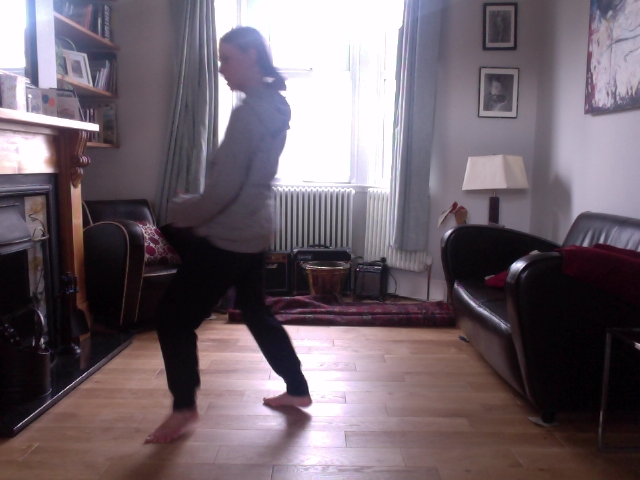
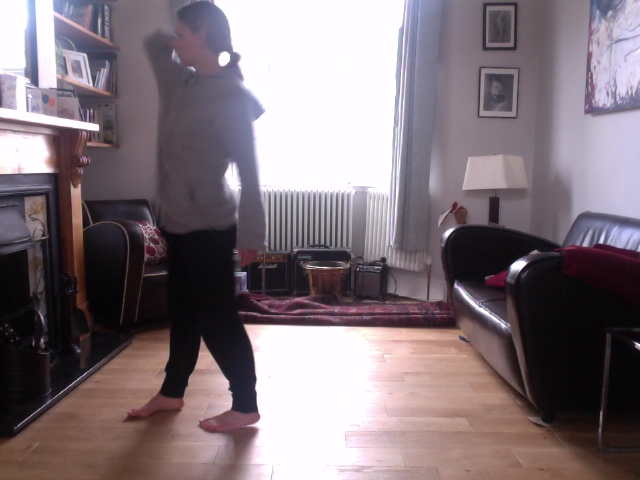
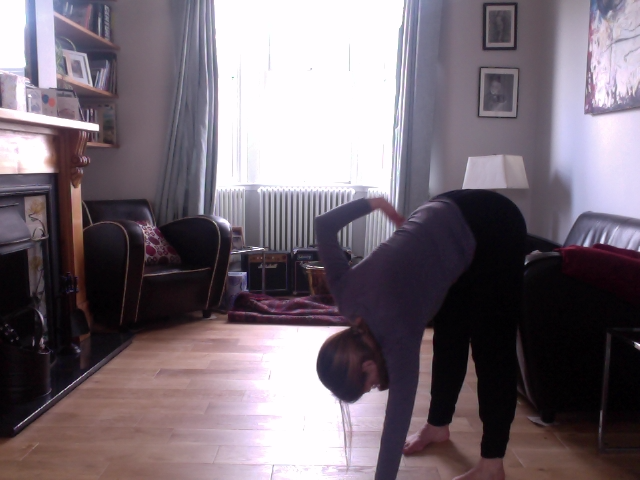
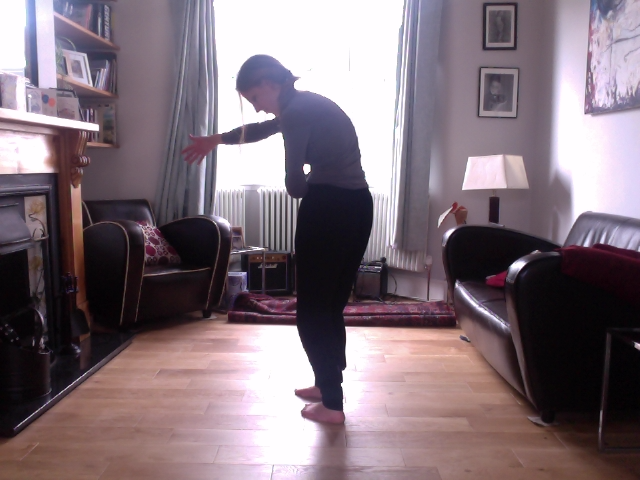
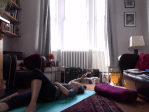
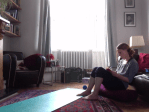
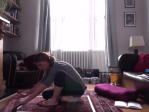
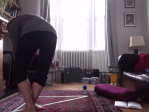
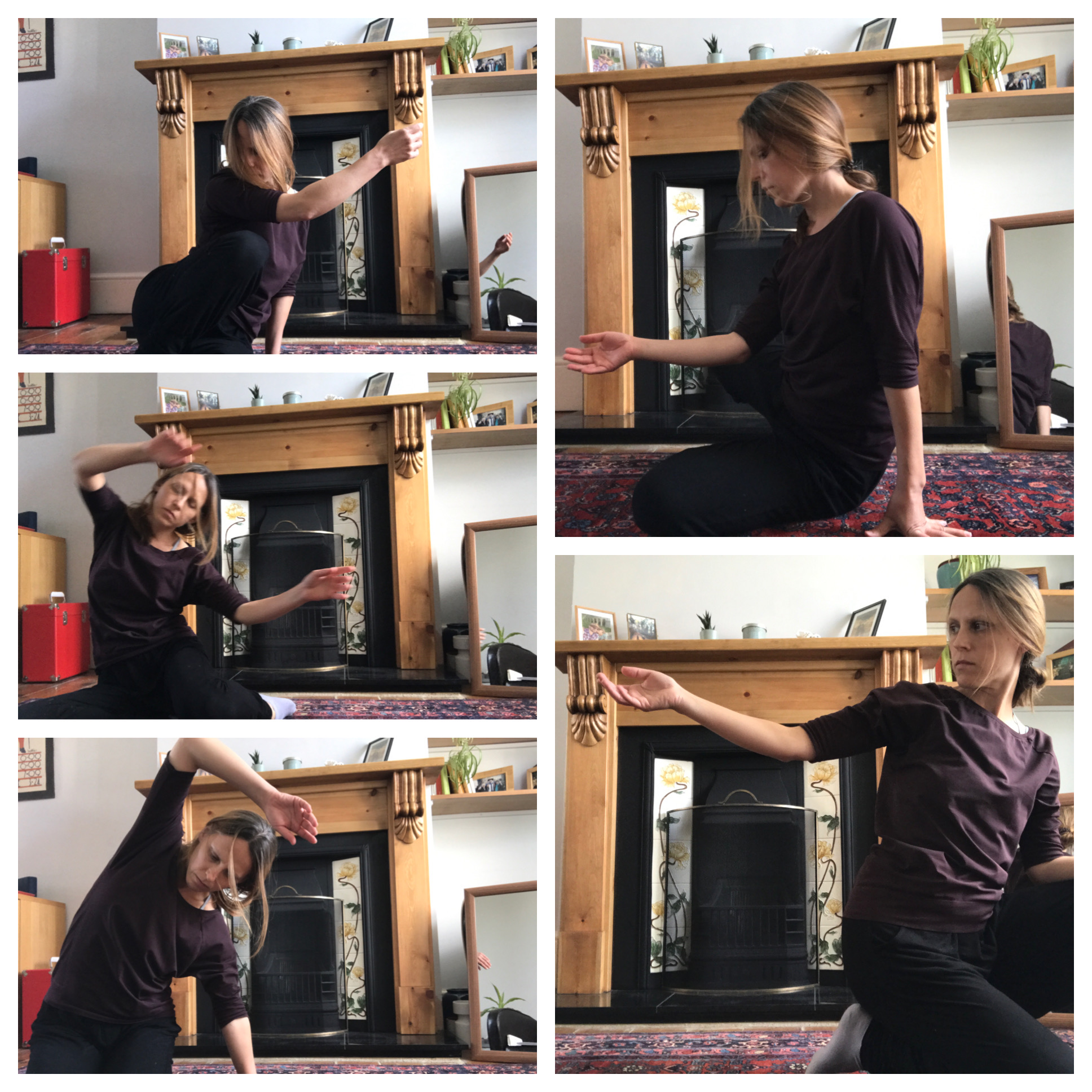
Images taken with autophoto app documenting self practice 26/10/2020. Score: Just one thing.
I’ve become obsessed with trying to pin down what I’m doing, to find a way of describing my practice without using my words and to find a way of seeing myself so that I can ‘know’ what I’m doing or at least know that I am ‘doing’.
Following on from my last thoughts where I considered ‘choreography’ as a form of capture and therefore attempted to ‘choreograph myself’ by ‘capturing myself’, this week I took the notion of capture one step beyond the practice of choreography. My aim was to capture my practice itself, to capture what it was I did when I ‘practiced’. I felt that the short term capturing 1 minute apart was too ‘close’ and that I was too aware of practicing for the camera. So Simon created a programme that allowed me to capture my practice by taking a photo every 5-10 minutes.
Unlike Capturing as Choreography, capturing practice required a real letting go of control. Firstly the wider time frame makes it harder to stay with something long enough to capture it. I therefore have to let go of things I might have liked to capture and accept that something less interesting might make the cut. This lack of control becomes all the more evident when my practice involves engaging in another ‘choreography’ that absorbs my attention as in the documentation below. The first set of images document my practice over a 1.5 hour period during which time I ‘warmed up’, thought about what I wanted to do, set up a ‘choreography’, ‘performed’ a choreography and watched back the choreography in order to repeat the cycle. (Further images of this process were captured, however the programme shut down before they were downloaded!) All words enclosed in ‘scare quotes’ above are written so to remind myself to think more about how I am using them in the context of my practice research.
The second set of images are the resulting ‘choreographies’ captured by my phone running an app set to take a photo every 1 minute. Unlike the previous experiments, I was not able to see the framing of the space or have some sense of when a photo might be taken, resulting in a less intentional choreography. I worked on my living room carpet with white masking tape to once again draw out the framing or enframing within the frame of the camera. The framing of the collage took place post practice and was almost accidental, however the appearance of white lines both between and across each picture draws out another possibility for choreographic interplay.
NB: the notes in this blog aim to document my work as a dance artist / researcher. For notes on my Pilates teaching work please go to http://www.margueritepilates.com
The above photos document my practice (in place) in July 2020. Working in my home here in Tottenham, North East London, I began to capture my movement through an automated photo app. I set up the app to capture a picture every 1 minute for 5 minutes. The result is a series of frames that I call ‘choreographies’, ‘temporal enframings’ of my explorations of the frame as I move around my living space.
‘To see choreography as an apparatus – moreover, to see it as an apparatus that captures dance only to distribute its significations and mobilizations, its gestures and affects, within fields of light and fields of words that are strictly codified – is to delimit those hegemonic modes of aesthetically perceiving and theoretically accounting for dance’s evolutions in time. The casting of dance as ephemeral, and the casting of that ephemerality as problematic, is already the temporal enframing of dance by the choreographic.’ (Lepecki, 2007)
“If we walk far enough,” says Dorothy, “we shall sometime come to someplace.”
― L. Frank Baum, The Wonderful Wizard of Oz
At the start of this scholastic year, when things seemed so certain, dates were fixed and real life plans were made and normally kept, I started a Practice as Research PhD. I began thinking, aiming, intending to unpack the solo form. I cannot really say that working solo was an absolute choice. It was more a situation that I found myself in, and when I tried it out, I found it sometimes fitted and sometimes did not. And so I began to think…
On the occasions when it worked, I was working with some kind of technology, by which I mean, a physical device of some sorts. It could have been a projector in the space, a mirror, a physical frame. Inanimate (although I’m sure that in later writing I will tear that assumption apart) but yet dialogic partners.
On the occasions when it did not work I was on my own in a (usually cold) space, rolling around on the floor, writing increasingly frustrated notes in my diary, like this one on the 14th March 2019: ‘Why am I doing something that I’m just finding really hard? Why do this?’ Or this one on the 25th April 2019: ‘I can’t just improvise!!!!!!’.
I was a maker, a choreographer even. I felt that I had to choreograph in some way, whatever that meant. And there I was, on my own, completely stuck. But I knew I had to ‘do this’, because as an artist for 17 years, I was on the brink of being annihilated. I had shifted so far to the edge of this thing we all call ‘the dance world’ that a gentle sneeze would have shoved me off. I was there, in a freezing cold studio, because I had to be, because being there was the only stake I had left in my claim to being an artist.
If the first two realisations were the basis for my PhD enquiry, then this last one was the motivation for pursuing it. And starting has been like a sigh of relief. Reading, thinking, writing in long hand, un-editing, listening in to this space around the solo and around my work with the solo. I was tired of fitting in to 200 word sections of applications. I now have 50,000 to write and I am going to enjoy every one of them! (Note to self to re-read this post in 4 years time).
I’m using this blog to document, track and share my practice research as it develops, in the hope that, by making this seemingly indulgent enquiry public, I might be prompted to think beyond the scope of my singular work.
You have my reasons for starting a PhD, but you might still wonder what the point of it is. In all honesty, I do not know, but I have a hunch, or a number of hunches: It is about the empowerment of the artist /self, about the problems with choreographic models (the assumptions within and the structures of support that enable them) and about recognising the layers of technology (both visible and invisible) that frame and enframe (to use Heidegger’s term), our practice, so as to reveal the wizard behind the screen.













 Marguerite Galizia